Bombadier Beetle
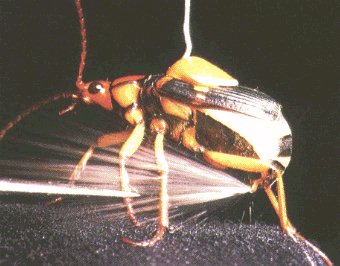
by Sara Auld
by Sara Auld
Bombardier beetles are a fascinating type of Ground beetle found in cool, moist areas throughout the Western United States, including the Bay area. They are typically about 12 millimeters, or half an inch long; their bodies are a dull blue-gray but their heads and chests are a brownish-orange. Bombardier beetles are nocturnal insects and they tend to dwell in small groups underneath rocks during the day. Like other types of Ground beetles, their forewings are fused together preventing them from flying.
The most distinguishing and interesting feature of the Bombardier beetle is its extraordinarily impressive defense system. In the abdominal region of the Bombardier beetle, there are two special storage chambers. Each of these chambers is filled with a different chemical substance. When the beetle is attacked, the chemicals from the storage chambers are released and they flow together into a thick-walled reaction chamber. Within the reaction chamber, an explosive reaction actually takes place when the two chemicals mix. As the reaction occurs, you can even hear a soft popping noise. Oxygen gas created during the reaction forces the chemicals out the rear of the beetle at temperatures as high as 212 degrees Fahrenheit. The beetle can release this incredibly dangerous spray in a series of tiny pulses to either side or to the front or back with a great deal of accuracy by adjusting the position of its lower abdomen. These chemicals are an excellent defense mechanism because they have a blistering effect on the skin and most attackers spit the beetle out as soon as they taste the noxious chemicals.
The adult Bombardier beetles usually live two to three years. They mate after a courting ritual involving both visual and sensory methods meant to identify other Bombardier beetles. After mating, the female beetles build mud cells that they attach to small objects such as stems, twigs, and stones. The eggs are placed inside these mud cells until they mature into the larval stage. The larvae of the Bombardier beetle are about half an inch long and cylindrical; they attach themselves to the adult beetles until they develop into mature beetles themselves.
http://www.pages.org/bcs/Bcs049.html
http://home.texoma.net/~alphom1/bb.htm
http://www.zianet.com/morgan1/mike/beetle.html
http://www.nsula.edu/departments/chemphysics/everyday/bug.htm
http://www.talkorigins.org/faqs/bombardier.html