 WRITING NATURE:
DISCOURSES OF ECOLOGY
WRITING NATURE:
DISCOURSES OF ECOLOGY
"ŠPour it in my witches' brew;
I got magic, Alacazaam a cazoo!"
Jill Poling and I cackled over our witchly concoction. Vapor rose from the metal pot, reminiscent of old black-and-white Halloween movies, but no toad toes, no rotting beetles, no rabbit paws, no sharp talons stewed in our brew.
Jill's dad is a physicist; my dad is a chemist. Jill and I were used to participating in science magic tricks. On this particular occasion, Dr. Poling brought home some dry ice to entertain us. How many fathers let their fourth-grade children play with dry ice? What a perfect surprise gift!
"Don't touch it," Dr. Poling instructed as he uncovered the present from its Tupperware package. He wore blue plastic gloves, demonstrating not to directly touch the dry ice. "It is so cold, it can burn your skin."
Jill and I experimented, slowly lowering with metal tongs each victim, sublimating, then lifting each back out ever so carefully. Then came the fun partŠdropping the objects and watching them shatter. The rose petals were the most dramatic. Enter a perfumed petal into the brew, lift, and drop! The stalactite roses broke into botanical shards.
Next we placed small chunks of dry ice on the tabletop. We blew the small lumps, watching them slide across the surface like pucks on an air hockey machine. ClinkŠclinkŠclink as each landed on the tile floor.
With Dr. Poling's help, we filled a pitcher with liquid nitrogen. It produced gas that exuded from the spout like steam from a whistling teapot. We poured the gas into glasses, making toasts with our airy drinks and proceeding to gulp the air down. The gas tickled our tongues and tasted like seltzer water.
"I hate seltzer water," Jill coughed in disgust. MmmmŠI loved it. Mom and I drink seltzer with ice on warm afternoons. I let the cold effervescence titillate my tongue.
"Is this harmful?" I thought to myself. I didn't want to seem rude, asking Dr. Poling if what he was allowing us to do was really okay for our bodies. I made a mental note: "Remember to ask Dad about this when you get home."
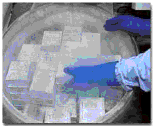
What is cold? The Inuits have over one hundred words to describe snow. The English language has so few. Ice blocks inhabit a cylinder. This vertical igloo, carved not of lifeless ice bricks but of rectangularly frozen life, shivers at a mere &endash;320 degrees Fahrenheit. A pair of hands, gloved in wrinkled rubber blue, reach into the liquid nitrogen vault. Lab coat arms outstretch like Frankenstein's monsterŠyet what is the hideous creation? Trapped chromosomes locked inside icy file cabinets.
What zoo is this? A genetic bank, fit for withdrawal. Would you like that in twenty or fifty dollar increments? But at this bank, grant money is deposited, while DNA is dispensed from the teller's window. What does he tell, this mute teller? Reaching toward the cold chromosomal cash, he is faceless, nameless. Is he ashamed, too proud, too great to show his full form? Is he God?
Inside rest viable cell lines, 3200 mammalian individuals waiting to be resurrected. Over 350 species and subspecies are represented ("InternationalŠ"). Which is the cheetah? Which is the elephant? Which is the chimpanzee? The vivid colors of life and the rotundity of three-dimensional shape have been stripped from these creatures; only by deciphering the black-and-white bar code of DNA run through gelatin via electrophoresis can one distinguish the bear from the hare.
Ever since I read about the Center for Reproduction of Endangered Species in fourth grade, I have been intrigued. Humans have endangered other species. Aren't we morally responsible for their restoration? Knowledge exists to recreate and procreate what has been decimated. In the past, I was satisfied with the response that if we can help, we should, yet now I wonder about the methods involved in this supposed solution.
If we are morally responsible for raising the population of endangered species, should we not also do so in a morally-sound fashion? New genetic technology coupled with the emergence of frozen zoos provide a fresh playground for eager scientists. Researchers can purchase DNA samples from these chromosome banks in order to perform experiments. This is not child's play. In his essay, "A Heretic's View on the New Bioethics," Jeremy Rifkin argues that the ethical side of bioengineering should be pursued. "As we begin to reprogram life, our moral code is being similarly reprogrammed to reflect this profound change in the way humanity goes about organizing the world" (In Ross 574). Although Rifkin focuses on genetically altering humans, his argument applies to other animals as well. How can we differentiate between positive and negative eugenics? Instead of deciding which "beneficial" traits should be carried on to human individuals, reproductive physiologists are deciding which species we should save. What right have we to proclaim the panda is more worthy of the gift of existence than is an endangered worm? Though, like my previous fourth-grade self, I still believe humans are morally responsible for raising the population of endangered species, I now also believe that we must do so first by vigorously investigating our motives and means for ameliorating this dilemma.
What perpetuates our bioengineering desires? Is it simply that we humans have a desire to control everything we can, a desire to create a mutation-free society or a society of balance and diversity? In contrast to the " eugenic" bioengineering pertaining to humans which Rifkin condemns, the bioengineering behind the frozen zoo has a purpose of widening the gene pool, not narrowing it. Why go to the trouble of artificial insemination if the product will be an inbred individual who will be unable to propagate and branch the species family tree? For this reason one of the main purposes of the frozen zoo is to pair up individuals of a particular endangered species that are as genetically diverse as possible. "Dashing cheetah seeking genetically diverse mate. Chromosomal credentials will be verified." Does this infer humans should choose mates not through love but on the basis of whom would birth the least inbred children?
Does the human-precipitated reproduction of endangered species infringe upon God's rights? We are not only creating life but deciding what kind of life we want to create: cheetah or rhino, condor or kangaroo rat. What happened to plain old survival of the fittest? Adaptation to nature's threats has widened to include human threats as well. A coyote harvests from a farmer's plot, killing sheep and chickens. In this way, the coyote has adapted to its environment. Next, the farmer shoots the coyote. Obviously the coyote has not adapted well enough! Wily Coyote's death-defying stunts are but a cartoon.
Scientists implant once-frozen embryos of endangered species into host mothers of non-endangered, but related, species. According to the Audubon Nature Institute, the world's first transfer of this kind was in November, 1999, when a once-frozen African wildcat embryo was transplanted into a domestic house cat surrogate mother. Since then, "in May of 2000, the world's first test-tube Caracal cats, a small species of African cat, were produced from sperm that had been stored in the frozen zoo" ("ResearchŠScientific").

What will happen next? What is forecast for this ethically-puzzling field? The Audubon Nature Institute predicts "applications of Frozen Zoo technology will be the provision of biological materials for basic and applied research in the areas of molecular genetics, disease research and new reproductive technology" ("ResearchŠApplications"). Where will we draw the line? As we continue to learn more about animal and human genomes, what effects will our tampering have? My childhood question persists: "Is this harmful?" Answers do not reassure me like Dad's answers once could. Let us make sure it is only chromosomes and DNA, not our ethics, that are frozen.
"International Conservation Zoo Project: Frozen Zoo." The Zoological Society of San Diego. 21 Oct. 2002 <http://www.sandiegozoo.org/conservation/frozen.html>
"Research: the Frozen Zoo: Applications." Audubon Nature Institute. 21. Oct. 2002 <http://www.auduboninstitute.org/rcenter/res_fzoo_app.htm>
"Research: the Frozen Zoo: Scientific Accomplishments." Audubon Nature Institute. 21 Oct. 2002 <http://www.auduboninstitute.org/rcenter/res_fzoo_accomp.htm>
Rifkin, Jeremy. "A Heretic's View on the New Bioethics." In Writing Nature: An Ecological Reader for Writers. Ed. Carolyn Ross. New York: St. Martin's Press, 1995. 571-580.