 |
Peter Stember
|
Thom Gunn. The poet in
a black leather jacket. The bad boy of Anglo-American
poetry. So the image goes.
But on this particular late-summer afternoon, the poet
with the salt-and-pepper crewcut is wearing jeans and
a faded green-and-black tartan flannel shirt and jeans.
He is cheery and slightly round-shouldered as he pads
downstairs to answer the door at his Upper Haight district
apartment. It’s a week from his 74th birthday.
Cast aside images of the unsmiling, skeptical cover
photo by Mapplethorpe on Gunn’s Collected
Poems, or the hard-as-bullets Steve McQueen-type
photos snapped by his brother Ander. Despite his reputation
for not suffering fools gladly, this is a kinder, gentler
Thom Gunn.
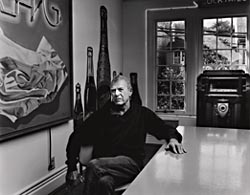
The second-floor flat is startlingly outré,
and very San Francisco. The walls are covered with a
large neon sign, apparently scavenged from a defunct
bar or café, and eye-grabbing metal advertising
from earlier decades of the last century. “It’s
endless,” he had warned climbing the stairs, where
rows of larger-than-life bottles ladder up like a halted
assembly line—Pepsi, Nesbitts, Hires, 7-Up and
Coca-Cola.
An old Wurlitzer jukebox is pushed against the far
wall. It calls to mind a line from “Elvis Presley,”
one of his most cited poems: “We keep in touch
with a mere dime.. . .”
Gunn, born in Gravesend, Kent, and reared in London,
has lived in San Francisco for more than 40 years, arriving
at Stanford on a writing fellowship in 1954. He shares
this apartment with longtime companion Mike Kitay and
a few more friends.
“No other poet has so vividly captured so much
of Bay Area experience—from San Francisco street
life to the surrounding natural world,” says Dana
Gioia, ’73, MBA ’77, chairman of the National
Endowment for the Arts. He calls Gunn an “antiauthoritarian
populist with mandarin standards.”
The Presley poem makes Gunn wince. “It was original
to write that poem at the time; it swiftly became unoriginal.”
Still, it was the only poem—and he has produced
some 30 volumes—quoted in full last March by the
Guardian in its announcement that Gunn had
won the £40,000 David Cohen British literature
award, sharing the honor with novelist Beryl Bainbridge.
Gunn was the first poet to receive the lifetime achievement
prize whose previous winners include V.S. Naipaul, Harold
Pinter, Muriel Spark and Doris Lessing.
“It was a great surprise, because I never heard
of it,” he says. How will he spend it? “Oh,
frivolities,” he says offhandedly. “Drink
and drugs and presents for my friends.”
Gunn has been the man-of-the-moment on more than one
occasion: first, beginning in the 1950s, as the poet
who wrote about motorcycle gangs and rock stars in iambic
pentameter. “He is clearly England’s most
important export since Auden,” proclaimed the
Christian Science Monitor. “Mr. Gunn
is obviously aiming at work on a larger moral scale
than most of his contemporaries,” said London’s
Times Literary Supplement. Then, in later decades,
came denunciation for “hippy silliness and self-regarding
camp” from the likes of Britain’s Poetry
Review.
Opinion shifted again with the onslaught of AIDS in
the 1980s.
Gunn was already an established poet—but he happened
also to be a gay poet living in San Francisco at the
time the great disease swept over the population, taking
its toll among his friends, at one point four deaths
in one month.
Gunn responded with some of his most moving elegies,
a poignant catalog of the dead and dying chronicled
in such poems as “To the Dead Owner of a Gym,”
“In Time of Plague,” “Words for Some
Ash.” And “To a Dead Graduate Student”:
Your pain still hangs in air,
Sharp motes of it suspended;
The voice of your despair—
That also is not ended;
When near your death a friend
Asked you what he could do,
‘Remember me,’ you said.
We will remember you.
“As my friends died, I wrote about them. I was
aware the number was adding up,” says Gunn. “We
were a very protected generation. During World War II,
penicillin was discovered. Things people died of in
my parents’ generation, no one died of now. We
didn’t naturally come across death so often.”
Gunn retired in 1999 after 40 years teaching at Berkeley
(where he relinquished tenure in the ’60s to be
free to work on his own terms). But on a bright autumn
afternoon last quarter, in a dingy, nondescript classroom
on the Stanford Quad, a dozen fortunate students are
getting instruction they will long remember. Gunn is
teaching The Occasions of Poetry, from 3:15 to 5:45
p.m. Wednesdays. With his trademark black leather jacket
slung over his chair, he gives them Ezra Pound’s
Canto XLVII as a reading assignment. “It’s
enough to make one consider whether one wants this course
or not,” he mutters.
 |
|
‘He becomes more adventuresome
as he grows older and is not afraid to fall on
his ass
trying out something different.’ |
“What I’m asking you to do is give it a
chance,” he exhorts the class. “Read it
four times. If possible, aloud. Read it the following
day.”
Gunn himself remembers some inspiring teaching decades
ago on the Farm, when he was a student of poet and critic
Yvor Winters. He finds it impossible to describe Winters’s
effect on his own work. “It’s like saying
‘What influence did your mother have on you?’
” he says. “Winters was taken very much
as a father figure by all the students who admired him—one
student who fell in love presented the young man to
Winters for approval. Winters was appalled. I hope they
got married and are still very happy.”
As the students discuss the “edgy” names
of characters in one of the poems they are reading,
the rolled-up cuffs on Gunn’s white shirt inch
upward, revealing one end of the long black panther
tattooed on his arm. Clearly, Gunn is a little edgy
himself.
For example, his most recent collection, Boss Cupid
(2000), includes five controversial “songs,”
as he calls them, about cannibalistic serial murderer
Jeffrey Dahmer. By comparison, the tattoo is ho-hum;
it is the artistry of renowned Lyle Tuttle of Seventh
Street, who tattooed Janis Joplin, he explains. Figuring
that he was probably the only instructor at Berkeley
so decorated, he says, “in the third week of term,
I’d roll up my sleeves, and my students loved
it.They thought it was shocking.”
For this class, Gunn has chosen not to focus on the
ancient greats, but rather a very young living one,
Philadelphia poet Daisy Fried, whose collection She
Didn’t Mean to Do It is one of two texts
selected for study. It’s typical of Gunn’s
hipness. “He becomes more adventuresome as he
grows older and is not afraid to fall on his ass trying
out something different,” poet August Kleinzaher
wrote of Gunn in Threepenny Review.
Gunn says Fried is “sexy and energetic and clever.”
The 20-something Fried, who has only had an epistolary
friendship with Gunn to date, praises the elder poet’s
poems. “They’re contentious and restless
at the same time that they’re economical and restrained—how
does he do that? They’re poems comfortable with
the street and also with literature,” says Fried.
“I get this tremendous feeling of the poet in
the world, in proximity to humanity, unfiltered.”
One of the students in the class describes Fried’s
poetry as “accessible,” and Gunn pounces
softly, edgily, like the panther on his arm. “Accessible?
A newspaper is accessible. That doesn’t make it
worth reading. Lots of crap is accessible,” he
says nonchalantly, and goads the class for more precision.
Afterwards, Gunn grabs the leather jacket and heads
for the Oval. But not to tear off in some trendy vehicle.
The San Franciscan-Londoner does not drive. Part of
the deal he made with Stanford includes a large lavender
car that will chauffeur him back to the Haight—casually,
effortlessly steering him through the infamous rush-hour
traffic.
|