
THE MAGAZINE OF THE CALIFORNIA ALUMNI ASSOCIATION |
||
 |
An Invisible Rope:
The Poetry of Czeslaw Milosz By: Cynthia Haven
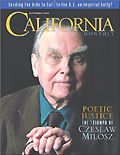
Robert Hass, a fellow Berkeley professor and poet and former U.S. poet laureate, stands to give an introduction. Milosz, says Hass, “has been making poems for 70 years out of some of the worst horrors and ideological battles of the 20th century.” When Milosz arrived at Berkeley four decades ago, he was comparatively unknown. His work had been banned in Poland, and few knew him here. “He looked out over the alien landscape of the Golden Gate, trying ferociously to describe what it’s been like to live in the 20th century,” says Haas. Milosz’s reading is simple and straightforward, but his asides between poems are sobering: “1943 was the most atrocious year of destruction—the year of the Polish ghetto,” he murmurs before a war poem. Before reciting a poem about his birthplace, which he revisited only after a half-century abroad, he explains that so many familiar to him “had emigrated or been murdered.” Following the brief reading, Milosz is mobbed by people eager to shake his hand, express appreciation, and have their books signed. “How do you think the reading went?” a reporter queries, about a foot from Milosz’s face. “That’s for you to judge,” the poet replies. The reporter, pleased, writes this down. The room is full of Polish speakers, who crowd around Milosz. One, almost incoherent with excitement, babbles his appreciation on his knees before Milosz as his book is signed. A tall Polish man, his eyes wet with emotion, wrings his jacket in hands, trying to contain his amazement and utter disbelief at being there, right in front of Milosz. The reporter by this time has cornered Milosz’s wife, Carol Thigpen Milosz, a former dean at Emory University, who struggles to describe Milosz’s reception in Poland: “a national hero…like a rock star…another world.” Several days after last winter’s reading, in the seclusion offered by ivy and trees at Milosz’s home on Grizzly Peak, the carnival atmosphere of the reading seems strangely remote. In this rare interview, Milosz reflects on his celebrity. “In America,” he says, “I am less a celebrity because there are so many Nobel laureates. In fact, one of them sent me a letter that said, ‘Welcome to the Club.’ In Poland, I am a celebrity because of the Nobel Prize. I was the first there to receive one.” His award came in 1980, just after the first Polish pope was elected, and about the same time that the birth of Solidarity made Lech Walesa a national hero. Three timely miracles for the Polish people. But Czeslaw Milosz is not, in fact, Polish. He was born in the charming, ancient Lithuanian town of Vilnius, part of a grand duchy on the fringes of the pre-revolutionary Russian empire. The gentry spoke Polish, and the peasants Lithuanian (with a smattering of Yiddish, Ukrainian, and Belorussian). In 1937, after a stint in Paris, the young poet moved to Warsaw. During World War II, he joined the socialist resistance to Nazi-occupied Warsaw and, via an underground press, published an anthology of anti-Nazi poetry. After the war, he served as a Polish diplomat, working first in the New York consulate and then in Washington, D.C. as cultural attaché. “The political situation changed when Stalinization came in 1950,” Milosz says. “I decided I couldn’t stomach it.” He asked for political asylum in Paris a year later. Sitting in his small, cozy living room overlooking the Bay, the world of Stalin’s reign of terror seems impossibly remote, almost mythical. Not so for Milosz, a man who wrote one of the most remarkable passages in 20th-century literature about state terror. In Milosz’s description of the effects of totalitarianism, The Captive Mind, he recalls diving to the ground when Germans began strafing the street; in Milosz’s pocket was a copy of T.S. Eliot’s “The Wasteland,” which he had been studying moments before: “A man is lying under machine gun fire on a street in an embattled city. He looks at the pavement and sees a very amusing sight: the cobblestones are standing upright like the quills of a porcupine. The bullets hitting their edges displace and tilt them. Such moments in the consciousness of man judge all poets and philosophers. Let us suppose…that a certain poet was the hero of the literary cafes…. [H]is poems, recalled in such a moment, suddenly seem diseased and highbrow. The vision of the cobblestones is unquestionably real, and poetry based on equally naked experience could survive triumphantly that judgment day of man’s illusions.” The late Polish author Witold Gombrowicz, recording his reaction to the book from Argentinean exile, noted that Milosz, at one stroke, had shifted the moral center of European literature one thousand miles east. The Captive Mind also inspired a young Robert Hass, who read it as a freshman in 1960: “I wanted to read poetry by people who did not assume that the great drama in their work was that everything in the world was happening to them for the first time,” he commented. But Milosz prefers to talk about the present, including Hass’s translation of his Treatise of Poetry, one of Milosz’s master works, written in the 1950s and never before published in full in English (it will be released this fall by Ecco Press). “I received an absolutely enthusiastic letter from [the well-known American critic] Helen Vendler,” he says. “She said, ‘You speak of the most horrible things, but in a voice of superhuman calm.’” Milosz reflects, and says: “I tried to learn that way of being sober, of speaking without exaltation and without exaggeration.” He has succeeded. Milosz was invited to teach at Berkeley in 1960. The University’s Slavic department was strong, though not in Polish. Milosz, for his part, had been living meagerly on his writings. With a family to feed, he accepted the offer, although with uncertainty. “I did not choose California. It was given to me,” he has written. “I should say something to the credit of the University,” he says now. “I came here as a lecturer. A few months later, I got tenure—without the intervening steps, and in spite of the fact that I had no Ph.D. It is a great achievement of the University to have the freedom to do that. They wanted to secure me so that I would not return to France. And it kept me from returning for some years. They had no reason to regret their decision.” The early years were hard ones. Poet Leonard Nathan, a Berkeley professor emeritus and translator of Milosz, says: “I’m not sure the people in his department knew what he was or what he was owed. I came here in the ’60s as a faculty member, and I didn’t know his name.” Milosz’s despair at the time is echoed in these self-mocking lines from “A Magic Mountain,” written in Berkeley in 1975: So I won’t have power, won’t save the world? Fame will pass me by, no tiara, no crown? Did I train myself, myself the Unique, To compose stanzas for gulls and sea haze, To listen to the foghorns blaring down below? “For many years, I was an obscure professor in an obscure department at Berkeley—and quite lonely, I should say,” says Milosz in his home. “I was known mostly as the author of The Captive Mind, as a political writer. I didn’t like that situation.” As so often happens, Milosz has opted for understatement. Robert Hass puts matters more strongly: “He was living in intolerable obscurity and loneliness,” Hass says. “He had to invent the idea that there was still somebody to read his poems.” A few lines later in the same poem, Milosz devises his own shamanistic means of escape: With a flick of the wrist I fashioned an invisible rope, And climbed it and it held me. That phrase, “an invisible rope,” became a catchword for the artistic survival of émigré writers everywhere, in foreign countries where their names were unpronounceable, their work untranslated, and their literature peripheral. Milosz himself concentrated on building a Polish network—his own “invisible rope.” His first book published in America was an anthology, Postwar Polish Poetry (1965). “Polish poetry in the second half of the 20th century is probably one of the most extraordinary bodies of poetry ever written,” says Marin poet Jane Hirschfield, a friend of the poet’s. “And one of the reasons it’s come to our attention is Postwar Polish Poetry.” When he came to Berkeley, Milosz had no background in teaching. Yet he later said that the work of a university professor was the optimal fit for his life and work. During his first two decades here, Milosz transformed himself into an international poet, rather than simply an Eastern European one, with an equal view of both the Old and New Worlds, perhaps caught a bit between the two. The path from obscurity to visibility in the West was opened by fellow Berkeley poets who became his translators. “The fact that my poems in translation have found American readers and listeners for me is almost a miracle,” Milosz told a Bay Area audience two years ago. He continues the accolade at his home: “I had the exceptional configuration of Robert Hass, Robert Pinsky, and Leonard Nathan. Thanks to them, I can communicate to American audiences. My English translations are exceptional.” Hass never expected his collaboration to stretch into a quarter century of close friendship. “By accident, at an age too old to acquire a master,” Hass says, “I became an apprentice to this amazing body of literature.” He came to value the older poet’s liveliness, whimsicality, and humor—as well as his gravity—and they became friends. Milosz’s translator-friends are full of stories about the master: “Milosz thinks it’s horrible that everything just passes away, into oblivion. He hates it,” says Hass. “There’s that terrific sense of urgency. If he can’t remember and get down on paper the hairstyle of his piano teacher who was crushed in a bombing when she was an old lady, if her life goes unmarked into oblivion, then oblivion won. “I found him one day looking at a book of the history of women’s underwear,” recalls Hass. “He was completely delighted because there was a huge section on late 19th- and early 20th-century undergarments. Those things that he once saw on his aunts’ and his mother’s clothesline suddenly could be rescued.” One of Milosz’s most controversial stances is the way he has come to grips with the cruelty of the world: although a Catholic, he has sometimes concluded, like the Manichees, that the world is a diabolical creation. Leonard Nathan remembers his first real conversation with Milosz. It was in the late 1970s, in the old stacks of the main library. Both men were laden with books when they began to talk. “I said, ‘I have one problem with your work,’” recalls Nathan. “‘Although I’m a nonbeliever, I have trouble with your heavy investment in the Manicheans.’ Milosz replied, ‘You think you have trouble? How do you think I—a church-goer—feel?’” Nathan says and laughs. Another story, this one from Hass: “A few years ago, he started taking lessons in Lithuanian. Why? I thought he was beginning to believe he might go back sometime.” But when he asked Milosz, the poet, gazing at the flowerbeds outside his Berkeley window, replied with characteristic whimsy: “I have a definite feeling it may be the language of heaven.” (Milosz did, in fact, return to Lithuania in recent years.) An early signal that Milosz’s obscurity was coming to an end was his receipt of the Neustadt International Literary Prize, in 1978—always a hint that a Nobel Prize may come in the future. “I have no hesitation whatsoever in stating that Czeslaw Milosz is one of the greatest poets of our time, perhaps the greatest,” the distinguished poet Joseph Brodsky told the Neustadt prize jury. “Even if one strips his poems of the stylistic magnificence of his native Polish (which is what translation inevitably does), and reduces them to the naked subject matter, we still find ourselves confronting a severe and relentless mind of such intensity that the only parallel one is able to think of is that of the biblical characters – most likely Job.” Consequently, the Nobel award in 1980 was a happy surprise, but not a thunderbolt from the blue. Nathan received an early-morning phone call from the New York Times. He was asked about the poet’s hobbies. “Poets don’t have hobbies,” he replied, “they have obsessions.” He described Milosz’s translations of the Psalms and the Book of Job into Polish, teaching himself Hebrew in order to do so. (Milosz went on to translate Ruth, Esther, Ecclesiastes, Lamentations, Song of Songs, and the Gospel According to Saint Mark, from the Greek.) Milosz was quickly characterized as a hermetic scholar-poet, and the image of the bookish Nobel Prize-winner tucked away in Berkeley, writing in “some unheard-of tongue,” as he himself once described it, persists to this day. But his friends around the world were genuinely pleased, and amazed, by his fame. He was suddenly receiving “four duffel bags of mail a day,” says Hass. “From all sorts of people—including everyone he ever went to school with.” Milosz has not stopped—or even slowed down—despite the Prize, the fame, his age, and the time-consuming work of supervising translations of his work. “I’ve never known him not to be working on something,” says Hass. “A lot of people get the Nobel Prize and go into the tank. But Czeslaw was just off and running. And he continues to find projects, forms, in which to invent and discover.” Hass cites a powerful example: last year’s publication of Zniewolony Umysl in Poland. With access to Kraków archives during his annual visits, the poet compiled an anthology of essays and reportage from 1937 to 1946, documenting arguments across the political spectrum—and chronicling the anti-Semitism that was later denied. “The book has caused a great stir in Poland,” according to Hass. “It was a great thing to do.” Another example is 1998’s Road-side Dog, Milosz’s inventive approach to a poetic dry spell. “He was going through a period where he thought he couldn’t write poetry, so after he awoke one morning with the memory of a dog barking on the road outside the [Lithuanian] manor house, he started writing these little pieces of prose,” recalls Hass. New poems are on the way, but Hass is not expecting thematic course changes or reversals, but rather refinements and clarifications of themes that have preoccupied Milosz all along. “It’s perhaps the equivalent of sitting down to music you’ve been haunted by, and continuing to tease it out of the piano, to see how the melody sounds this time,” says Hass. “In the history of world literature, we don’t have much poetry that reports back from the end of a long and well-considered life,” says Hirschfield. “Milosz has given us a considerable body of poems that do that.” She has learned a great deal from the master: “I have learned what grandeur of soul is and what true seriousness is—which is not the same as self-seriousness,” she says. She’s also benefited from “his immense, perhaps Polish, sense of irony” about the human condition. “It’s not American cynicism,” she says. “What he brings is a sense of irony that diminishes self-importance, but does not diminish the seriousness with which he takes the world.” Did Czeslaw Milosz change Berkeley as much as Berkeley changed him? “I don’t think so,” Milosz answers with characteristic diffidence. “However, some students of mine preserved notes from my classes. And I produced some translators of Polish literature and poetry.” Which has certainly become more visible because of Milosz’s work. “Yes, yes. That’s true,” he says, and then changes the subject. “Have you heard of the Polish poet Anna Swir? What a guest we had!” he says of her life (1911-1984), and hurries to his bookshelves to fetch his translation of her works. Milosz has oscillated, over nine decades, between fame and obscurity—and
now his fame seems permanently secure. Or is it? In a sense, Milosz is
one of those rare individuals who has disappeared behind his celebrated
name and iconic face. He has disappeared behind his own legend—disappeared
into the productive privacy of his Grizzly Peak study. Perhaps that famous
seclusion is exactly what has allowed him to continue his life’s work
as a poet, thinker, and teacher, as he carries on his lifelong struggle
against oblivion. The invisible rope he wove at Berkeley so many years
ago continues to guide him into the 21st century.
|