 |
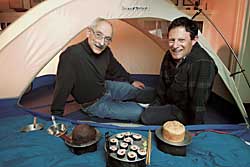
TRAIL MIX: Kahn and Greenspan
do risotto, dim sum, crepes in the wilderness.
|
Ahhh, camping. Fresh air, roughing it in
the wilderness, supper around the campfire. Soufflé,
sushi or a calzone, perhaps.
Outdoor life has never been so good. History professor
emeritus Hal Kahn and alum Rick Greenspan, the Click and Clack
of the backpacker set, are two reasons why. They make an unlikely
team—a septuagenarian Chinese scholar and an auto
mechanic—but they have at least two things in common.
They love camping and they love food.
After years of sharing both, they’ve written two books
about it, beginning with Foghorn Outdoors:
Camper’s Companion (Avalon, 1991). Their most recent venture, The
Leave-No-Crumbs Camping Cookbook: 150 Delightful, Delicious,
and Darn-Near Foolproof Recipes from Two Top Wilderness Chefs (Storey Publishing,
2004), instructs the footsore on how to make quiches, crepes
flambées and chocolate cake with brandy icing (spirits
swiped from the first-aid kit, of course) while on the trail.
Kahn is a tall, lean 74. Greenspan, ’70, MA ’71,
is 50-something. Kahn admits he has cut back on some of
the rough stuff, like “bagging peaks.” As Greenspan
puts it, “I like to climb mountains. Hal likes to fish.”
The two met in the late ’60s in an inter–disciplinary
program on social thought. “A lot of the professors were
conservatives. He was one of the activists,” Greenspan
recalls. “We pretty much hit it off when we met.”
Greenspan introduced Kahn to camping a few years later.
Their first trek was in the Marble Mountains in Northern California,
near Yreka. It’s the least-traveled wilderness area in
the state. “I thought I was going to die on the first
trip. Everything was heavy. My boots didn’t fit,” Kahn
recalls. He learned to love it—and find the right footwear.
With Greenspan, he is reversing what they call the “army
mentality” of the outdoor life.
“We tell people over and over—this is a vacation,
not a boot camp!” Kahn says. Readers should regard a
campfire or stove as an “invitation to the imagination,” they
write. “You won’t care if your hands get dirty,
the yeast rises faster than you’re used to, or the home-dried
strawberries need rehydrating before you can proceed with
the cobbler. You’ll be willing to scramble up a boulder
field to get the last snow of summer for the snow cones
or rename the trout that’s fallen off the grill—it’s
now ‘Cajun black’—then fetch it out of the
ashes. . . .”
“It doesn’t weigh any more to make good stuff than
it does to make goulash or beans and hot dogs,” Greenspan
says. Sushi rollers are thin and portable, for example, about
the size of a placemat.
Not everyone is a fan of such culinary improvisation. A
camper from Reno, Nev., Ronald Kohlenberger complained on Amazon.com
that many recipes required forays to gourmet and specialty
stores—not the stuff of macho backpacking. “Scones
are cool when sitting at an outdoor table at Starbucks discussing
the evils of a capitalistic society with your liberal friends,” he
opined, “but come on, when camping, I eat biscuits!”
Kahn and Greenspan are undeterred. The tone of Leave-No-Crumbs is upbeat, even euphoric with promises. “If your idea
of wilderness fare is the stuff that comes in freeze-dried
packets or out of a can, or is limited to prepackaged pancake
mix, ballpark franks, and a flank steak over the grill,
you’re reading the wrong book,” they write. “You
won’t like what follows, and we hope you disapprove.
“If, however, you think that fine cooking can be done
no matter where you are; if improvisation is part of your culinary
vocabulary; if, in a word, you think it’s possible
and desirable to begin a day at your campsite with fruit crepes,
wrap poached trout in a sushi roll, celebrate the Sabbath (whatever
day of the week it is) with a braided challah, wow the woodlands
with a homemade pizza, or make dumplings for your casserole
or for your Chinese dim sum, then stick around.”
Another camper/critic applauded the digression from
the traditional “shoe leather and birdseed” approach
to campsite food. “Be prepared to break out the food
dehydrator and camping oven,” he warned, but concluded
that “Leave-No-Crumbs is the best kind of camp companion:
it kept us well-fed and laughing.”
The journey to the Marble Mountains camp trail was a long
one for Kahn, who still teaches and spent spring quarter at
Stanford in Beijing. He says he began his career with one aim: “I
didn’t want to sell insurance in Poughkeepsie.” Instead,
he studied Swedish with a scholarship to the University of
Stockholm. (At the time he received the scholarship, he
says, he wasn’t even sure where Sweden was.) En route
to Harvard to pursue political science, someone encouraged
him to study China. At that point, he recalls, the only Chinese
names he knew were Charlie Chan and Anna May Wong.
But something about the culture grabbed him. He is now
a specialist in the Manchurian Qing dynasty and the emperor,
painter and poet Qianglong, who reigned for 60 years (1736-1796). “He
basically was the 18th century,” says Kahn, noting it
would be like having Truman still president today.
Greenspan was working toward a master’s degree in the
School of Education when he realized he wasn’t interested
in studying the effects of class size on student learning.
He moved to San Francisco during the height of the feminist
movement. His girlfriend was taking a course in auto mechanics
for women, and Greenspan asked if he could tag along. He loved
it. “I like fixing things,” says Greenspan,
who found a way to combine both fields: he teaches auto mechanics
at Alameda College.
Kahn and Greenspan concede they devote a lot of time to
preparing meals on the trail. “It’s not unusual
for us to spend all day cooking,” says Greenspan.
Kahn recalls waking up one morning and asking Greenspan, “What
shall we do today?” Greenspan replied, “Let’s
eat dessert.” So they made desserts all day in the wilderness.
But they don’t just cook. While one stirs the risotto,
the other reads aloud—Mark Twain’s Tom
Sawyer and
Huckleberry Finn, Dickens’s Bleak
House, or maybe a popular
detective novel from Janet Evanovich. They have no tales of
lions and tigers and bears in the wilderness. “Rick and
I are not newsworthy,” says Kahn. “Nothing
happens except we have a good time. And we always have a good
time.”
Digs from their critics raise the obvious question: why
not just stay home and cook? Kahn stares in disbelief at the
question. “It’s fun,” he says. “You
get to places so beautiful and so remote, there’s no
way to see them except by walking there.”
Kahn also admits that a typical camping trip is not strictly
persimmon bread and pizzas made in a frying pan. “The
notion of going camping without gingersnaps is alien to
me,” he
says. So you can keep the granola if you want. Their rule
of thumb is simple: “Do not take what you do not like
to eat.”
|