 |
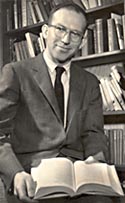
ON THE FARM: He arrived without
a poem.
Special Collections, Charles
E. Young Research Library, UCLA
|
The Name OF Edgar
Bowers is rarely included in the firmament of top 20th-century
American poets. Yet Bowers, PhD ’53, received the prestigious
Bollingen Prize in 1989, which puts him squarely in the
constellation of Wallace Stevens, Marianne Moore, W.H.
Auden and Robert Frost.
He had a distinguished if small coterie of fans in his
lifetime—and
still does, three years after his death, judging from a
Bowers conference and exhibition held last spring at UCLA,
home of
his archives.
Why the obscurity? For one thing, his output
was small in an era favoring rampant productivity. (His
Collected Poems is 168 pages.)
Though sociable, he neither strove for celebrity nor flattered
his peers. “He wrote, as many
great poets always have, without hope of commercial success
or even
recognition,” says
San Francisco poet Suzanne Doyle, MA ’77. “He
wrote because it was the way he lived most fully.” Bowers
himself used to say that a poet is only a poet when writing
a poem.
There are other reasons. His poems—“austere,
quiet, indestructible as an Alp,” in the words of
former U.S. poet laureate Anthony Hecht—are often
allusive and difficult. Joshua Mehigan, a New York
poet and teacher,
says Bowers was “a
hopeless square, a subtle-minded rationalist” who “showed
clear hints of a complex personal ideology in a time
of nebulous or simplistic relativism.”
Los Angeles
poet Leslie Monsour points out another whammy. Bowers
taught at UC-Santa Barbara for more than
30 years
and spent his final decade in San Francisco, in a nation
whose
literary world remains decidedly skewed to the East
Coast. “Had
Robert Frost remained in his home state of California
instead of establishing himself as a New England poet,
who knows what
would have become of his work?”
Bowers’s personal
habits were as unassuming as his life. He threw away many
of his books, along with marginalia revealing
his thinking and tastes. And he was careless with his
papers. His literary executor, Joshua Odell, recalls an
occasion when
Bowers was cooking a favorite dish, linguine in a white
wine and clam sauce, from a recipe out of a fireman’s
cookbook.
“I can still remember my amazement when Edgar asked
me to pull the cookbook off the shelf as he was busy slicing
the green peppers and singing ‘Figaro.’ Carefully filed
away in the cookbook was a beautiful typed letter from
Robert Lowell praising ‘Autumn Shade,’ congratulating
him on the publication of The Astronomers, and inviting
him to dinner in Boston.”
Odell later recounted the incident to a mutual
friend, who tipped him off: “Check out Marcella Hazan’s
Classic Italian Cooking. It has a letter from
Yvor Winters from way back!” Both letters, rescued
from their respective cookbooks, were displayed under
glass in the ucla
exhibit. (An online version continues at www.library.ucla.edu/libraries/special/scweb/bowers.htm.)
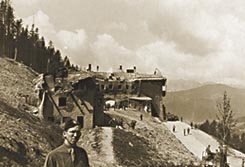 |
WARTORN: WWII pervades Bowers’s
poems. Behind him are the remains of Hitler’s
house.
Special Collections, Charles
E. Young Research Library, UCLA
|
“You are quite different from anyone
in your generation,” the
preeminent poet Lowell had written in his 1964
letter. “What’s
best, quite unique I think, and quite enviable
to another poet is the clear fineness of the blank verse,” he said. “I
hardly see how one could ask for more . . . a
long and high tradition of technique and contemplation speaks, and speaks
with surprising certainty.” And from the formidable
poet and critic Winters in 1956: “It’s
a very impressive book,” he wrote of The
Form of Loss. “I hope
a few people are impressed.”
A few people have
been. In 1999, critic Harold Bloom called him “one
of the best living American poets these last
forty years.”
Bowers’s upbringing was
modest. He was born in Rome, Ga., in 1924, and
spent a peripatetic childhood throughout
the South. The family eventually returned to
Georgia. On 90 acres near Stone Mountain, they
raised and sold azaleas, camellias,
daphnes and—a first in that part of the South—rhododendrons.
The setting figures in such poems as “The Mountain
Cemetery.”
The rhododendrons suffer with the
bees
Whose struggles loose ripe petals to the
earth,
The heaviest burden it shall ever bear.
World War II was a
crucible for Bowers, interrupting his studies at the
University of North Carolina,
Chapel Hill, weeks
shy of his 19th birthday. He attended Army
basic training and nearly became a chaplain’s assistant
because he could play the piano. In training
for counterintelligence, he studied
French at Princeton for several months.
The friendships he formed there proved some of the most
significant
of
his life.
As the war deepened, however,
Bowers’s academic idyll
was interrupted; he was sent abroad as
a French interpreter. He traveled through France
and Germany, where the Allies had
been “bombing to rubble cities with textbook
names,” in
his words. His unit moved from one fine
German home to another, displacing owners
to conduct counterintelligence activities.
For 10 months, he was posted at Berchtesgaden,
Hitler’s
retreat in the Bavarian Alps.
The war and
its ethical concerns underpin Bowers’s
poems, typically in haunting references
and asides. “In Defense
of Poetry,” for example, alludes to Polish
writer Janusz Korczak. When the Germans
ordered him to assemble
the 200 destitute
children in his famous orphanage, he refused
to exempt himself and led the children
through the ghetto to the
train that would
take them all to Treblinka. In the poem,
Bowers recalls seeing actor Frederick March
playing Mr. Hyde, which
tormented him
as a child, even at school among his teachers:
I
heard the voice that mocked them. ‘There
is no
Language,’ it whispered, ‘no
A on tests, no trust
To keep you from the
presence of my face.
Parents and children die, anguish
will be
Greater than its hard sum and no familiar
Voices deliver you
from Mr. Hyde,
However Dr. Jekyll seem secure.’
The scene shifts itself
to adulthood, among colleagues who “drive Camrys, drink
good wines, play Shostakovich/Or TV news before they
go to bed . . . .”
But when my mind remembers, unamused
It pictures Korczak going
with his children
Through Warsaw to the too
substantial train.
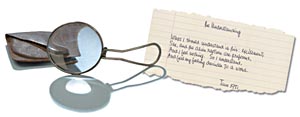 |
EFFECTS: The poet’s archives
are housed at UCLA, though he discarded many of his
books.
Special Collections, Charles
E. Young Research Library, UCLA
|
After
the war, Bowers came to Stanford to study with
Winters, whose
In
Defense of Reason (1947)
inspired him. Bowers
ambushed the elder poet-critic in
a hallway; Winters accepted
him into
his
class without seeing
a single poem
and
with nothing to
recommend him except
his “desire
and quaint opinions.” After
listening indulgently,
Winters conceded simply, “All
right. You look intelligent.”
In
a 1984 address, Bowers
described his classroom
experience with
Winters. “The poem
itself began to take
on the characteristics
of the class.
Our demands of each other;
our intolerance of
the ‘good enough’;
our insistence on better
argument, better meter,
better speech, better
unnamables; our resistances
to erasure and our defenses
of the poem as it already
was; our cooperation
with
the poem’s seeming
readiness to change—all
these produced, at last,
the voice of the poem
in its own right . .
. its own
demand that it be alive
and just. Come on, learn
good habits, it would
say, so you won’t regret
me by the time Arthur
[Winters] reads me or
whoever reads
me. Stay awake, erase
me, look for
me, find
me.”
Bowers died of
non-Hodgkins lymphoma
in February
2000. His posthumous
reputation shows early
signs of a slow
but steady rise. He has
been anthologized more
frequently in recent
years, and his poems
are beginning
to surface more regularly
on the Internet. More
importantly,
some prominent
members of the literary
establishment rank him
highly.
“He’s not a Billy Collins—and he never will
be,” says
Los Angeles poet Kevin
Durkin, curator for the recent exhibition. “He
is a choice, favorite
poet among connoisseurs. A ‘poet’s
poet’ is such a cliché,
and he’s not
merely that. I think,
though, that he does
appeal to a knowledgeable
reader.”
Some lines
Bowers wrote for his
fallen comrades
in World
War II might serve
as his own epitaph:
Like
none before, never to be again,
And see in them a cause
for the belief
That
nature loves too well the soul it makes
Willingly to let
it pass away forever.
Bowers may bypass
the usual purgatory
that awaits poetic
reputations after
death.
It’s too soon
to tell. But the affable
poet, who rarely gave
readings,
might have been
amused at the rumblings
of a posthumous fame.  |