































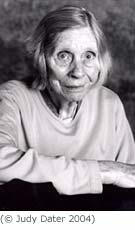
 "When Say The Word Home, I Almost Whisper It"Barbara Guest: 1920-2006Barbara Guest, a leading poet of the New York School, died February 15 in Berkeley, California. She was 85. According to San Francisco poet Michael Palmer, œTo speak with Barbara Guest about poetry was always to be in the presence of a fiercely uncompromised vision of the art and its obligations. Her insights continually astonished me. They were beholden to no one. And the work itself, of a lyric intelligence entirely her own. For whatever reasons, and I can sadly imagine many, it has not received its full due, but it will. The music insists." The author of nearly 30 books of poetry, plays, essays, and fiction, as well as an acclaimed biography of the poet Hilda Doolittle (H.D.), Guest was the only female member of the New York School, which included Frank O'Hara, John Ashbery, Kenneth Koch, and James Schuyler. At the time of her death, she was enjoying a late-life resurgence of interest in her poetry. One of America's foremost poetry critics, Marjorie Perloff, also noted the eclipse of Guest's poetic reputation after the 1950s, but emphasized the renewed interest in recent years: œAlthough she was very close to Frank O'Hara, who wrote many poems to her, she was neglected for years and was rediscovered, partly by the Language poets like Charles Bernstein and Douglas Messerli, the editor of Sun & Moon Press, and partly by younger women poets like Kathleen Fraser and Norma Cole, who appreciated Barbara's innovative syntax, prosody, and imagery in her ˜painterly' poems. "Of all the New York poets, she was perhaps the one who took most seriously the notion that a poem can be like an abstract expressionist painting, and she practiced her craft assiduously. Today, she is studied by young scholars and apprentice artists all over the country and her loss will be very much felt." Rootless childhood Guest was born on September 6, 1920, in Wilmington, North Carolina, the oldest of five children. Her birthplace was purely happenstance"her father, a probation officer, was looking for work at the time. œHis work was helping wayward boys," said Guest's daughter, Hadley Guest. œ[The boys] loved him, and many of them came to his funeral. Mother laughed and said they loved him because he was a wayward boy himself." With his drinking and gambling, family finances were strained. After a peripatetic life around Florida, Guest moved in with a Los Angeles aunt and uncle at 11, following her father's early death. Her rootless childhood left its mark, however: in a 1992 interview, she said that as a young person she œnever really had a home," and that this caused her œunnecessary anxiety." She admitted, œWhen I say the word ˜home' I almost whisper it." Guest was precocious, teaching herself to read at three. In college, she was impatient with her university professors for their reluctance to embrace the Modernists, even dropping out of university for a year to attend a junior college, where she felt Modernist ideas would be more openly accepted. After attending UCLA and UC Berkeley (she received her degree from the latter in 1943), Guest moved to New York to be part of the literary scene. She met her husband, Stephen, Lord Haden-Guest, who had emigrated in the 1930s, and H.D., the future subject of her biography, at a Greenwich Village party. The Guests were married in 1948, and their daughter Hadley was born the following year. (Barbara Guest also had a brief previous marriage to a sculptor in Kansas, later referred to only as œDudley.") The Guests divorced in 1954. Barbara later married Trumbell Higgins, who died in 1970. Jonathan Higgins was born in 1955. Guest soon crossed paths with Frank O'Hara, James Schuyler, John Ashbery, and Kenneth Koch. She became a first-generation member of the innovative New York School of poetry in the 1950s. The group rebelled against Confessional poetry and the New Critical aesthetics. Like that of the other New York School poets, Guest's poetry was influenced by the abstract expressionist painters, such as Jackson Pollock and Willem de Kooning, as well as by surrealist poetry. Guest was known for her writing on the visual arts. Her poems often focused on a painting or other art object, and she wrote reviews and essays for Art News and Art in America. She also served briefly as the poetry editor of the Partisan Review. Apolitical in a political era Her first collection, The Location of Things (Tibor de Nagy, 1960), coincided with the decade that was to prove her undoing. The sixties were to prove a contentious era for Guest, who eschewed political categories. In particular, she decried the use of art for political purposes. Her daughter recalled her saying, œWe fought the Nazis to stop that. What are people doing?" The sixties were to prove difficult for another reason: in 1966, her close friend and champion, O'Hara, was hit by a dune buggy and killed while visiting the beach on Fire Island, New York. He was only 40 years old. œExcept from O'Hara, she didn't get the support she needed to get," said her daughter. Without him, she was left to what Timothy Gray of the City University of New York, Staten Island, writing in Jacket magazine, called œthe boys club cliquishness exhibited by Koch and other ˜charter members' of the New York School." Hadley Guest concurred: œThere was a certain jealousy because she was so experimental. I've always considered her, personally, the most experimental of the whole group. . . . She was very independent in her thinking; she could be outspoken. Sometimes she felt that women weren't supposed to be outspoken, that even male poets didn't want women to be independent and outspoken." œShe wouldn't go along to get along"she paid a price for that. No doubt about that. But her poetry has a purity that much poetry does not," Hadley Guest continued. œA purity spiritually, metaphysically, and that shows. True genius has a spiritual quality, and independence"she thought that, and I think that. And she had it." Guest refused the academic path that kept many of her peers in print. œShe didn't approve of workshops"she thought it was kind of fraudulent, with many people claiming to be poets who weren't. She looked warily at academics," said Hadley Guest. Her daughter recalled her saying, œI can't be a teacher and a poet at the same time. First, I don't approve of academia, and second, I don't have the energy to do both." Guest invited more controversy with her acclaimed biography Herself Defined: The Poet H.D. and Her World (Doubleday, 1984). The New York Times called it œa shimmering, delicately patterned narrative that is never less than absorbing." However, feminists decried her portrayal of H.D., which included œa lot of what Barbara thought was the truth about H.D."her fierceness, her selfishness, the way her poetry declined when she got older," said Hadley Guest. œShe said, ˜I'm going to tell the truth because that's the duty of the poet,'" recalled her daughter. œIt never did well in sales. It did have influence among biography writers, made breakthroughs in form and style." Guest has, in recent years, been reclaimed as œthe fifth point of a star" of the New York School, a reference taken from a 1971 letter Schuyler wrote to Guest, deploring their exclusion from discussions of the New York School. œThey do not realize that the Founders of the NY School . . . are not a trefoil, but a star, a five-pointed star at the very least." Late-life fame Time, however, told another story. A new generation of scholars and writers, particularly the Language poets, œhave spent the last 25 years or so claiming Guest as their materfamilias, the intrepid pioneer who paved the way for their own experiments in verse," according to Gray. Guest's Selected Poems (Sun & Moon Press, 1995) caused a flurry of new interest. Brown University held a Festschrift for Guest in 1994. Charles North, poet-in-residence at Pace University, wrote in 1988 that although Guest had long been overshadowed by other experimental writers, she œhas come into her own . . . partly because the fragmented language and consciousness she has always worked with have become fashionable." He added that œmuch of the current fashion is uninspired, lacking her artistic integrity, her artistic intelligence, and, to put it simply, her gift." Guest was awarded a National Endowment for the Arts Fellowship in Poetry. In 1999, she received the Frost Medal for Lifetime Achievement from the Poetry Society of America. On that occasion, Language poet Charles Bernstein thanked Guest “for continually testing the limits of form and stretching the bounds of beauty, for expanding the imagination and revisioning"both revisiting and recasting"the aesthetic." He added that œwe are still unprepared for Guest: she has never quite fit our pre-made categories, our expectations, our explanations. She has written her work . . . with a constant, even serene, enfolding in which we find ourselves folded." Guest remained active, and actively writing, until her stroke on Christmas Day 2004, from which she never fully recovered. Her final book, The Red Gaze, was published last year by Wesleyan University Press. œIf Nietzsche had been an American woman steeped in 20th-century modernist arts and letters and had undertaken to articulate how one can look back over a long life yet still grasp each present moment in its fullest intensities, he might have written like Guest," wrote Publishers Weekly. She took her newfound fame in stride. According to her daughter, œOne day I said to her, ˜Wow, this is wonderful, you're finally getting recognition!' She looked at me and said, ˜Mark my words: Fame goes up and down. There may very well come a day my reputation goes down. Fame is a ˜sometime' thing. That's not why I write poems.'" œShe was a natural innocent, but she became wise. She said many people have knowledge, but not many wisdom," Hadley Guest said. œThe idea of creativity"without giving up your ideals, not losing yourself to the world. Idealistic, independent, speaking your own mind. Those are her personal legacies to me. I found her an extraordinary person." Guest is survived by her daughter, Hadley Guest of Berkeley, and her son, Jonathan Higgins of Eugene, Oregon. |



  Cynthia Haven is a literary critic for the San Francisco Chronicle, and also contributes regularly to the Times Literary Supplement, the Washington Post Book World, the Los Angeles Times Book Review, and the Cortland Review.... More >> |
|
POETRY TOOL Search for poems by poet, title, theme, and occasion. Also, articles, audio, and works for children. 
|
|
E-MAIL SIGN-UP News, updates, events, and media releases by e-mail.
|