Research
My research focuses on the optical properties of semiconductors, specifically the two-dimensional monolayer transition metal dichalcogenides. I am interested both in laser-based methods to increase sample quality, the intrinsic optical properties of this materials system, and the optical devices that can be made using it. In analogy to an atom, I am interested in investigating the linear and non-linear optical properties of the strong excitonic feature present in the material. To this end, a variety of different laser and spectroscopic measurement techniques are used. The long-term goal is to build information processing devices using this potentially scalable materials system.
Laser Annealing of MoSe2
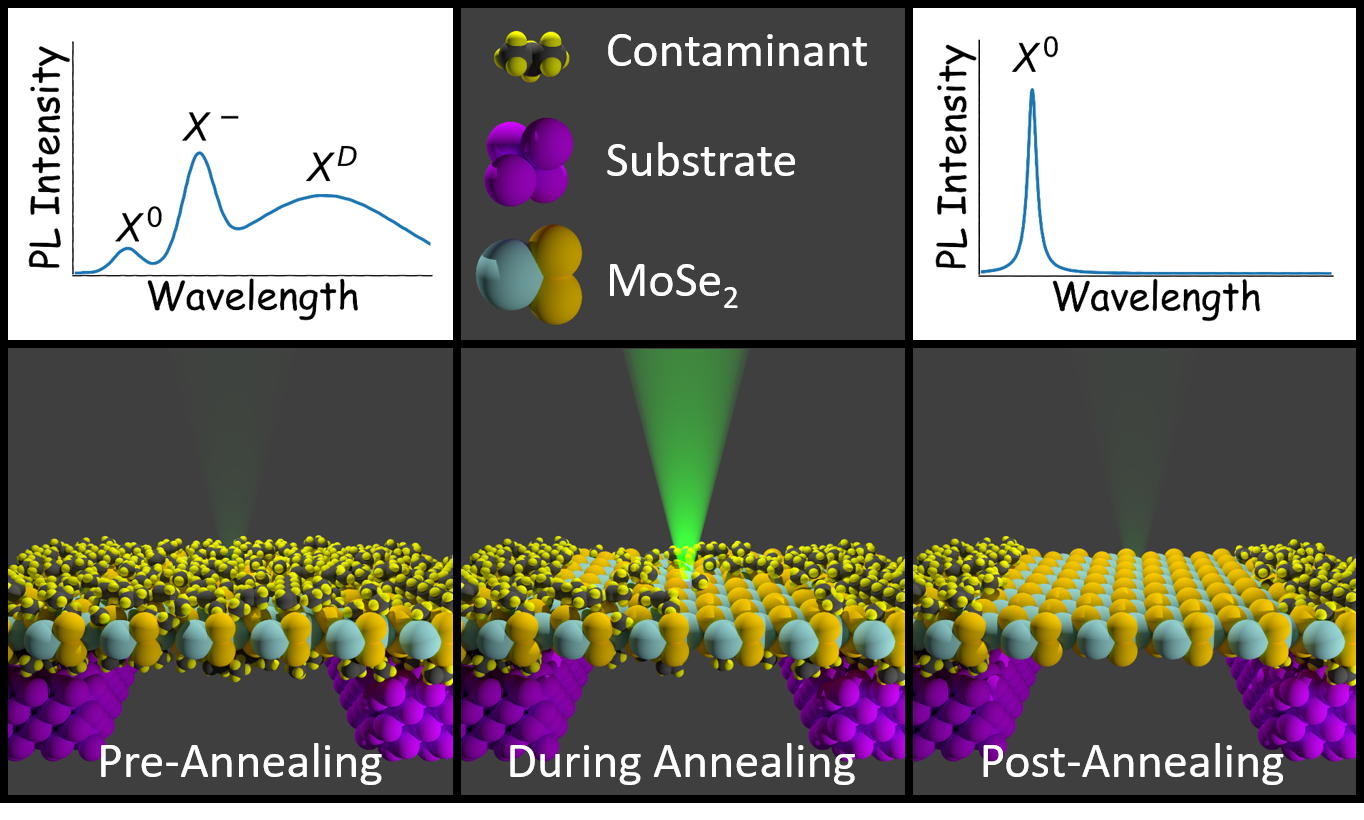
A major challenge in making scalable devices from monolayer 2D materials is that large-transverse-area samples, which are typically grown using chemical vapor deposition (CVD), are of low optical quality. I have discovered and developed a laser annealing technique to drastically and repeatably increase the optical quality of suspended CVD-grown monolayers, which is outlined schematically below. More details can be found in Phys. Rev. Materials 2, 094003 .
Coherent Control of Excitons in MoSe2
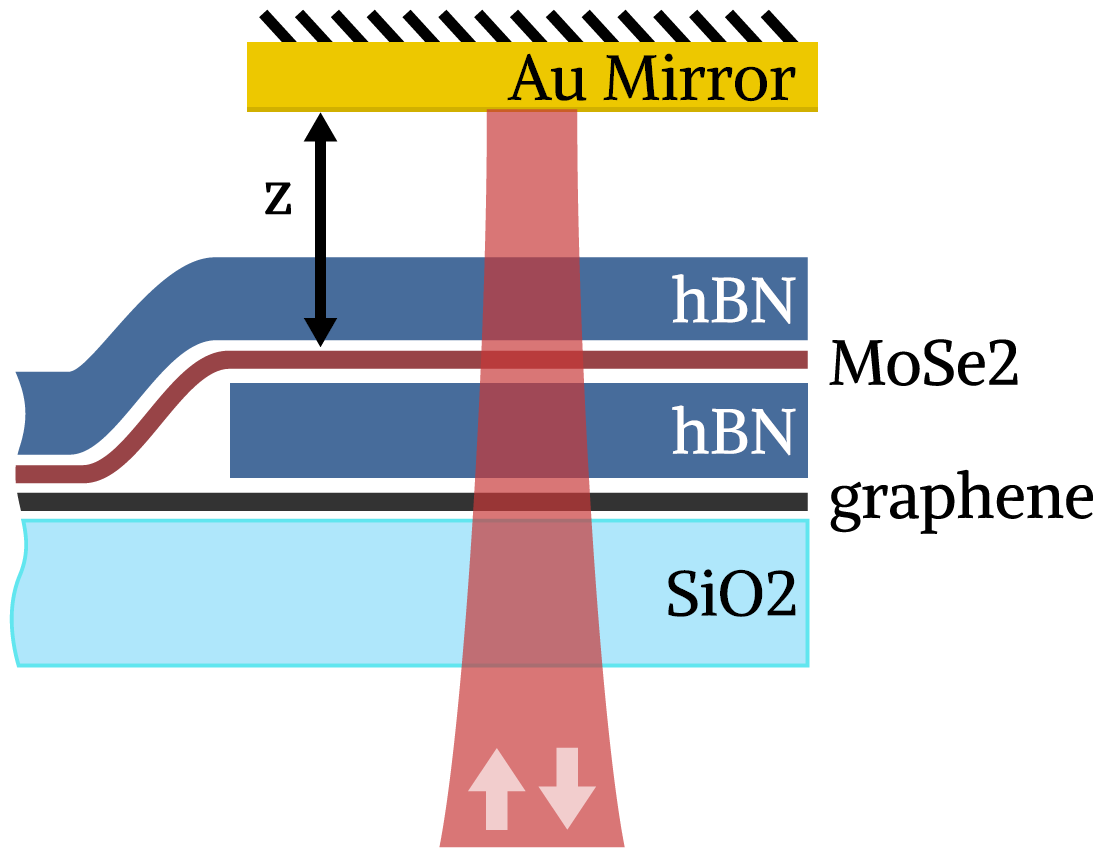
It is possible to control electric dipole radiation by engineering of the photonic environment, in which case a coherent interaction between forward and backward emission depends interferometrically on the position of a nearby mirror. This is shown schematically below.
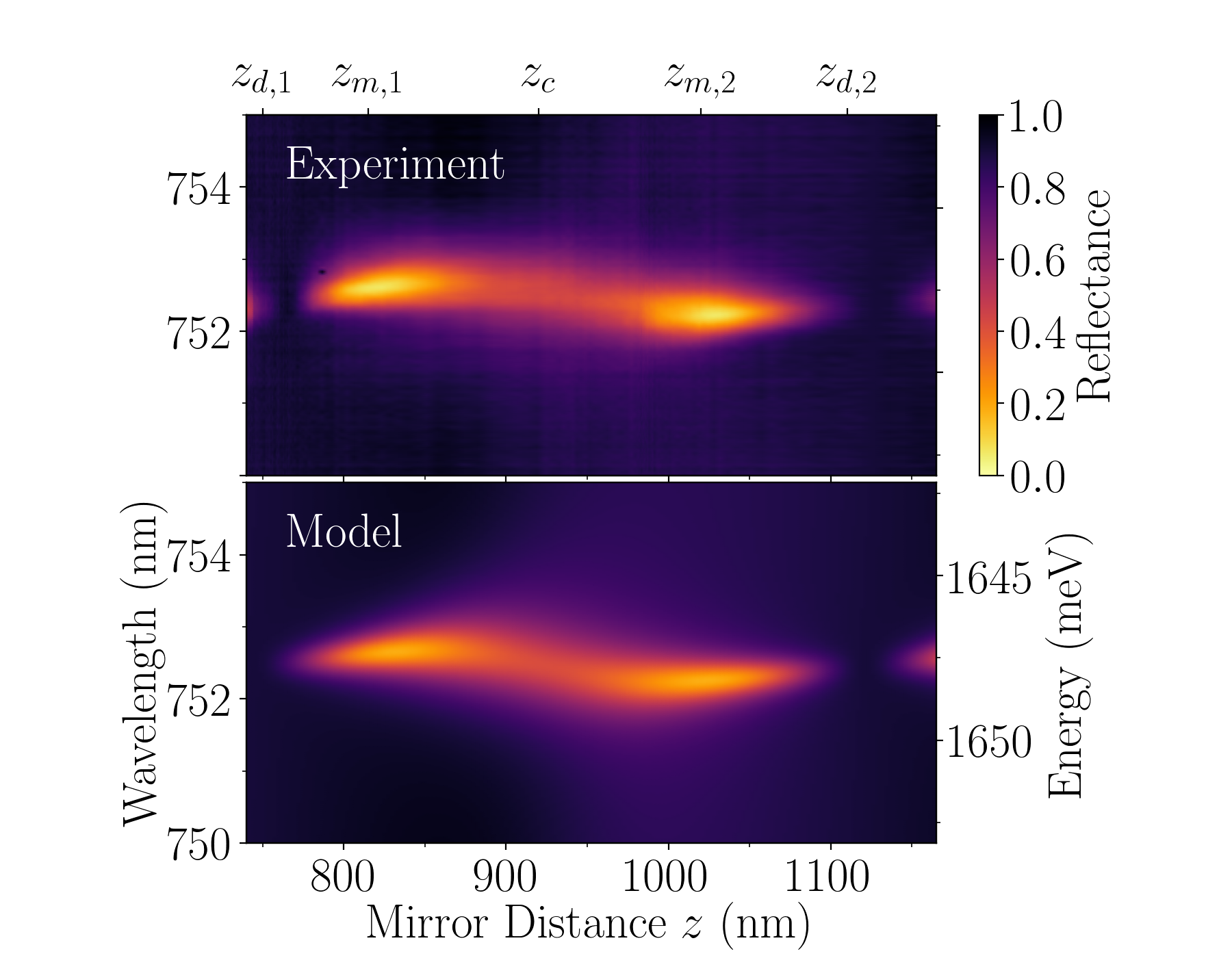
The high quality and radiatively broadened nature of our samples implies that this change in radiative coupling to the environment should be accompanied by a change in total linewdith of the exciton resonance. In addition, the transverse coherence of exciton emission in a single layer of MoSe2 removes fundamental physical limitations of previous experiments employing point-like dipoles. This enables full control over the exciton radiative coupling rate and total linewidth at cryogenic temperatures from near-zero to 1.8 meV and from 0.9 to 2.3 meV, respectively. A plot of the experimental and modelled reflectance vs. mirror position is shown below. More details can be found in arXiv:1902.05036 .