
Pdfs are available on the Publications page of this website.
A long-term study of ant colony behavior and ecology is described in D. M. Gordon, Ants at Work. 2000. Norton Publ.
D. M. Gordon. Ant Encounters: Interaction Networks and Colony Behavior was released in spring 2010. Princeton Univ. Press.
1. Colony organization
We investigate how individual ants, using local information, produce the coordinated behavior of colonies. An ant colony operates without central control. Task allocation is the process that allows the colony to adjust the numbers of ants engaged in each task, in a way appropriate to the current situation.
An ant's task decisions depend on its recent experience of brief encounters with other ants.
1993. Gordon, D. M., R. E. H. Paul, and K. Thorpe. What is the function of encounter patterns in ant colonies? Animal Behaviour 45:1083-1100.
1996. Gordon, D. M. The organization of work in social insect colonies. Nature 380:121-124.
In the course of an encounter, one ant assesses the task-specific cuticular hydrocarbons of another.
2003. Greene, M. J. and D. M. Gordon. Cuticular hydrocarbons inform task decisions. Nature 423: 32.
Ants use the rate of interaction in task decisions.
2007. Greene, M.J. and D.M. Gordon. Interaction rate informs harvester ant task decisions. Behavioral Ecology doi:10.1093/beheco/arl105
Colonies adjust foraging activity using a feedback system based on the pattern of encounter between inactive ants inside the nest, and returning, successful foragers.
2007. Gordon, D. M. Control without hierarchy. Nature 4468:143.
2009. Beverly, B., H. McLendon, S. Nacu, S. Holmes, and D.M. Gordon. How site fidelity leads to individual differences in the foraging activity of harvester ants. Behavioral Ecology doi:10.1093/beheco/arp041
2008. Gordon, D. M., S. Holmes and S. Nacu. The short-term regulation of foraging in harvester ants. Behavioral Ecology 19:217-222.
2002. Gordon, D. M. The regulation of foraging activity in red harvester ant colonies. American Naturalist 159:509-518.
Dynamical networks of interactions are crucial in regulating colony behavior. Previous work showed that colony behavior changes as colonies grow older and larger. (Some references below). Current modeling work examines the role of colony size in the dynamics of interaction networks.
1987. Gordon, D. M. Group-level dynamics in harvester ants: young colonies and the role of patrolling. Animal Behaviour 35:833-843.
1992. Gordon, D. M. How colony growth affects forager intrusion in neighboring harvester ant colonies. Behavioral Ecology and Sociobiology 31:417-427.
1992. Adler, F. R. and D. M. Gordon. Information collection and spread by networks of patrolling ants. American Naturalist 40:373-400.
1996. Pacala, S. W., D. M. Gordon and H.C.J. Godfray. Effects of social group size on information transfer and task allocation. Evolutionary Ecology 10:127-165.
1999. Gordon, D. M. and Mehdiabadi, N. Encounter rate and task allocation in harvester ants. Behavioral Ecology and Sociobiology 45:370-77.
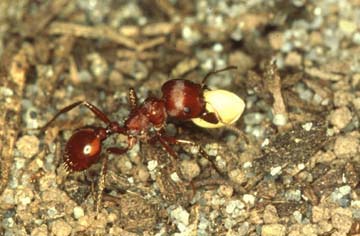
Photo courtesy Diane Wagner
Individual ants move from one task to another, depending on current conditions and colony needs.
2005. D.M. Gordon, J. Chu, A. Lillie, M. Tissot, and N. Pinter. Variation in the transition from inside to outside work in the red harvester ant, Pogonomyrmex barbatus. Insectes Sociaux, 52:212-217.
The expression of a gene linked to foraging behavior changes as ants move from work inside the nest to foraging outside the nest.
2005. K. K. Ingram, P. Oefner and D. M. Gordon. Task-specific expression of the foraging gene in harvester ants. Molecular Ecology 14:813-818.
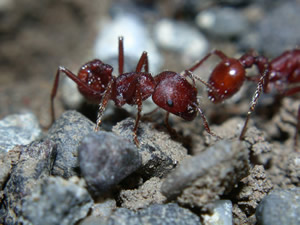
Photo courtesy of Alex Wild
2. Ecology of harvester ant populations
We are conducting a long-term study of a population of about 300 colonies of harvester ants.
1996. Gordon, D. M. and A. W. Kulig. Founding, foraging and fighting: colony size and the spatial distribution of harvester ant nests. Ecology 77:2393-2409.
1995. Gordon, D. M. The development of an ant colony's foraging range. Animal Behaviour 49: 649-659.
1993. Gordon, D. M. The spatial scale of seed collection by harvester ants. Oecologia 95: 479-487.
A model of interactions between colonies shows how competition for food shapes foraging behavior.
2003. Adler F. R. and D. M. Gordon. Optimization, conflict, and non-overlapping foraging ranges in ants. American Naturalist 162:529-543.
Demographic studies show the effects of interspecific interactions and climate on colony mortality.
2004. N. J. Sanders and D. M. Gordon. The interactive effects of climate and interspecific neighbours on mortality of red harvester ants. Ecological Entomology 29:632-637.
Colonies live for 15-20 years. Colony development alters the chemistry of the soil near the nest.
2004. D. Wagner, J. B. Jones and D. M. Gordon. Development of harvester ant colonies alters soil chemistry. Soil Biology and Biochemistry 36:797-804.
3. Population genetics of harvester ant populations
The population of harvester ants we study has an unusual 3-sex system. Recent work shows that this population, like other harvester ant populations nearby, is divided into two lineages. When a queen mates with a male of the same lineage, she produces female reproductives. When she mates with a male of the other lineage, she produces sterile female workers.
2006. Linksvayer, T., M.J. Wade and D.M. Gordon. Genetic caste determination in harvester ants: possible origin and maintenance by cyto-nuclear epistasis. Ecology 87:2185-2193.
2006. V.P. Volny, M.J. Greene and D.M. Gordon. Brood production and lineage discrimination in a harvester ant population with genetic caste determination. Ecology 87:2194-2200.
2002. Volny, V. P. and D. M. Gordon. Genetic basis for queen-worker dimorphism in a social insect. Proc Nat Acad Sci 99:6108-6111.
Current work examines the evolution of this system.
Males are produced by queens.
2007. Suni, S., C. Gignoux and D. M. Gordon. Male parentage in dependent-lineage populations of the harvester ant Pogonomyrmex barbatus. Molecular Ecology 16:5149-5155.
Dispersal distances are short, about 150 m.
2009. Suni, S. and D. M. Gordon. Fine-scale genetic structure and dispersal distance in the harvester ant Pogonomyrmex barbatus. Heredity, in press.
Current work investigates changes in the ratio of the two lineages over the past few years.
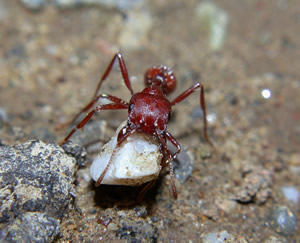
Photo courtesy of Alex Wild
4. The invasive Argentine ant
The Argentine ant, Linepithema humile, is native to Argentina and has spread worldwide in regions with Mediterranean climates. We are conducting a long-term study, now in its 17th year, monitoring the spread of the Argentine ant in a reserve in Northern California.
Argentine ants from widely separated nests are rarely aggressive when introduced experimentally, leading to the impression that the ants form large 'supercolonies'. Supercolonies were thought to be an innovation in the introduced range. However, in Argentina (the native range) and California (the introduced range), Argentine ant densities are similar, neighboring nests are linked by trails, and intraspecific aggression is uncommon within a few hundred meters.
2004. Heller, N.E. Colony structure in introduced and native populations of the invasive Argentine ant, Linepithema humile. Insectes Sociaux 51:378-386
Genetic analysis of Argentine ants in California shows that nests differ genetically at the scale of 100 m.
2003. Ingram, K. and D. M. Gordon. Genetic analysis of dispersal dynamics in an invading population of Argentine ants, Linepithema humile. Ecology 84:2832-42
These genetic results, showing differences between nests at 100 m, are supported by recent work showing a clear seasonal pattern of colony aggregation and dispersal at scales of about 100 m.
2006. Heller, Nicole E., and D.M. Gordon. Seasonal spatial dynamics and causes of nest movement in colonies of the invasive Argentine ant (Linepithema humile). Ecological Entomology 31:499-510.
Seasonal expansion and contraction explains seasonal patterns in the distribution of ants at the landscape scale. During the winter, Argentine ants aggregate in large nests in warm, sunny locations. As summer approaches, these aggregations break up into smaller nests, connected by trails, spreading out over a wider area.
2009. Heller, N.E., K.K. Ingram and D.M. Gordon. Nest connectivity and colony structure in unicolonial Argentine ants. Insectes Sociaux, in press.
2005. Heller, N.E., Sanders, N.J. and D M Gordon. Linking temporal and spatial scales in the study of an Argentine ant invasion. Biological Invasions, 8: 501-507.
The rate of spread depends on climatic conditions, especially rainfall.
2007. Heller, N.E., Sanders, N. J., Shors, J. W. and D. M. Gordon. Rainfall facilitates the spread, and time alters the impact of the invasive Argentine ant. Oecologia doi: 10.1007/s00442-007-0911-z
Some native ant species, especially the winter ant Prenolepis imparis, are able to resist and impede the spread of Argentine ants, but once established the Argentine ants alter community assembly in native ant species.
2003. Sanders, N. J., N. J. Gotelli, N. E. Heller, and D. M. Gordon. Community disassembly by an invasive species. Proc Nat Acad Sci, 100:2474-2477.
2001. Sanders, N. J., Barton, K.E., and D. M. Gordon. Dynamics of the distribution and impact of the invasive Argentine ant, Linepithema humile, in northern California. Oecologia 127:123-130.
1996. Human, K. G. and D. M. Gordon. Exploitative and interference competition between the Argentine ant and native ant species. Oecologia 105:405-412.
1998. Human, K. G., Weiss, S., Weiss, A., Sandler B. and Gordon D. M. The effect of abiotic factors on the local distribution of the invasive Argentine ant (Linepithema humile) and native ant species. Environmental Entomology 27:822-833.
Argentine ants may also affect butterfly populations. Many North American ants and lycaenid butterflies have a mutualistic relationship in which the ants protect butterfly larvae from parasitoid wasps, and the butterfly larvae secrete honeydew which the ants consume.
Shors, J.W. and D.M. Gordon. In prep.
5. Ant-plant interactions
We have begun several projects on ant-plant interactions in tropical forests. Our focus is on the effects of mutualism on the evolution of life history.
Megan Frederickson (University of Toronto) studies ant-plant associations in the Peruvian Amazon. In "devil's gardens," ants use formic acid as a herbicide to create dense, monospecific stands of the tree Duroia hirsuta.
2005. Frederickson, M., M.J. Greene and D.M. Gordon. Ants bedevil devil's gardens. Nature 437:495-496.
The trees in devils' gardens are subject to more herbivory than are single Duroia hirsuta trees. (Read a summary from Nature's Research Highlights here.)
2007. Frederickson, M. and D. M. Gordon. The devil to pay: a cost of mutualism with Myrmelachista schumanni ants in "devil's gardens" is increased herbivory on Duroia hirsuta trees. Proceedings Royal Society B. 274:1117-1123.
Mutualist ants and plants create positive feedback on the growth of the other.
2009. Frederickson, M. E. and D. M. Gordon. The intertwined population biology of two Anazonian myrmecophytes and their symbiotic ants. Ecology 90(6):1595-1607.
In the dry forests of Mexico and Costa Rica, graduate student Beth Pringle, co-advised by Rodolfo Dirzo, Dept of Biology, Stanford, has been investigating interactions among Cordia alliodora trees, Azteca ants, and scale insects.
Although scale insects are themselves tree-sap herbivores, higher densities of scale insects increase the effectiveness of ant defense of tree leaves, creating indirect benefits for trees.
2011. Pringle, E.G., R. Dirzo, and D.M. Gordon. Indirect benefits of symbiotic coccoids for an ant-defended myrmecophytic tree. Ecology. doi:10.1890/10-0234.1
