
EFS 693B - STANFORD UNIVERSITY
Advanced Listening and Vocabulary
Development
EFS 693B
Notes: Week 5
I. Another interesting website,
http://lingual.net: video clips: some with
subtitles, transcripts, and comprehension quizzes Their old site has a
more consistent interface:
www.lingual.net/lingualproductitems/details.php.
II. Any questions about the English
sound system - an overview?
A. Basic sounds (phonemes):
http://www.uiowa.edu/~acadtech/phonetics/#; see also
http://www.manythings.org/pp/ for practice with difficult sound distinctions
B. Rhythm:
http://en.wikipedia.org/wiki/Stress_timing
C. Stress:
www.englishclub.com/pronunciation/word-stress.htm
D. Intonation:
www.americanaccent.com/intonation.html
E. Linking:
www.englishclub.com/pronunciation/linking.htm
F. Reduced forms:
www3.telus.net/linguistics issues/ReducedForms.html.
Review handout on
Reduced Forms
III. Quiz on "No Time to Think"
(15 minutes)
IV. Reminder: We've talked about three types
of listening activities: practice for comprehending
more effectively, practice for building language knowledge, and practice for
improving language processing. This week we'll focus on practice for
comprehending more effectively.
Most of the time you listen, your goal is to
understand. However, depending on the situation, you may need to understand very
well or just get the basic idea. Sometimes you are listening for specific
information (for example, listening to a weather report if you're planning an
outdoor activity the next day), sometimes you're trying to pick out key ideas
and the information that supports them (as in a lecture), sometimes you're
trying to be entertained (listening to a TV show or movie), and there are many
other situations, each with their own objectives. And once you understand
something at whatever the desired level is, how much of that understanding do
you need to retain in some form so that you can make use of it later? And how do
you interpret that information and integrate it into what you already know? In
most cases you're trying to do one or more of the following:
You can improve in each of these areas by doing listening
activities that focus on them.
Getting the basic meaning.
We've already seen that
preparing for listening is an important first step, so most of the time when
you're listening to improve comprehension, you want to prepare appropriately,
activating background information and making predictions about what you might
hear. If you practice pre-listening regularly, you're more likely to transfer
that valuable strategy to your everyday life. Preparing also makes it more
likely that you will pay attention to the context, including visual information,
and make use of that information to help you keep track of what you're hearing.
Other problems with getting the basic meaning include keeping up with the speed
of the speaker, staying focused (not letting your mind wander), and linking the
specifics of what you're hearing to the "bigger picture" so that you are able to
distinguish the main points from the details, the facts from the opinions, and
so on. Finally, if you get lost or distracted, you need to be able to return
without losing too much of the information. During listening practice, you can
focus your attention on these needs. For example. Pausing recorded material at
regular intervals or anytime you feel yourself losing concentration or getting
lost is a good way to get back on track.
Retaining important points. As you
listen and build your understanding of a spoken text (lecture,
presentation, conversation, story, or whatever), it's important to be able to
retain and recall key parts of it that will help you remember the rest. It
doesn't help to say you "understood everything" if you don't remember it a few
minutes later. In academic or professional settings, taking notes is often the
most effective way of doing this. Taking notes is not a natural activity for
humans, but an acquired skill. This is especially true in a second language
because it's especially hard to interpret and write down ideas while trying to
stay focused on what the speaker is saying. Like all skills, you get better if
you practice it, so take notes--good notes--whenever you can. Another good skill
to develop is to quickly summarize material as soon s you've heard it, using
your short term memory to help you internalize the information before you lose
it. This is especially important in situations where taking notes is impossible
or might be considered impolite (such as at a social gathering). A good practice
activity for this is to listen to a clip or a part of a longer text (less than
five minutes) and pause and summarize it orally or in writing before continuing.
This also gives some good practice in producing English. Interestingly, if you
know you're going to have to do this, you seem to pay closer attention, so it's
a good motivator too.
Interpreting and integrating. We are
not just tape recorders. When we listen even in our native languages, we are
constantly judging what we hear, deciding how true or convincing it is, how
interesting or useful it is, how it connects with what we already know. When
listening in a second language, it's sometimes difficult to do this effectively,
and as a result, what is heard is only remembered partially if at all. Although
it's hard to do this when you're listening to live material, with recorded
material it's easier to gain the time to reflect. Use the pause button
regularly, not just to be sure you understand, but to savor and critically
evaluate what is coming in.
Cognitive resource limitations. In addition to the
preceding, an important concept to be aware of as you practice is your cognitive
resource limitations. Basically, this refers to the increasingly well-documented
observation that the human brain is not good at focusing attention on more than
one or two things at a time. In your native language, processing is automatic,
so it's easier to notice a single new word or phrase, to interpret, and to
recall details. Not so in a second language: when new words or idioms are
encountered, or the speed or accent make it difficult to process what you hear
rapidly, or the information itself is new or abstract, your brain takes longer
to process the information and even with more time may do it incorrectly.
Current learning theory suggests trying to avoid cognitive overload. That means
taking advantage of comprehension tools when needed (text support, slower speed,
pausing, etc.), selecting material for practice that is usually not too far
beyond your ability to understand easily, and working with familiar topics of
interest so that you can bring in your existing knowledge to aid comprehension.
It also means building up the other areas we'll be discussing over the next two
weeks--language knowledge (especially vocabulary) and processing ability--so
that these become more unconscious and automatic over time as they are in your
native language. If you're having trouble understanding well, especially the
second or third time through a piece, it may be because you're just asking your
brain to do more than it reasonably can.
V. Go to the Online News Hour:
http://www.pbs.org/newshour/. We'll look at both today's shows and the
archive:
http://www.pbs.org/newshour/newshour_index.html.
VI. Technical training: how to get more control of the
media player (in a PC). Go to a site that has Windows media player as an option,
like
http://ecorner.stanford.edu/authorMaterialInfo.html?mid=1524.
-
Load the video using the Windows Media Player
download option
-
Save it to your desktop, then open with
Windows Media Player.
-
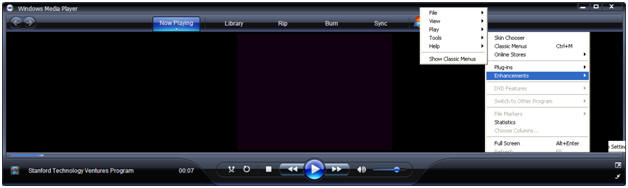
Open the file using Windows
Media Player, giving you the full playbar and allowing access
to speed control and the graphic equalizer (set to speech). Note that these
are accessible by right-clicking on the top bar and selecting View >
Enhancements
-
VII. Option: using the VLC media player: go to
www.videolan.org/vlc/ to download
player or use the machines in the Meyer Lab (second floor): See detailed
instructions here. Note: for some reason the VLC player
doesn't handle the sound in ecorner videos well. You can use it for esl-lab
though
-
Load the video into the VLC Player, using the
Media menu. Use "Open Network Stream" if you have a URL for it.
-
If you don't have the URL handy, right click on the
video screen and select "properties" to find it; alternatively, for Flash
videos you may be able to get it by using View > source and searching for "flv".
Sometimes, you just can't find it.
-
Note that the speed control is on top: you can also
jump back two seconds using Shift- <-- and one minute using Ctrl -
<-- (use the same with forward-arrow to jump forward)
----------------------------------------------------------------------------------------------------------------------------------------------------------------------------------------
Homework: Unless otherwise stated (e.g.,
the independent project) you should complete this material in time to discuss it
in the following class. Be sure to bring notes if requested.
1) Continue working on your independent project. Remember to incorporate any
suggestions made in the individual meetings. Plan to do some combination of
3-6 sessions for a total of at least three hours. Try to have a mixture of
objectives that includes not only comprehension, but also building language
knowledge and improving processing. Be sure you are doing something about
reviewing your vocabulary. Get the report form here
2) Read (IV) above and think about what it means to both your everyday listening
and especially your independent project work. This should only take about 10
minutes, but it's a very important 10 minutes. Come to class next week with any
questions you might have after going through it.
3) Go to the Online News Hour:
http://www.pbs.org/newshour/. You can either pick a story from the current program or
look at the archives under "recent programs"
http://www.pbs.org/newshour/newshour_index.html and find one there. Use the
following listening lesson procedure through at least one story: (note, if
you're already using this for your independent study, do this anyway--it
shouldn't count as part of your three hours)
A.
Pre-listening: Read about the story.
Think about what you already know of the topic and predict what you might
hear. If you don't know much about the topic, go to
http://news.google.com and search for a
recent article to read before listening.
B. While listening: The first time through, pause occasionally (more often if you're having
trouble) and try to recall what you know up to that point; jot down a note of
the time for interesting or difficult parts. This is called a "punctuated
presentation."
C. Post-listening: What do you remember? What should you do
next?
- Listen again to the full story for comprehension,
or listen to selected parts for comprehension
- Look at the transcript for comprehension help;
look up key words that you don't understand--don't worry about others.
-
Listen straight through one more time
Bring your notes to
the next class and come prepared to discuss your experience.
4) Ecorner with Marissa Mayer: trying different speeds:
A. Go to
http://ecorner.stanford.edu/authorMaterialInfo.html?mid=1524. Follow the
instructions in VI to set the graphic equalizer to speech and activate the
play speed control. Prepare for listening by reading Mayer's bio and looking
at the description. Listen to the clip first at slow speed (70 or 80%) and
then again at normal speed. Did slowing it down seem to help your
comprehension? Were you able to notice new words, reductions and linking,
more easily?
B. Try the next clip
http://ecorner.stanford.edu/authorMaterialInfo.html?mid=1525. For this
one, listen first at normal speed and then again at slow speed (70-80). Did
you notice a difference in your comprehension?
C. Try the third clip
http://ecorner.stanford.edu/authorMaterialInfo.html?mid=1526. For this
one, start at normal speed and then pause and change the speed as needed. Go
through two times using this method.
Describe your experience briefly
on your next report. Does the slower speed seem to help or hinder your
comprehension? Which of the three options (A, B, or C) do you think would work
best for you when listening to fast speech?
5) Prepare to discuss your individual project with other students in the class (bring
a copy of your report
to help you remember)
1) What material are you using?
2) Why did you pick that? What are your objectives?
3) Give an example of an effective procedure you're using. Why do you
think it's effective?
4) What is the most useful thing you've learned so far from the project?
5) What is your main problem in doing the project?
Last modified:
April 26, 2010, by Phil Hubbard