Understanding our Chinese Students
Learn about the Chinese Culture
By Leslie Chui
If your students are English Language Learners whose Native Language is Chinese, (Mandarin or Cantonese dialect), here are some things you need to know about them. Though some are generalizations, they might give you an idea to help you better understand your students.
My Definition of Culture:
Culture is the way in which a group of people from a similar background in society acts, behaves and functions.
A comprehensive definition of culture can be found in the Encyclopaedia Britannica:
“Culture” may be defined as “the integrated pattern of human knowledge, belief, and behaviour… language, ideas, beliefs, customs, taboos, codes, institutions, tools, techniques, works of art, rituals, ceremonies, and other related components…” (Encyclopaedia Britannica, 1989).
According to a website hosted by Ohio State University, there are six elements in culture:
The Chinese Culture:
A list of Chinese Culture & Traditions can be viewed at About.com
There is also a Chinese Cultural Center in San Francisco. It offers a variety of educational and cultural programs. These programs range from lectures, workshops, and classes to art exhibitions, dance and musical performances, and cultural exchanges--all of which enable members of the Chinese American community and the general public alike to gain a deeper knowledge of historical as well as contemporary Chinese and Chinese American culture.
Did you know that San Francisco’s Chinatown is the biggest Chinatown in North America? For more information about points of interest, please visit: http://www.sfchinatown.com/point_of_interest/interest.html
Here are some more facts about San Francisco’s Chinatown:
http://www.sfchinatown.com/resources/ataglance/index.html
Critical Demographic Information on China:
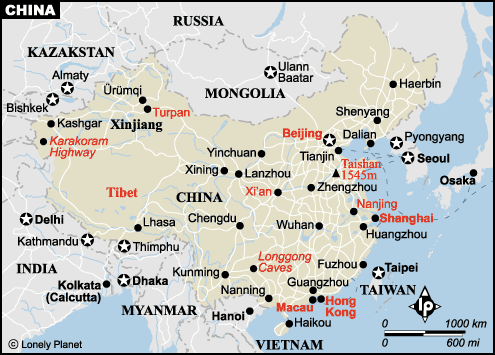
· China is the third largest country in the world.
· It is in the continent of Asia.
· The capital is Beijing
· The official dialect spoken in China is Mandarin
For more information, visit their website:
http://www.un.org/esa/population/unpop.htm
If you are interested in learning more about China’s geography, people, government, economy, communications, transportation, military or transnational issues, please visit the CIA’s World Fact book on China
If you plan to give your kids a project on China, here’s another great website suitable for students. It has a comprehensive section on China’s history.
http://www.factmonster.com/ipka/A0107411.html
Expectations that Chinese students and parents have about schooling and their community:
Traditionally, Chinese American parents have great expectations of their children’s education. Making sure that their children are performing well in school is the parent’s top priority. Parents usually are willing to spend a good portion of their paycheck on their child’s education. Many Chinese students have tutors, or are involved in after-school programs. Chinese students in America have often been referred to as the “model minority. ”
C.N. Le, a Ph.D. candidate in Sociology at the University at Albany, SUNY wrote A Closer Look at Asian Americans and Education:
http://www.blarg.net/~building/mult_le.htm
Here’s another good read:
Chinese Parents' Influence on Academic Performance by Shu Ya Zhang, Angela L. Carrasquillo
Abstract: This article reviews the literature
related to Chinese parents' influence on Chinese students' educational
performance. Cultural values always play an important role in the educational
achievement of Chinese students. Chinese parents are renowned for their
willingness to sacrifice for the sake of their children's education. Parents
have a significant influence in the academic performance of Chinese students.
Factors about the group that have influenced its immigration to the U.S.;
Angel Island is located in San Francisco Bay, California. During the period beween 1910 and 1940, there were as many as 175,000 Chinese immigrants detained and processed there.
Just like the European immigrants, the early Chinese immigrants came to the United States for much of the same reasons. China was experiencing some tough times with poverty and famine. The United States was a land of opportunities where people could get jobs and send money home to one's family. The California gold rush and the transcontinental railroad were promising for many. Thus, the United States was known as "Gum San" or Gold Mountain.
The Chinese were welcomed to work in California welcomed the Chinese to work during the boom in the mid 1800's, but the Chinese were being segregated. The Chinese were in demand for labor, but as the economic conditions soured, discrimination against the Chinese increased.
A Brief History of Chinese Immigration to America can be found at the American Immigration Law Foundation’s website:
http://www.ailf.org/heritage/chinese/essay01.htm
For a comprehensive and difficult read on Chinese Immigration and Chinese in the United States, visit the US government website on Waverly B. Lowell’s book, Chinese Immigration and Chinese in the United States: Records in the Regional Archives of the National Archives and Records Administration.
More Recent Factors:
During the 80’s and 90’s the majority of Chinese immigrants came from Hong Kong, Taiwan and Macau. The Hong Kong Handover in 1997 and Macau Handover in 1999 led many families to the United States, Canada, Australia and other countries in the world.
To find out more about how the Hong Kong handover affected immigration, please view the statistics compiled by the British Columbia government of Canada.
http://www.bcstats.gov.bc.ca/pubs/immig/imm971sf.pdf
Variability within the group:
What are some of the differences between Chinese immigrants from Hong Kong, Taiwan and China.
Read about Hong Kong:
The CIA World Fact Book on Hong Kong
http://www.info.gov.hk/eindex.htm
http://journalism.berkeley.edu/projects/pacific/index.html
Read about Taiwan:
The CIA World Fact Book on Taiwan
Profiles of selected Taiwan immigrants, from Chinatown No More, by Hsiang-Shui Chen, copyright Cornell University Press, 1992.
Characterization of the Chinese language structure:
Chinese is a language with clearly distinguished syllables, each of which corresponds to a meaningful unit, a morpheme. As it is an “isolating” language, rather than an inflected language like Latin or, to a lesser degree, English, each morpheme is represented separately by a separate syllable. (Encyclopedia Britannica, 2002)
In my opinion, Chinese is a complex language in that there are many dialects. The national dialect is Mandarin. People living in China are supposed to be able to speak both the national dialect plus their provincial dialect. For example, if you live in the province of Shanghai, you would be able to speak Shanghainese and Mandarin.
According to the UCLA Chinese Language Profile, Mandarin is the most widely spoken of all Chinese languages/dialects. It is used by more than 720 million people in China, or 70 percent of the population of China.
A great number of Mandarin speakers outside of China are in Taiwan, Singapore,
Malaysia, Indonesia, Russia, the USA, Mongolia, Vietnam, Brunei, South Africa,
Thailand, Laos, Cambodia, and Hong Kong. Thus, the total number of speakers is
approximately 885 million.
Cantonese is widely spoken by the Chinese immigrants in San Francisco. In fact, the majority of the Bilingual Programs in Chinese is of the Cantonese dialect. UC Davis has a comprehensive webpage on the Cantonese dialect. Learn more about what Cantonese is and who speaks Cantonese by clicking here.
Here’s an abstract about Chinese students in learning English on Teaching and Learning Forum 2001. The title of the article is called Pragmatic breakdown of Chinese students in English communication