`
|
Selected Resources for
Teachers Of
Students with Cultural Ties To El
Salvador |
||||
|
Cultural
Profile |
||||
|
Immigration |
|
|
||
|
Language |
|
|||
|
Education |
|
|||
Culture. The San Francisco Bay Area has a large
population of students whose families have immigrated from El Salvador. It is critical that those of us who
work with these students acknowledge their culture and incorporate our
students’ background in our classrooms. As Rosemary Henze and Mary Huaser (CREDE, 1999) have pointed
out the concept of culture has changed over the past few years. Today, it is recognized that culture is
learned, not inherited; that there are many more bicultural,
multicultural and multiethnic
communities as opposed to homogeneous ones; that there is enormous variability
within a cultural group; that living cultures are constantly changing, and that
culture exists inside people and in their everyday, lived behaviors. For our students from El Salvador their
culture has been shaped in part by their ties to El Salvador itself and what
they experienced while living there, their immigration experience, the
language(s) that they speak, and their lives today in the United
States.
|
Factors that have Influcened Immigration to the
US. The BBC
News provides the following overview: “A tiny country, El Salvador is both the most
densely populated state on the mainland of the Americas and the most
industrialized in Central America. However, social inequality and the fact
that the country lies within a seismic zone define much of contemporary El
Salvador. During the 1980s, El Salvador was ravaged by a bitter civil war.
This was the result of gross inequality between a small and wealthy elite,
which dominated the government and the economy, and the overwhelming majority
of the population, many of whom lived - and continue to live - in abject
squalor. The war left around 70,000 people dead and caused damage worth 2
billion dollars, but it also precipitated important political reforms. In
1992 a United Nations-brokered peace agreement ended the civil war, but no
sooner had El Salvador begun to recover when it was hit by a series
of natural
disasters. The most notable of these was Hurricane Mitch in 1998, and a
number of earthquakes in 2001. These left at least 1,200 people dead and more
than a million others homeless. Poverty, civil war, natural disasters and
their consequent dislocations have left their mark on El Salvador's society, which is among the most
violent and crime-ridden in the Americas.” |
|
|
|
Critical demographic, social and historical
information from the CIA World
Factbook Country name: local long
form: Republica de El
Salvador; local short form: El Salvador Population: 6,237,662 (July
2001 est.) Population growth rate: 1.85%
(2001 est.) Birth rate: 28.67
births/1,000 population (2001 est.) Death rate: 6.18 deaths/1,000
population (2001 est.) Net migration rate: -3.95
migrant(s)/1,000 population (2001 est.) Infant mortality rate: 28.4
deaths/1,000 live births (2001 est.) Life expectancy at birth:
total population:
70.03 years Total fertility
rate: 3.34 children
born/woman (2001 est.) HIV/AIDS - adult prevalence
rate: 0.6% (1999 est.) HIV/AIDS - people living with
HIV/AIDS: 20,000 (1999 est.) HIV/AIDS – deaths:
1,300 (1999 est.) Ethnic groups: mestizo 90%,
Amerindian 1%, white 9% Religions: Roman Catholic 86%
Languages: Spanish,
Nahuatl Natural hazards: known as the
Land of Volcanoes; frequent and sometimes very destructive
earthquakes and volcanic activity Environment - current issues:
deforestation; soil erosion; water pollution; contamination
of soils from disposal of toxic wastes; Hurricane Mitch damage
Geography - note: smallest Central American country and
only one without a coastline on Caribbean Sea Literacy definition: age 10 and over can read and write:
total population:
71.5% Government type:
republic Capital: San
Salvador Independence: 15 September
1821 (from Spain) Legal system: based on civil
and Roman law, with traces of common law; judicial review of legislative acts
in the Supreme Court; accepts compulsory ICJ jurisdiction, with
reservations Suffrage: 18 years of age;
universal |
Education Expectations. According to UNESCO
International Centre on Higher Education in El Salvador, education is
compulsory from age 7 to 15, after which students receive a certificate. After that they may elect to complete
either a 2 year secondary “Bachillerato General” which prepares
them for college or a 3 year technical “Bachillerato Tecnico
Vocacional”
which prepares them for work. CIDEP reports
“that
for 1995, the basic schooling (first through sixth grade) rate was 50.33%. Average schooling at the national level
is 4.67 years with an urban average of 6.25 and a rural average of
2.66 grades. In El Salvador only 5.91% of the
population over 6 years of age has completed more than 12 years of
schooling.” These statistics have implications for
our Salvadoran immigrant students in the United States. Both students and their families need
to be clearly informed about the expectation that students in the US complete
12 years of school. In addition,
for students whose parents have not completed secondary or post-secondary
education, it is critical that they be given information early on about what
high school courses are required for college and what benefits a college
education can confer.
Variability within the group. As already noted, there may be great
differences in schooling and literacy among our Salvadoran students based on
whether or not they lived in urban or rural areas in El Salvador. In addition, while the vast majority of
Salvadoran immigrants have little wealth when they arrive in the US, there is a
small percentage (less than 5%) who are quite wealthy, both in land holdings
and financial terms. And, while
most Salvadorans are Roman Catholic, about 14% are now evangelical Protestants
or practice some other religion.
These variances just go show that it is important not to pre-judge our
students; they may well differ from the typical portrait painted in
the media.
Key Discourse Rule Regarding Education. In El Salvador teachers are often
regarded as on the same level as priests and doctors. Parents, let alone students, often hesitate to ask questions
for information and certainly are reluctant to question teachers and school
administrators (see Canada Employment and Immigration Commission link
above.) This means that as
educators we must be particularly solicitous when requesting information,
concerns, questions and suggestions from both our students and their
families. In addition, family ties are extremely
influential for many Salvadoran students.
Family visits and assigning ethnographic interviews for students to do
with their families are two methods that help build on this
strength.
Resources for the Classroom. As James Banks and others have pointed
out, as educators we have a great deal of control over the level of culture
that is acknowledged in our classrooms.
The first level focuses on discrete cultural elements, such as food
(pupusas which are cheese-filled tortillas and horchata a rice, milk and
cinnamon drink are widely available in San Francisco’s Mission District),
heroes, holidays, etc. of El Salvador
The second level entails adding a to a traditional course, such as
adding a unit about Mayan numbers to a math class. The third level is transformative and includes multiple
perspectives and points of view about the complexity of Salvadoran
society. The fourth and final
level builds on the third and encourages students to take action and make
decisions, perhaps about the issue of sweatshops and the impact they have in El
Salvador. Following are
some suggested
readings that might help get the ball rolling through the various
levels.
Books. Available from Amazon.com,
the descriptions are also from that site.
A Movie in My
Pillow/Una Pelicula En Mi Almohada
By Jorge
Argueta, Elizabeth Gomez
From Booklist Review
Gr. 4-8. Along with an estimated 500,000 Salvadorans who immigrated to the
U.S. in the 1980s, the poet Jorge Argueta and his family fled the civil war in
El Salvador and came to live in America. These 21 poems recount his childhood
experiences of being an immigrant and having dual homelands, with roots in El
Salvador and a new life in San Francisco's Mission District. In a format very
similar to that of Chicano poet Francisco X. Alarcon's award-winning bilingual
poetry collections, each poem is closely twinned on the page with its
translation and embraced by Gomez's illustrations, which flood each spread with
a rich rainbow of colors, rippling with vibrant images of magic realism.
Argueta's first book for children will add multicultural depth and historical
authenticity to any poetry collection. Annie Ayres
Magic Dogs of
the Volcanoes : Los Perros Magicos De Los Volcanes by Manlio Argueta,
et al
From Horn
Book
An original
bilingual tale, based on traditional myths from El Salvador, beautifully tells
of the magic dogs, called cadejos, who are the protectors of the people of El
Salvador. A great read-aloud, with illustrations. –
From
Grandmother to Granddaughter:
Salvadoran Women’s Stories
By Michael
Gorkin, Marta Pineda, Gloria Leal
Gorkin, an
American psychologist, teamed with two Salvadoran women psychologists to
explore the life histories of three generations of women in El Salvador. Their
recollections of childhood, courtship, marriage, and child rearing are conveyed
against the backdrop of the social upheaval of El Salvador's 12-year civil war
that ended in 1992. The subjects--grandmother, mother, and
granddaughter--reflect the range of Salvadoran social and economic strata. The
Nunez family are wealthy owners of a sugar plantation. The Rivas family (the
teacher mother and the university student daughter) represent the growing
middle class. The Garcia family are poor campesinas who live in a community
that benefited from land reform that came out of the civil war. Maria Garcia
was a former member of the guerrilla faction.
One Day of Life
by Manlio Argueta
Awesome for
the authenticity of its vernacular style and the incandescence of its lyricism,
One Day of Life depicts a typical day in the life of a peasant family caught up
in the terror and corruption of civil war in El Salvador.
5:30 A.M. in
Chalate, a small rural town: Lupe, the grandmother of the Guardado family and
the central figure of the novel, is up and about doing her chores. By 5:00 P.M.
the plot of the novel has been resolved, with the Civil Guard's search for and
interrogation of Lupe's young granddaughter, Adolfina. Told entirely from the
perspective of the resilient women of the Guardado family, One Day of Life is
not only a disturbing and inspiring evocation of the harsh realities of peasant
life in El Salvador after fifty years of military exploitation; it is also a
mercilessly accurate dramatization of the relationship of the peasants to both
the state and the church.
Bitter Grounds
by Sandra Benitez
Bitter
Grounds, Sandra Benitez's American Book Award-winning novel, chronicles the
lives of three generations of women in war-torn El Salvador. After losing most
of their family during the massacres of 1932, Mercedes Prietas and her daughter
Jacinta go to work for Elena de Contreras and her family, who own enormous
coffee and cotton plantations. During the next 40 years, the women of both
families help each other endure the many hardships that come their way. Benitez
manages to portray both the poor and the rich women in this book as complex,
sympathetic characters.
|
Any poetry by Roque Dalton El Salvador’s Poet of the Revolution |
|
The Massacre at
El Mozote : A Parable of the Cold War by Mark Danner
From the Back
Cover
"Mark
Danner is one of our best, most ambitious narrative journalists. He writes only
on what he knows deeply, cares about passionately. His harrowing, rebuking
account of an atrocious episode of the civil war in El Salvador touches on many
of the central issues raised by American policies and journalistic practice in
the Cold War and after. This is an admirable, necessary book."-- Susan
Sontag
Culture and Customs of El Salvador: (Culture and Customs of Latin America and the Caribbean) by Roy C. Boland
Revolution in
El Salvador : From Civil Strife to Civil Peace by Tommie Sue
Montgomery, et al
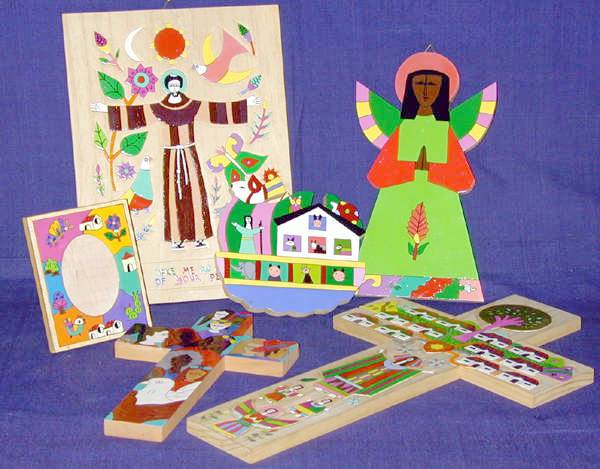
Crafts.
|
Check out Global Exchange Fair Trade Craft
Center at 4018 – 24th Street in San Francisco for
Salvadoran crafts. (415)
648-8068 You might also want to contact the Salvadoran
Embassy in San Francisco at 870 Market Street. (415)
781-7924 |
|