History & Government
The fishing and farming villages which emerged on Guatemala's
Pacific coast as early as 2000 BC were the forerunners of the great Maya civilization
which dominated Central America for centuries, leaving its enigmatic legacy
of hilltop ruins. By AD 250, the Early Classic Period, great temple cities were
beginning to be built in the Guatemalan highlands, but by the Late Classic Period
(AD 600 to 900) the center of power had moved to the El Petén lowlands.
Following the mysterious collapse of the Maya civilization, the Itzaes also
settled in El Petén, particularly around the present-day site of Flores.
When Pedro de Alvarado came to conquer Guatemala for the king of Spain in 1523,
he found the faded remnants of the Maya civilization and an assortment of warring
tribes. The remaining highland kingdoms of the Quiché and Cakchiquel
Maya were soon crushed by Alvarado's armies, their lands carved up into large
estates and their people ruthlessly exploited by the new landowners. The subsequent
arrivals of Dominican, Franciscan and Augustinian friars could not halt this
exploitation, and their religious imperialism caused valuable traces of Mayan
culture to be destroyed.
Independence from Spain came in 1821, bringing new prosperity to those of Spanish
blood (creoles) and even worse conditions for those of Mayan descent. The Spanish
Crown's few liberal safeguards were now abandoned. Huge tracts of Mayan land
were stolen for the cultivation of tobacco and sugar cane, and the Maya were
further enslaved to work that land. The country's politics since independence
have been colored by continued rivalry between the forces of the left and right
- neither of which have ever made it a priority to improve the position of the
Maya.
Few exceptional leaders have graced Guatemala's political podium. Alternating
waves of dictators and economics-driven Liberals were briefly brightened by
Juan José Arévalo, who established the nation's social security
and health systems and a government bureau to look after Mayan concerns. In
power from 1945 to 1951, Arévalo's liberal regime experienced 25 coup
attempts by conservative military forces. Arévalo was followed by Colonel
Jacobo Arbenz Guzmán, who continued to implement liberal policies and
instituted an agrarian reform law to break up the large estates and foster highly
productive, individually owned small farms. The expropriation of lands controlled
by foreign companies, a move supported by the country's Communist Party, was
the signal for the CIA to step in (one of these foreign companies was the United
Fruit Company, which interestingly was part-owned by the then US Secretary of
State). With their help a successful military coup was organized in 1954, Arbenz
Guzmán fled to Mexico and the land reform never happened.
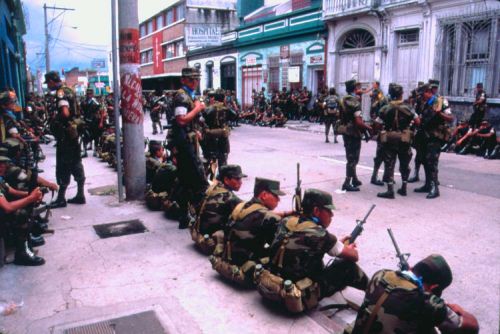
A succession of military presidents followed, and as both protest and repression
became more violent, civil war broke out. Booming industrialization in the 1960s
and '70s helped the rich get richer, while the cities became increasingly squalid
as the rural dispossessed fled the countryside to find urban employment. The
military's violent suppression of antigovernment elements (which meant the majority
of landless peasants) finally led the USA to cut off military assistance, leading
in turn to the 1985 election of the civilian Christian Democrat Marco Vinicio
Cerezo Arévalo.
Arévalo's five years of inconclusive government were followed by Jorge
Serrano Elías, who won the presidency for the conservative Solidarity
Action Movement. His attempts to end the decades-long civil war failed, and
as his popularity declined he came to rely increasingly on military support.
On May 25, 1993, following a series of public protests, Serrano carried out
an auto-coup. Lacking popular support, Serrano fled the country, and an outspoken
critic of the army, Ramiro de León Carpio, was elected by Congress. Carpio's
law-and-order mantle was taken up by new president, Alvaro Enrique Arzú
Irigoyen, who attempted to heal his feuding and crime-ridden country with a
neo-liberal technocratic salve. In December 1996, the government signed a series
of peace accords with leftist guerrillas and the army agreed to reduce its role
in domestic security matters. The greatest challenge to a lasting peace stems
from great inequities in the basic social and economic power structure of Guatemalan
society.
Guatemala swore in a new government January 14, 2000, under its recently elected
right-wing president, Alfonso Portillo. An admitted murderer, Portillo won by
claiming that if he could defend himself, he could defend his people. His main
campaign promise is to shake up the country's armed forces.
| HOME |