A unique aspect of human visual understanding is the ability to
flexibly interpret abstract concepts: acquiring lifted rules
explaining what they symbolize, grounding them across familiar and
unfamiliar contexts, and making predictions or reasoning about
them. While off-the-shelf vision-language models excel at making
literal interpretations of images (e.g., recognizing object
categories such as tree branches), they still struggle to make
sense of such visual abstractions (e.g., how an arrangement of
tree branches may form the walls of a maze). To address this
challenge, we introduce Deep Schema Grounding (DSG), a framework
that leverages explicit structured representations of visual
abstractions for grounding and reasoning. At the core of DSG are
schemas—dependency graph descriptions of abstract concepts
that decompose them into more primitive-level symbols. DSG uses
large language models to extract schemas, then hierarchically
grounds concrete to abstract components of the schema onto images
with vision-language models. The grounded schema is used to
augment visual abstraction understanding. We systematically
evaluate DSG and different methods in reasoning on our new Visual
Abstractions Dataset, which consists of diverse, real-world images
of abstract concepts and corresponding question-answer pairs
labeled by humans. We show that DSG significantly improves the
abstract visual reasoning performance of vision-language models,
and is a step toward human-aligned understanding of visual
abstractions.
Humans possess the remarkable ability to flexibly acquire and
apply abstract concepts when interpreting the concrete world
around us. Consider the concept "maze": our mental model can
interpret mazes constructed with conventional materials (e.g.,
drawn lines) or unconventional ones (e.g., icing), and reason
about mazes across a wide range of configurations and
environments (e.g., in a cardboard box or on a knitted square).
Our goal is to build systems that can make such flexible and
broad generalizations as humans do. This necessitates a
reconsideration of a fundamental question:
what makes a maze look like a maze? A maze is not defined
by concrete visual features such as the specific material of
walls or particular perpendicular intersections, but by lifted
rules over symbols—a plausible model for a maze includes its
layout, the walls, and the designated entry and exit.
Current VLMs often struggle to reason about visual abstractions
at a human level, frequently defaulting to literal
interpretations of images, such as a collection of object
categories. Here, we propose Deep Schema Grounding (DSG), a
framework for models to interpret visual abstractions. At the
core of DSG are schemas—a dependency graph description of
abstract concepts. Schemas characterize common patterns that
humans use to interpret the visual world, generalize efficiently
from limited data, and reason across multiple levels of
abstraction for flexible adaptation. A schema for "helping"
allows us to understand relations between characters in a finger
puppet scene, while a schema for "tic-tac-toe" allows us to play
the game even when the grid is composed of hula hoops instead of
drawn lines. A schema for "maze" makes a maze look like a maze.

Deep Schema Grounding (DSG) explicitly uses schemas generated
by and grounded by large pretrained models to reason about
visual abstractions. Concretely, we model schemas as programs
encoding directed acyclic graphs (DAGs), which decompose an
abstract concept into a set of more concrete visual concepts
as subcomponents. The full framework is composed of three
steps.
1. First, we extract schema definitions of abstract concepts
from a LLM.
2. Next, DSG hierarchically queries a VLM, first grounding
concrete symbols in the DAG (i.e., symbols that do not depend
on the interpretation of other symbols), then using those
symbols as conditions to ground more abstract symbols.
3. Finally, we use the resolved schema, including the
grounding of all its components, as an additional context into
a vision-language model to improve visual reasoning.
Our method is a general framework for abstract concepts that
does not depend on specific models; the LLMs and VLMs used are
interchangeable.
To investigate the capabilities of models in understanding
abstract concepts, we introduce the Visual Abstractions Dataset
(VAD). VAD is a visual question-answering dataset that consists of
diverse, real-world images representing abstract concepts. The
abstract concepts span 4 different categories: strategic concepts
that are characterized by rules and patterns (e.g.,
"tic-tac-toe"), scientific concepts of phenomena that cannot be
visualized in their canonical forms (e.g., "atoms"), social
concepts that are defined by theory-of-mind relations (e.g.,
"deceiving"), and domestic concepts of household objectives that
cannot be directly defined by specific arrangements of objects
(e.g, "table setting for two").
Each image is an instantiation of an abstract concept, and is
paired with questions that probe understanding of the visual
abstraction; for example, "Imagine that the image represents a
maze. What is the player in this maze?" The VAD comprises 540 of
such examples, with answers labeled by 5 human annotators from
Prolific.
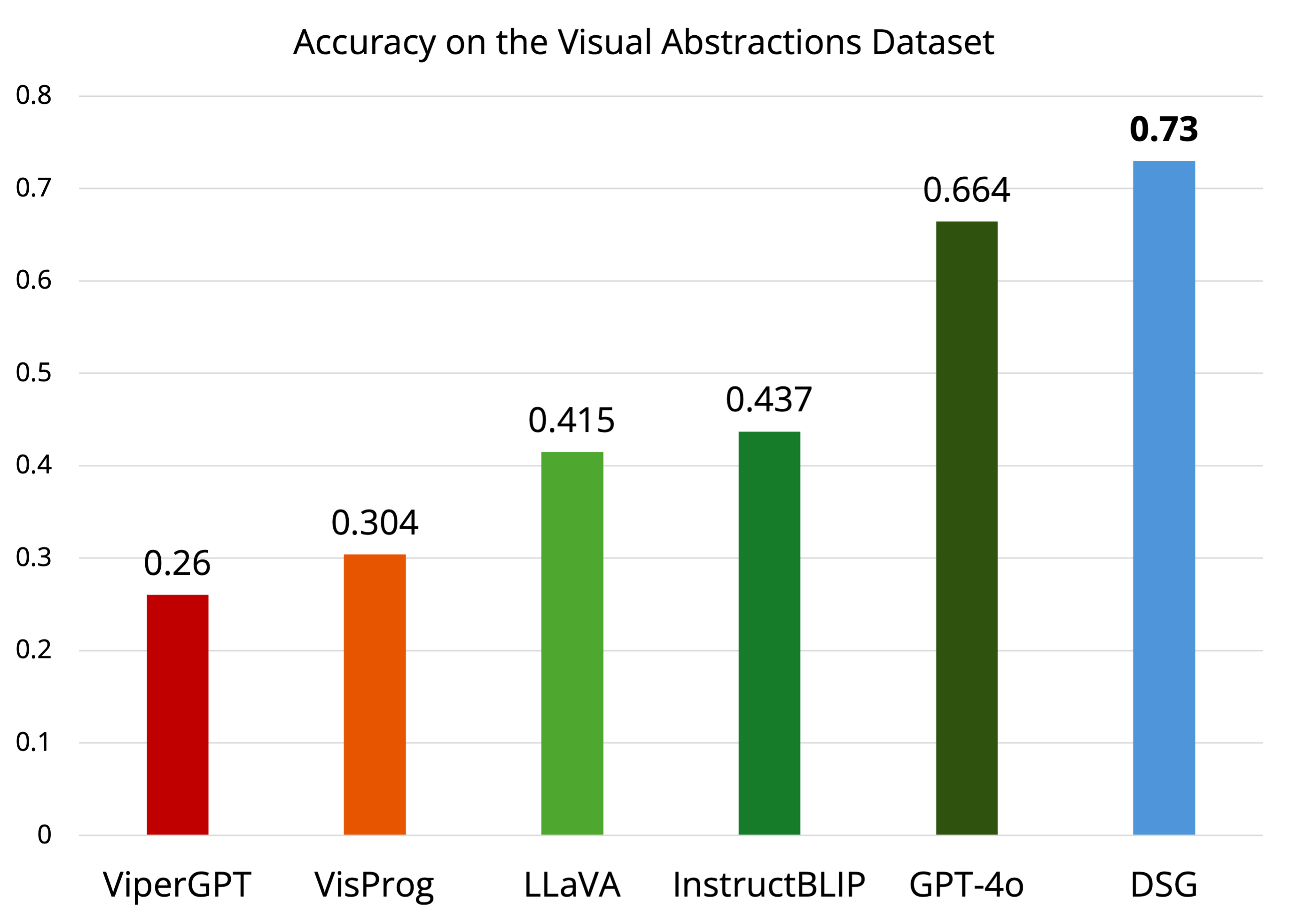
We evaluate Deep Schema Grounding on the Visual Abstractions Dataset, and show that DSG consistently improves performance of vision-language models across question types, abstract concept categories, and base models. Notably, DSG improves GPT-4o by 6.6 percent points overall (↑ 9.9% relative improvement), and, in particular, demonstrates a 10 percent point improvement (↑ 16.6% relative improvement) in questions that involve counting.
Below, we show examples of schemas for concepts across categories in the Visual Abstractions Dataset, as well as the visual features that they may be grounded to.