Assignment 7, Problem 1
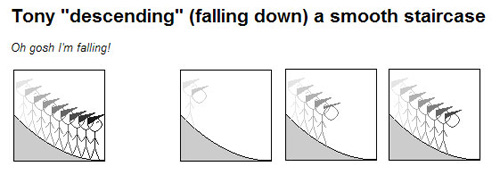
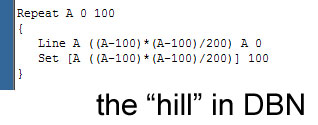
In retrospect, the central characteristic of this assignment is its reliance on mathematical structures: it was the first piece that I created, in which every visible element was defined by a mathematical function. For instance, the "hill" on which the figure stands is a parabola with a vertex at the point (100, 0).
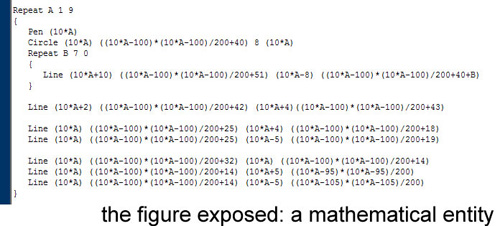
The immediate consequence of this design choice is that the end product possesses a "synthetic" quality that, some may claim, detracts from the "human-quality" of artistic works. It is this complaint that Krauss makes, when she disregards the concept of "painting-by-numbers" as a "parody of art." In works composed of such symmetric and exact components -- with careful inspection, for instance, the viewer will notice that each repetition of the descending figure is perfectly identical to each other (except for the feet) -- the "individual strokes of paint" and "peculiar physiognomy [of the artwork]" that Krauss values as the qualifiers of "art" in the traditional sense can no longer be found.
Was this work successful?
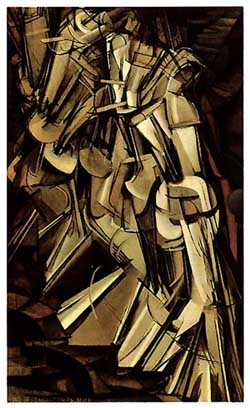
The specific objective of this assignment was to "draw a [self]-portrait in the style of Duchamp." In this respect, Krauss (apparently) would have rejected the work, despite the similarity in content between my work and Duchamp's "Nude descending a staircase, No. 2" (1912). She may even view it as the perfect example of the "painting-by-numbers" parody. In other words, my "coloring-book style" reconstruction of Duchamp's famous piece ultimately fails.
 However, many of my peers in MAS110 believed that my piece "worked."
Lihua, for example, writes: "But, unlike Cubist artists who showed multiple angles of a static object, Duchamp picked a
particular angle showed an object through the passage of time, recording its movement… Tony Hyun Kim's
self portrait of himself running down a hill… [displays] this motion." Likewise, Christine remarks:
although "Tony Kim's Assignment 3, Problem 3, titled 'Tony falling down a smooth staircase'… [is] an
exceedingly abstract work of lines and geometric shapes in which neither a nude figure nor a staircase
is immediately discernable," the work still manages to "include a sense of dynamism" in the style of
Duchamp. And, finally, Moira writes that: the work "captures the same feeling of motion that Duchamp's
"Nude Descending a Staircase (No. 2)" does, using a very similar technique. Kim's use of overlapping,
similar images is very reflective of the style of Duchamp."
However, many of my peers in MAS110 believed that my piece "worked."
Lihua, for example, writes: "But, unlike Cubist artists who showed multiple angles of a static object, Duchamp picked a
particular angle showed an object through the passage of time, recording its movement… Tony Hyun Kim's
self portrait of himself running down a hill… [displays] this motion." Likewise, Christine remarks:
although "Tony Kim's Assignment 3, Problem 3, titled 'Tony falling down a smooth staircase'… [is] an
exceedingly abstract work of lines and geometric shapes in which neither a nude figure nor a staircase
is immediately discernable," the work still manages to "include a sense of dynamism" in the style of
Duchamp. And, finally, Moira writes that: the work "captures the same feeling of motion that Duchamp's
"Nude Descending a Staircase (No. 2)" does, using a very similar technique. Kim's use of overlapping,
similar images is very reflective of the style of Duchamp."
Conclusion
This piece was, by nature, abstract (its components include only edges, circles, simple geometric shapes); yet, it was moderately successful in mimicking an artistic style.
This, in turn, shows that our current views on "art," in contrast to that of Krauss, allow traditional artistic techniques to flourish in digital space.