Impacts of gaps on canopy flow dynamics
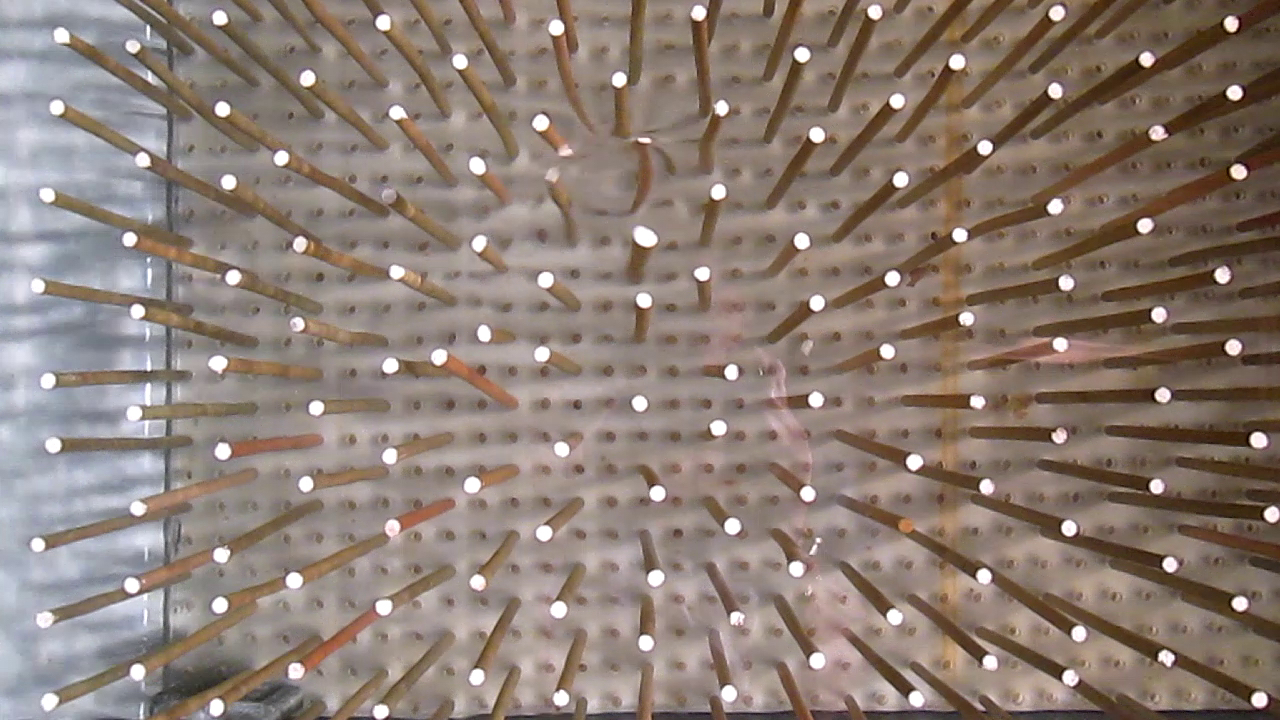
Submerged vegetation canopies are found prevalently in coastal, fluvial, lake and other natural aquatic systems. By exerting drag on the flow, such vegetation formations lead to the formation of ‘canopy flows’, characterized by hydrodynamics analogous to the canonical ‘mixing layer flow’. The video below shows Kelvin-Helmholtz rollers due to such a mixing layer created by the presence of a submerged canopy.
By altering the flow around them, canopies such as seagrass meadows provide ecological services that include, but are not limited to: the mitigation of storm surges; prevention of the erosion of shorelines, the promotion of sediment accumulation by reducing stress near the bed, and the provision of healthy habitats to local biota.
The video below shows the alteration in Kelvin-Helmholtz rollers due to the presence of another canopy patch downstream of the leading canopy with the introduction of a gap between the two.
However, due to both natural and anthropogenic impacts, global canopy formations such as seagrass meadows have been greatly diminished, and many seagrass meadows display patchiness or gaps that persist for several years.
Interruptions of canopies by gaps and patchiness alter the type of canopy flow that characterize these systems with increases in flow velocity and local erosion, and other modifications to mean and turbulent flow characteristics. Furthermore, both the gaps and canopy edges cause a streamwise discontinuity in shear that results not only in momentum readjustment, but also in mixing and restructuring of the turbulence locally. Despite the limited past work studying impact of gaps and trailing (downstream) edges of canopies on the flow, most studies have focused just on the local scale. Therefore, to better understand the impact of such patchiness from local to larger habitat scales, it is crucial to understand how the mean and turbulent flow structures introduced by the gap are propagated, and how they impact non-local canopy regions.
Related publications
- Chung, Hayoon & Mandel, Tracy & Zarama, Francisco & Koseff, Jeffrey. (2021). Local and Non‐local Impacts of Gaps on Submerged Canopy Flow. Water Resources Research. 57. 10.1029/2019WR026915.
- Chung, Hayoon & Koseff, Jeffrey. (2021). Turbulence structure and scales in canopy-wake reattachment. Physical Review Fluids. 6. 10.1103/PhysRevFluids.6.114605.