Transport of Non-Spherical Particles in Wavy Flows
The basic objective of this project is to delineate and mathematically describe the mechanisms by which the mixing and Plastic debris are a relatively new yet persistent environmental pollutant. An enormous amount of used and byproduct plastics end up in marine environments every year; in 2010, for example, an estimated 8 million metric tons of plastic leaked into the world’s oceans. Much of this plastic is less dense than seawater and accumulates near the surface. The rest predominantly settles out and collects on the sea floor. Most marine plastic debris is in the form of small, irregularly-shaped pieces termed “microplastics,” which are typically defined as plastic particles on the order of 5 mm or smaller.
Plastic pollution is seen by governments and global organizations as an extreme threat to both the environment and human health. The World Economic Forum predicts that the mass of plastic in the ocean—currently estimated at 150 million tons—will exceed the mass of fish by 2050. Detrimental health effects to marine organisms that ingest microplastics have been well documented. Microplastics vary widely in their shape, size, and density, all of which will modulate their dynamics and reaction to hydrodynamic forces. They break down over time mainly due to mechanical mixing and UV radiation, both strongest at the ocean’s surface. Therefore, the time history of their position in the water column controls their degradation rate. The near-shore environment is also of interest, as most plastic pollution is land-sourced, and many delicate ecosystems reside near shorelines. The transport of scalars in these environments is controlled by phenomena such as wind waves, turbulence, Langmuir cells, and tidal currents. Published research on microplastics, however, has mainly focused on modeling large scale transport, refining sampling methods, and understanding biological interactions, without applying the powerful research techniques used to characterize other particle-laden flows. Conversely, research on the detailed dynamics of non-spherical particles has focused primarily on either simple laminar shear flows or isotropic turbulence, without consideration of flows of relevance for the microplastics problem. Thus, this proposal addresses the intersection of these two complementary lines of research to make progress on this emerging environmental problem.
 </div> –>
The research objectives of this project are to describe how microplastics are transported locally in the ocean and how they sort based on size and shape. Specifically, we are focused on how non-spherical and (nearly) neutrally-buoyant particles are transported in canonical flows typically present in the ocean surface boundary layer and near-shore environment. Thus, the specific aims of our project are to
1. Identify and classify the mechanisms that control transport and tumbling of anisotropic particles in wavy environments and
2. Quantify the dispersion rate and sorting of these particles in waves.
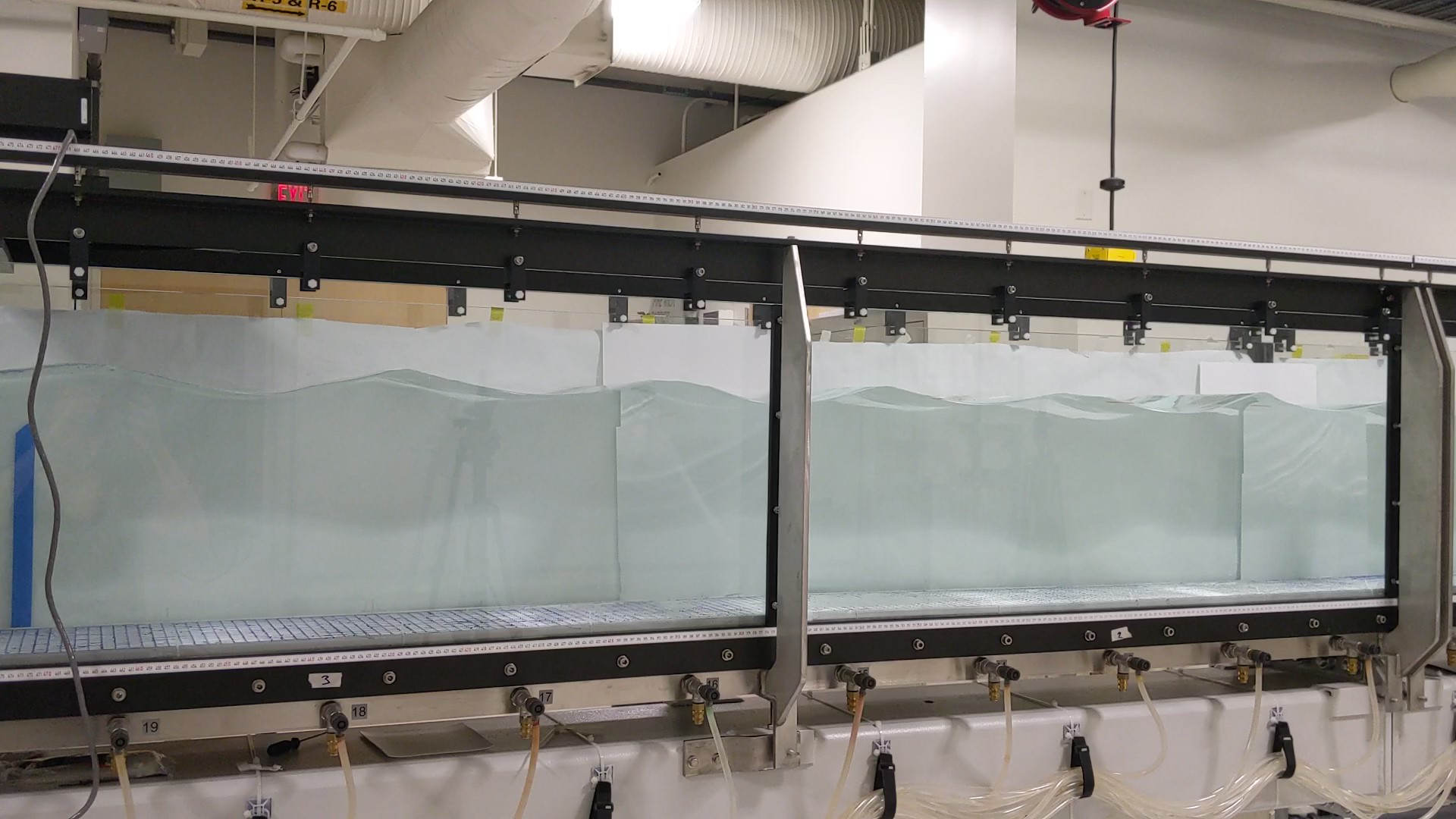
To achieve these aims, we employ a combination of laboratory experiments and empirical modeling to characterize particle transport in idealized wavy flows that are representative of those found in the ocean. This work is structured so as to be relevant to the particular problem of microplastic transport as well as to non-spherical particle-laden flows in general. The primary focus of this work is the explication of the fundamental fluid mechanics associated with the transport of non-spherical particles, but we are also working to translate our research into a solutions-oriented framework to help inform conservation efforts
Related publications
- Clark, Laura & Dibenedetto, Michelle & Ouellette, Nicholas & Koseff, Jeffrey. (2022). Dispersion of finite-size, non-spherical particles by waves and currents. Journal of Fluid Mechanics. 954. 10.1017/jfm.2022.968.
- Dibenedetto, Michelle & Clark, Laura & Pujara, Nimish. (2022). Enhanced settling and dispersion of inertial particles in surface waves. Journal of Fluid Mechanics. 936. 10.1017/jfm.2022.95.
- Clark, Laura & Dibenedetto, Michelle & Ouellette, Nicholas & Koseff, Jeffrey. (2020). Settling of inertial nonspherical particles in wavy flow. Physical Review Fluids. 5. 10.1103/PhysRevFluids.5.124301.