Understanding and Modeling the Effects of Stratification on Turbulence in the Ocean
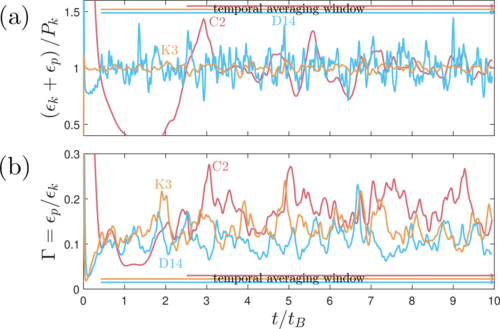
Figure from Yi and Koseff (PRF, 2022): Time series of volume-averaged (a) (εk+εp)/Pk and (b) Γ from simulations. Temporal averaging windows are marked by horizontal lines. Note the marked decay and growth of (εk+εp)/Pk for the constant-A simulation (red) in contrast to the behavior of the constant-k and constant-εk simulations (orange and blue, respectively).
In the ocean thermocline region, direct estimates of vertical fluxes of scalars are generally an order of magnitude smaller than those required to close bulk estimates, suggesting that the majority of the mixing must occur elsewhere, either at boundaries or in under-sampled hot spots in the ocean interior at which mixing rates are considerably higher. Questions regarding ocean energetics and mixing efficiency are especially important in efforts to calculate the ocean state under very different conditions than those existing today, for example, under climate-change scenarios. It is thus crucial to be able to describe small-scale mixing with high accuracy. So why is this specification of the vertical mixing so difficult? A fundamental problem is that the gravitationally influenced vertical component of the turbulent mixing is highly unsteady and inhomogeneous, which, in turn, leads to fundamental measurement and interpretation problems. In the ocean, a mix of essentially quiescent and patchy turbulent regions exists, and the turbulence intensity is highly variable even in the turbulent regions. In the time domain, turbulence intensity can vary from laminar to turbulent and back again.
Vertical, turbulent mixing in the ocean is strongly affected by density stratification behavior that is important to controlling global distributions of water properties as well as ecological functioning of many marine ecosystems. The extent to which turbulent mixing is affected by stratification can be represented by the flux Richardson number, Rif defined by Ivey and Imberger as Rif = B/B+ε, where B is the turbulent buoyancy flux and ε is the rate of dissipation of turbulent kinetic energy (TKE). The expression for Rif is also advantageous in that ε can be measured directly with shear profilers, and B can be estimated from measurement of χ, the rate of dissipation of temperature variance. Nonetheless, for the most part, microstructure-based measurements of ocean mixing have assumed that Rif = 0.2 and computed mixing rates solely from measurements of ε. In a recent review, Gregg et al. argue that in light of the fact that estimates of vertical mixing based on Rif = 0.2 do not differ significantly from what has been inferred from tracer dispersion studies that “…observations should continue to be scaled with 0.2 until observations, laboratory experiments, and numerical simulations converge on a more accurate formulation.” However, this view overlooks the substantial body of evidence that shows that Rif can be substantially less than 0.2 when turbulence is energetic and stratification is weak.
Related publications
- Yi, Paul & Koseff, Jeffrey. (2022). Revised mixing coefficient scaling for sheared stably stratified turbulence. Journal of Fluid Mechanics. 952. 10.1017/jfm.2022.904.
- Yi, Paul & Koseff, Jeffrey. (2022). Dynamics and energetics underlying mixing efficiency in homogeneous stably stratified turbulence. Physical Review Fluids. 7. 10.1103/PhysRevFluids.7.084801.