Effects of internal waves on mixing and transport by gravity currents
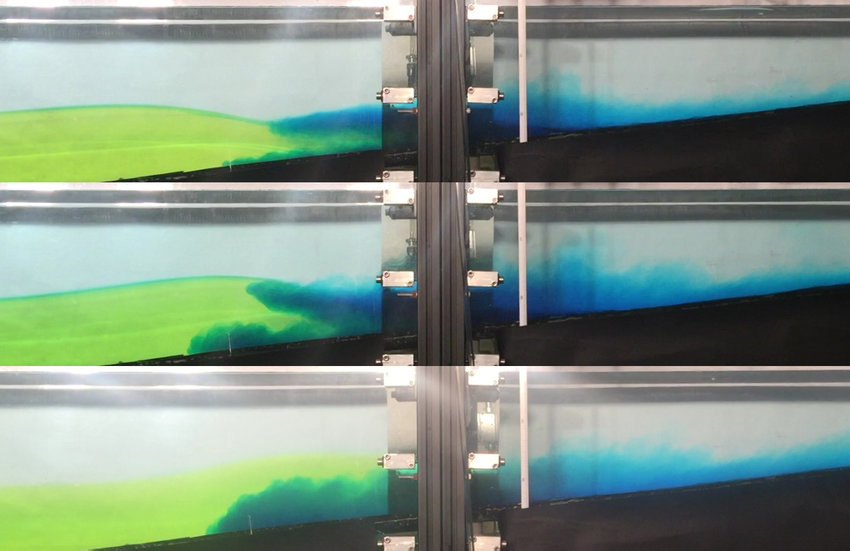
The basic objective of this project is to delineate and mathematically describe the mechanisms by which the mixing and dilution of dense gravity-current underflows down slopes are influenced by oncoming internal gravity waves. This situation arises in many geophysical contexts, and is particularly prevalent in the coastal ocean. But although our understanding of how waves on slopes break and how gravity currents descend through stratified ambient water have independently moved forward considerably in recent years, surprisingly little work has been done to understand the influence of breaking waves on gravity currents.
Gravity currents interact with internal waves in a host of natural settings, such as dense river inflows into lakes, benthic turbidity currents or katabatic winds, and so the results of our project will provide valuable insight into how to model and predict the outcome of these events.
More and more, however, we need to consider the fate of anthropogenic gravity currents in the coastal environment, such as the discharge of brine effluents from seawater desalination facilities. Because of increased global water scarcity governments are increasingly considering the contribution made by desalination as a primary source. Thus, the fate of dense brine effluent from coastal discharges is becoming an increasingly acute issue. The areal extent over which desalination facility brine plumes impact the coastal ocean remains a major uncertainty, particularly because in many coastal oceans where desalination facilities are present or proposed there are energetic internal wave fields which can cause significant mixing. Fundamental understanding of the mixing and transport of the plume in the ambient receiving waters, which typically have strong internal wave action, is critical to predicting the concentrations of brine and chemical additives in the plume and the reduction in oxygen at the sea bed beneath the brine. The research we are conducting will enable the development of predictive tools to determine how natural internal waves will influence these anthropogenic gravity currents, so that they can be better designed, monitored, and operated.
The specific aims of our project are to
- identify and systematically catalog the ways that internal waves can influence the physics of gravity currents, and
- build and validate mathematical models of the mechanisms by which internal waves influence gravity currents.
To achieve these aims, we employ a combination of laboratory experiments, numerical simulations, and theoretical modeling. We have chosen to primarily use laboratory experiments for our work because there is a crucial need for a study that is controllable, repeatable, and focused on the critical interaction phenomena. We also augment our work with theoretical modeling and with three-dimensional numerical simulations to enable us to introduce some of the complexity and scale not present in laboratory experiments into our research plan, and to ensure that our laboratory findings are placed in the proper geophysical context.
Related publications
- Y. Tanimoto, N. T. Ouellette, and J. R. Koseff, “On the interaction between oncoming internal waves and a dense gravity current in a two-layer stratification,” submitted.
- Y. Tanimoto, N. T. Ouellette, and J. R. Koseff, “Secondary generation of breaking internal waves in confined basins by gravity currents,” Journal of Fluid Mechanics 917, A49 (2021).
- Y. Tanimoto, N. T. Ouellette, and J. R. Koseff, “Interaction between an inclined gravity current and a pycnocline in a two-layer stratification,” Journal of Fluid Mechanics 887, A8 (2020).