Abstract
Does language modeling on image-text data truly improve vision, or does it merely adapt visual features for language alignment? Despite rapid progress in multimodal large language models (MLLMs), this question remains poorly understood. We present the first systematic analysis of visual representations in MLLMs by probing popular model families across a broad suite of dense visual tasks and comparing each MLLM to its exact pre-MLLM vision encoder. We find that language modeling largely improves visual representations for semantic tasks but can degrade performance on fine-grained geometric tasks, such as monocular depth. We further show that scaling the language model consistently improves the quality of visual representations. Given the improved MLLM representations, we next examine how to best extract and aggregate these features. Since no single layer provides a universally strong representation and concatenating features across layers is impractical, we propose a lightweight adapter that efficiently combines features across MLLM layers, turning frozen MLLMs into competitive visual backbones. Finally, we study whether MLLM representations can improve downstream applications, including image generation and inverse dynamics modeling, and show that they can outperform pre-MLLM visual features as general-purpose representations. Together, our results provide a representation-centric perspective for understanding and leveraging MLLMs as visual foundation models.
ProbeBench
ProbeBench evaluates MLLMs as visual foundation models by directly probing their visual representations. For each MLLM, we train lightweight task heads on top of frozen features across pipeline stages and on the pre-MLLM vision encoder used for initialization. This setup provides a clean before-versus-after comparison, isolating the visual learning that emerges from MLLM training.
ProbeBench is comprised of five dense visual tasks spanning semantic and geometric capabilities. For every MLLM, we probe at five stages spanning the full pipeline: the vision encoder output (VE), the projector output (Proj), and three LLM layers (Early, Mid, Late). We select four MLLMs: PerceptionLM-8B, SAIL-VL2-8B, LLaVA-OneVision-1.5-8B, and Molmo2-O-7B.
Visual representations are reshaped in task-dependent manner. We find that all four MLLMs improve over their pre-MLLM encoder on segmentation and semantic correspondence for at least one pipeline stage, with the vision encoder often surpassing its initialization. Within geometric tasks the picture is more nuanced: geometric correspondence improves, monocular depth mostly degrades, and surface normals often improve at the vision encoder stage but degrade at subsequent stages.
Finding 1: MLLM training largely improves visual representation quality for semantic tasks, while geometric tasks are more mixed, with depth often degrading.
Pipeline-stage strength varies. For most tasks, we observe that the vision encoder produces the strongest representations, with probed quality often degrading across LLM layers. However, for segmentation we find that for three of four models, the best representations emerge at early-to-mid LLM layers.
Finding 2: Vision encoder features are typically the strongest (often degrading across LLM layers) except for semantic segmentation, which tends to peak at early-to-mid LLM layers.
Impact of Language Model Size
End-to-end MLLM performance scales with language model size. However, the degree to which this scaling behavior reflects improvement in the underlying visual representations versus the LLM's utilization of the pre-trained visual features remains unexplored. For a controlled experiment, we examine model families that hold the vision encoder fixed across multiple language model sizes.
Language model scaling consistently improves visual representation quality. We find that scaling the language model improves probed visual quality across all four families and all five tasks, with gains surprisingly extending upstream to the vision encoder.
Language model size is one of several factors shaping visual representations. While scaling the LM helps within each family, gaps between families at the same parameter count often exceed within-family scaling gains. For instance, PerceptionLM-1B even surpasses every 8B-scale model from the other three families on all tasks except depth.
Finding 3: Scaling the language model directly improves visual representations within each family, though differences across MLLMs often exceed within-family scaling gains.
Towards MLLMs as Effective Visual Backbones
Assessing Synergy of Multi-Stage Features
Can combining features from multiple stages outperform any single layer? Starting from the vision encoder layer that feeds into the LLM, we test (i) adding four earlier ViT layers, (ii) adding the projector output together with three LLM layers, or (iii) combining all of the above.
Multi-stage aggregation can improve performance, but its effects are both stage- and task-dependent. Adding ViT-layer features improves segmentation and surface-normal prediction, but degrades zero-shot correspondence and depth estimation.
Finding 4: Aggregating features across MLLM pipeline stages can outperform vision encoder features alone, but the effect of adding stages is inconsistent.
SLIM: Spatial Latents In MLLMs
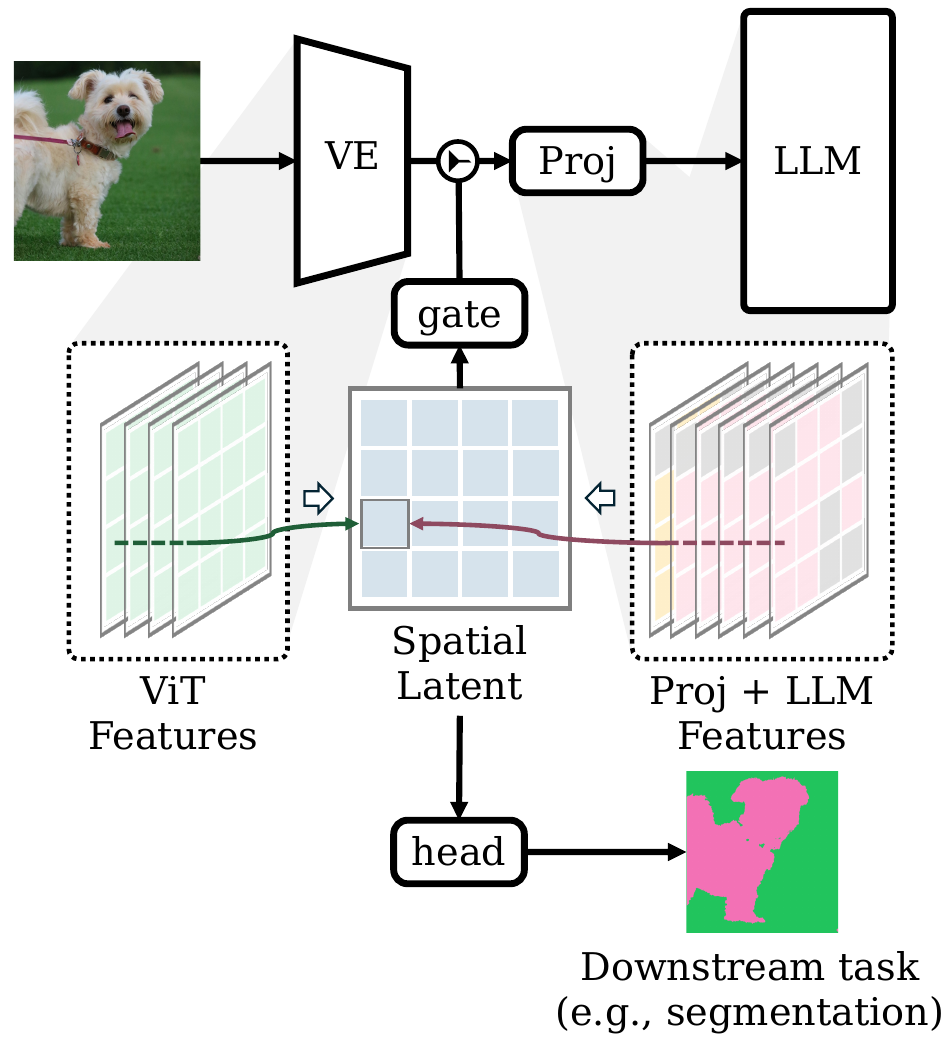
Feature concatenation has three drawbacks that prevent it from serving as a practical visual backbone. First, it requires committing in advance to a specific set of stages. Second, the per-location feature dimension grows linearly with the number of stages. Third, running every spatial position through the full language model is costly in practice.
To resolve these issues, we propose SLIM: a spatial grid of learnable latents that cross-attends to multi-stage MLLM features and adaptively prunes LLM tokens.
Spatial latent grid with per-location cross-attention. At each spatial position, the latent query cross-attends only to features from all stages at that same position. The output is always H×W×D regardless of how many stages contribute, eliminating the dimension blow-up of feature concatenation.
Adaptive depth via gating. Since LLM stages primarily aid semantic features, most positions likely need only low-level ViT features. SLIM exploits this with a learned gate that scores each spatial position. At inference, pruned tokens are physically removed from the LLM forward pass, giving compute savings proportional to the prune rate.
| Sem. Seg.ADE20K ↑ | Sem. Corr.SPair ↑ | Geom. Corr.NAVI ↑ | NormalsNYUv2 ↓ | DepthNYUv2 ↓ | |
|---|---|---|---|---|---|
| General-purpose vision encoders | |||||
| SigLIP2 g/16 | 41.0 | 58.7 | 45.7 | 31.4 | 0.378 |
| Web-SSL DINO 7B | 40.0 | 62.4 | 51.7 | 29.6 | 0.314 |
| DINOv3 7B | 53.2 | 74.7 | 58.0 | 28.4 | 0.295 |
| PerceptionLM-8B | |||||
| Pre-MLLM VE | 39.9 | 46.0 | 43.1 | 31.1 | 0.321 |
| MLLM best stage | 45.8 | 57.7 | 46.0 | 29.5 | 0.355 |
| SLIM (ungated) | 50.9 +5.1 | 60.5 +2.8 | 48.2 +2.2 | 28.9 −0.6 | 0.336 −0.02 |
| SLIM (pruned) | 50.6 60% | 61.2 75% | 45.9 84% | 28.8 65% | 0.353 100% |
| SAIL-VL2-8B | |||||
| Pre-MLLM VE | 34.3 | 37.4 | 38.1 | 33.8 | 0.398 |
| MLLM best stage | 38.8 | 48.4 | 42.4 | 32.9 | 0.426 |
| SLIM (ungated) | 48.5 +9.7 | 50.5 +2.0 | 43.6 +1.2 | 31.1 −1.8 | 0.395 −0.03 |
| SLIM (pruned) | 48.2 58% | 50.2 73% | 42.7 82% | 31.5 97% | 0.377 99.8% |
| LLaVA-OneVision-1.5-8B | |||||
| Pre-MLLM VE | 38.8 | 41.7 | 39.3 | 36.0 | 0.426 |
| MLLM best stage | 42.4 | 49.8 | 42.9 | 32.5 | 0.373 |
| SLIM (ungated) | 49.5 +7.2 | 55.4 +5.6 | 45.7 +2.8 | 30.1 −2.4 | 0.337 −0.04 |
| SLIM (pruned) | 49.3 58% | 56.4 64% | 45.9 75% | 30.4 100% | 0.344 100% |
Without pruning, SLIM substantially outperforms the oracle best individual MLLM stage in every setting across all three models and five tasks. With our learned per-position gate enabled, SLIM still beats the oracle best stage in 14 of 15 settings with little loss in quality, even when most LLM tokens are pruned.
Comparison with general-purpose vision encoders. The strongest SLIM setup using PerceptionLM features surpasses SigLIP2 on all five tasks. While it is still outperformed by DINOv3, SLIM narrows the gap relative to the best individual MLLM stage on every task.
Finding 5: SLIM demonstrates a strong ability to aggregate features across MLLM stages while doing so efficiently, charting a path forward for using MLLMs as visual backbones.
MLLM Use in Downstream Systems
We now consider how these features can serve as backbones for more complex downstream applications. We focus on two case studies: image generation and inverse dynamics modeling (IDM).

Image generation. We adopt the Representation Autoencoder (RAE) framework. We compare PE-Core-L and the vision encoder of PerceptionLM-3B (PLM-VE), which is initialized from PE-Core-L and further trained end-to-end as part of the MLLM. The PLM-VE RAE reaches a stronger reconstruction FID (rFID 4.03 vs. 5.23 for PE-Core), and this advantage carries into generation, converging to 23.7 vs. 26.8 gFID at epoch 80.
Inverse dynamics modeling. We use the Minecraft VPT setting, predicting the action sequence that produced an observed video. The pipeline-stage profile of PerceptionLM-8B closely mirrors what we observed for many ProbeBench tasks: the vision encoder scores above its pre-MLLM initialization (+1.8 mean AUROC), while features degrade inside the LLM in mid and late layers.
Finding 6: MLLM features show promise as backbones for image generation, and their pipeline-stage trends on inverse dynamics modeling mirror those observed in ProbeBench.
Conclusion
In this work, we take a representation-centric view of MLLMs and show that language modeling on image-text data does more than align visual features with language: it substantially reshapes the visual representations themselves. Through ProbeBench, we find that MLLM training, particularly with larger language models, generally strengthens semantic visual capabilities. Together, these findings suggest that MLLMs should be understood not only as language interfaces for visual reasoning, but also as emerging visual foundation models whose representations can be studied, extracted, and leveraged in their own right.