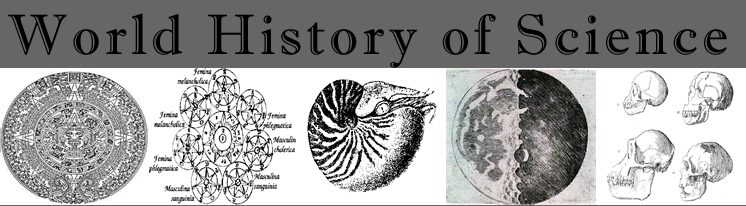
World History of Science:
From Prehistory through the Present
IHUM 6a Winter 2008
Prof. Robert N. Proctor (rproctor@stanford.edu)
Tues-Thurs 1:15-2:05 Annenberg Auditorium
What are the oldest scientific discoveries of humans? Knowledge of the stars? Medicinal plants? Our own mortality? How have people in different parts of the world come to know the natural world, and what does this tell us about the history of science more generally?
The purpose of this course is to trace the broad sweep of global science, from the prehistoric roots of the oldest known technologies through the mega-events of the Scientific Revolution, global voyaging, and recent triumphs in the physical and life sciences. We begin with theories of human origins and the oldest known tools and symbols, especially those found in Africa, following which we turn to achievements of the Maya, Aztecs, and native North Americans (calendrical astronomy, paleobotany, metallurgy, mathematical nomenclature, etc.). Science and medicine in the ancient worlds of the Mediterranean will be the focus of several lectures, following which we’ll look at the sciences of early China, Africa, medieval Europe, and the Islamic world, along with challenges to traditional cosmologies in Copernicus, Galileo, and Newton.
Whereas the first quarter concentrates more on prehistory and cosmology, the second focuses more on the life sciences since the Scientific Revolution. We begin with an exploration of how 16th-18th century voyages of discovery transformed (especially European) knowledge, as people tried to understand and exploit new kinds of animals, plants, and minerals in the New World, Africa, and Asia. Some attention is given to Enlightenment philosophies of the eighteenth century and the chemical revolution, following which we turn to early theories of fossils, the nineteenth century discovery of “deep time,” debates over extinction vs. evolution (Cuvier vs. Lamarck), and the uniformitarianism triumphant in Lyell’s geology and Darwin’s theory of evolution. A final section looks at the twentieth century’s revolutionary understandings of matter, life and the cosmos, with particular attention to the impact of the First and Second World Wars, computerization, the molecular understanding of life, and ethical challenges raised by the abuses of Nazi racial science, the Scopes Trial and creationism, tobacco industry agnotology, global climate change and threats to biodiversity.
Our focus throughout will be global, recognizing that history is always profoundly and unavoidably selective. The overarching theme will be to explore how science transforms—and is transformed by—human engagements with technology, religion, art, politics, and moral values.
Teaching Fellows Section # Time
Joann Kleinneiur 14 WF 11:00-11:50a
(joannk@stanford.edu) 15 WF 2:15-3:05p
16 WF 3:15-4:05p
Molly McCarthy 2 TTh 3:15-4:05p
(mollym1@stanford.edu) 3 TTh 4:15-5:05p
4 TTh 5:15-6:05p
Mark Sander 11 TTh 3:15-4:05p
(sanderm@stanford) 12 WF 10:00-10:50a
13 WF 1:15-2:05p
Melissa Stevenson 5 WF 9-9:50a
(melissas@leland.stanford.edu) 6 WF 10-10:50a
7 WF 11-11:50a
Gabriel K. Wolfenstein 8 TTh 3:15-4:05p
(gkw@stanford.edu) 9 TTh 4:15-5:05p
Course Coordinator, Winter & Spring 10 TTh 6:00-6:50p
Course Goals:
The goals of winter/spring IHUM courses are the following: to introduce students in a sustained way to a body of material in a specific discipline; to hone the reading, analytical, and critical thinking skills begun in fall quarter; and to continue to develop college-level argumentation skills, both oral and written.
Course Wiki: http://worldhistoryofscience2008.pbwiki.com (password ihum6ab)
Required Texts:
Course reader. Available through Field Copy’s (for sale after class during the first week and in
the basement of Lane during Weeks 1 & 2.)
Francis Bacon. Selected Philosophical Works. Ed. Rose-Mary Sargent. Hackett, 1999.
Rene Descartes. Discourse on Method, Optics, Geometry, and Meteorology. Hackett, 2001.
Jared Diamond. Guns, Germs, and Steel: The Fates of Human Societies. Norton, 1999.
Stephen Jay Gould. Wonderful Life. Chicago: University of Chicago Press, 1989.
Galileo Galilei. Sidereus Nuncias, or the Sidereal Messenger
Londa Schiebinger. The Mind Has No Sex? Cambridge: Harvard University Press, 1989.
Schedule
WINTER QUARTER
( ** = Found in the Course Reader)
Week 1: Introduction
Jan. 8 Tues: What is History? What is Science?
Jan. 10 Thurs: Human Origins
Stephen Jay Gould, Wonderful Life, pp. 23-52
**Thomas Kuhn, “The Function of Dogma in Scientific Research”
Week 2: Prehistoric Science and Technology
Jan. 15 Tues: Human Origins and the Earliest Tools
**Elaine Morgan, Descent of Woman
Jan. 17 Thurs: Acheulean Handaxes: What were they used for? Guest Demo: Ian Robertson
Jared Diamond, Guns, Germs and Steel (pp. 9-52)
**Kafka, “Report to an Academy”
Film night: Quest for Fire! Time TBA
Week 3: Prehistoric Science and Technology cont.
Jan. 22 Tues: Paleolithic Astronomy
Jared Diamond, Guns Germs and Steel (pp. 83-156, 403-26)
Jan. 24 Thurs: Mesoamerican Math and Paleoastronomy
Film: The Sundagger
Week 4: Science in the Ancient Mediterranean World
Jan. 29 Tues: Mesopotamian Life and Science
**Plato, Timaeus (selections)
Jan. 31 Thurs: Presocratic and Socratic Philosophy
**Plato, The Allegory of the Cave
Week 5: Ancient Science and Medieval Science
Feb. 5 Tues: Aristotelian Philosophy and Ptolomaic Astronomy
**Aristotle, Physics, Book 8
Feb. 7 Thurs: Galenic Medicine
**Hippocratic oath(s)
*Paper #1 due Monday, February 11*
Week 6: Middle Eastern Science and the Islamic World
Feb. 12 Tues: Science in Arabia, India, and the Islamic World
**Ibn Sina, Canon of Medicine, selections
Feb. 14 Thurs: Magical and Alchemical Traditions
Ibn Khaldun, The Muquaddimah, selections (found on wiki and Coursework)
Week 7: Eastern Science and Medicine
Feb. 19 Tues: Gunpowder, Printing, the Compass, and other Chinese Wonders
**Yellow Emperor’s Classic of Medicine
Feb. 21 Thurs: Chinese Medicine and Philosophy
**Yellow Emperor’s Classic. cont.
Discussion of Research Papers
Week 8: Renaissance Science
Feb. 26 Tues: Leonardo’s World – Guest lecture: Prof. Paula Findlen
**Stephen Jay Gould, “Leonardo’s Mountain of Clams and the Diet of Worms”
**Pico della Mirandola, “Oration of the Dignity of Man”;
**Jonathan Swift, Gulliver’s Travels, selections
Feb. 28 Thurs: Copernicus, Giordano Bruno, Galileo and the Heliocentric Universe
Galileo, Sidereus Nuncias, selections
Week 9: The Scientific Revolution
Mar. 4 Tues: Bacon’s New Method
Francis Bacon, Novum Organon
Mar. 6 Thurs: The Cartesian Method
Descartes, Discourse on Method
*Paper #2 due Monday, March 10*
Week 10: The Modern Cosmos
Mar. 11 Tues: Newton’s Calculus
Londa Schiebinger, The Mind Has No Sex, pp. 1-101, 265-277.
Mar. 13 Thurs: Recent Controversies
March 20 3:30-6:30 FINAL EXAM
* Please note that if you are in a Wed/Fri section, then the reading assignment for Tuesday applies to Wednesday and the reading assignment for Thursday applies to Friday.
Course Policies: Course communications & email etiquette: various course announcements and materials will be sent via email and/or be available on the course website. It will be assumed that students have ready web access and will check email regularly; please advise your section leader if you anticipate any difficulties. Although section leaders and faculty may encourage email communication from students, be sure to allow adequate time for a response (i.e. at least 24 hours on weekdays); it’s advisable to limit such email communications to the important and/or necessary (i.e. “what did I miss today” is best directed to another student in the course).
Attendance at lectures and seminars is required, and absences will cause your grade to suffer. The IHUM Attendance Policy states the following: More than two section absences will severely affect a student’s participation grade. If a student has a prolonged illness, varsity athletic competitions, or a personal situation that might lead to more than two absences, the student should contact his or her Teaching Fellow before missing section. Under certain conditions (such as varsity athletic competitions or prolonged illness), a student may be provided an opportunity to make up the work missed in section. Note: insufficient section attendance will result in failure of the course.
Late work is similarly subject to penalization and, in some cases, may require make-up work. All major (graded) written assignments are due on coursework on or before the specified due date; hard copies should be turned in to your section leaders in your regularly scheduled sections or as otherwise specified. It is expected that students will complete all required assignments. Late assignments are subject to penalization of 1/3 of a grade per day late.
Grading:
Paper 1 (5-6 pages) 20% Due February 11 at 11:00 AM
Paper 2 (6-7 pages) 25% Due March 10 at 11:00 AM
Final Exam 30% Mar. 20 3:30-6:30 PM
Class Participation 25%
Note: Failure to complete any one assignment will result in a failing grade for the quarter.
Grading Guidelines: Essays: IHUM courses foster rigorous inquiry and critical thinking and promote effective written argumentation.
A range: This paper is outstanding in form and content. The thesis is clear and insightful; it is original, or it expands in a new way on ideas presented in the course. The evidence presented in support of the argument is carefully chosen and deftly handled. The argument is not only unified and coherent, but also complex and nuanced.
B range: This paper’s thesis is clear; the argument is coherent and presents evidence in support of its points. The argument shows comprehension of the material and manifests critical thinking about the issues raised in the course. The paper is reasonably well written and proofread. The argument, while coherent, does not have the complexity, the insight, or the integrated structure of an A range paper.
C range: This paper has some but not all of the basic components of an argumentative essay (i.e., thesis, evidence, coherent structure): for example, it may offer a thesis of some kind, but it presents no evidence to support this thesis; or it may present an incoherent thesis; or it may simply repeat points made in class without an overall argument. Such a paper is usually poorly organized, written and proofread.
A paper lacking more than one of the basic components of an argumentative essay will earn a grade of “D” or below.
Section Participation: IHUM courses are mandated to encourage vigorous intellectual exchange, the expression of various viewpoints, and the ability to speak effectively and cogently. Participation in discussion will be evaluated on the following guidelines, which stress the quality rather than the mere quantity of contributions to discussion.
A range: The student is fully engaged and highly motivated. This student is well prepared, having read the assigned texts, and has thought carefully about the texts’ relation to issues raised in lecture and section. This student’s ideas and questions are substantive (either constructive or critical); they stimulate class discussions. This student listens and responds to the contributions of other students.
B range: The student attends participates consistently in discussion. This student comes to section well
prepared and contributes quite regularly by sharing thoughts and questions that show insight and a familiarity with the material. This student refers to the materials discussed in lecture and shows interest in other students’ contributions.
C range: The student meets the basic requirements of section participation. This student is usually prepared
and participates once in a while but not regularly. This student’s contributions relate to the texts and the
lectures and offer a few insightful ideas but do not help to build a coherent and productive discussion.
Failure to fulfill satisfactorily any of the criteria for C-range participation will result in a grade of “D” or below.
Resources:
Stanford Writing Center (Building 460, Room 20) does not offer editing services but rather help for your overall writing skills in one-to-one conferences and writing workshops. Make appointments online at:
http://swc.stanford.edu
Stanford’s Center for Teaching and Learning (4th Floor, Sweet Hall, ctl.stanford.edu) provides a wide variety
of resources for students including tutors, workshops.
Provost’s Statement concerning students with disabilities:
Students who have a disability that may necessitate an academic accommodation or the use of auxiliary aids and services in a class, must initiate the request with the Student Disability Resource Center (SDRC), located within the Office of Accessible Education (OAE). The SDRC will evaluate the request with required documentation, recommend appropriate accommodation, and prepare a verification letter dated in the current academic term in which the request is being made. Please contact the SDRC as soon as possible; timely notice is needed to arrange for appropriate accommodations. The Office of Accessible Education is located at 563 Salvatierra Walk (phone 723-1066; TDD 725-1067).
∞ Syllabus subject to change