

Ethics in Medicine
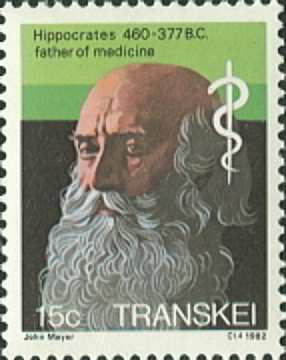
Hippocrates (link)
Referred to as the "father of medicine" in recognition of his lasting contributions to the field as the founder of the Hippocratic school of medicine. This intellectual school revolutionized medicine in ancient Greece, establishing it as a discipline distinct from other fields that it had traditionally been associated with (notably theurgy and philosophy), thus making medicine a profession.
 iLearn
|
Course Objectives
The focus of this course is on you and your ethical decision making. Some people think of ethics as intensely personal. Others think of it as powerfully interpersonal. We will explore both these dimensions of being ethical. But whether you characterize ethical decisions as subjective or objective, you cannot avoid the need to engage in such decisions, especially if you become involved in our health care system. Ethical issues arise for patients, for their families, for health care professionals who treat them, for other professionals who offer support services, for employers who select health care insurance plans, for insurers who decide what coverage to offer, for researchers, and for government policy makers. In how many of these roles do you see yourself - in your past, in your life now, in your future? What values should guide you if you assume or are thrust into any of these roles? What values would you want others to adopt if their role(s) in the health care process interact with your own? Our conversations in this course will be held with a view toward enriching, extending and deepening your own thoughts about such important ethical questions as:
An important objective of the course is to introduce you to historical and philosophical perspectives on the development of new knowledge in biological science and the application of this knowledge in medicine. We will see how such knowledge has opened up possibilities that challenge and change some of the concepts most fundamental to our culture. In this regard, we will, for example, see how better understanding of circulatory and neurological systems, and of the mechanisms of organ transplant, has changed our definitions of life and death. We will learn about the medical progress during the last quarter century that facilitates human reproduction. We will consider whether this technology has altered our concepts of the family and the human life cycle. We will learn about the progress made in genomics and will debate whether genomics challenges and changes our conceptualizations of humans and human society. We will ask whether there is a bright line between natural and nurtured (that is, socially acquired) human characteristics. We also will ask whether there is a bright line between anomalous and pathological biological conditions. We will explore how medical engineering has altered disability policy. We will become familiar with the ethics of research on human subjects, especially on members of vulnerable populations. We will understand and appreciate the ways in which the perspectives of population biology illuminate policy discussions about health care justice. This course will familiarize you with moral theories (including theories of justice, feminist ethics of care, communitarianism, and the values of various spiritual traditions) that influence clinical decision making. The course will help you understand, articulate and apply these theories to your own conduct. It also will help you communicate with others about these matters. You will gain experience in researching facts about patients' medical conditions as they present in the cases you will analyze. You will learn how to use information gained from different sources to understand the patient's prognosis and options. You will know how to identify ways in which cultural, social, and economic influences affect patient outcomes. You will become able to articulate patients' and health care professionals' options and to assess the ethical concerns that arise in regard to each option. In respect to your personal development, the course has triplet goals. Your active learning in this course should develop:
|