Optimization of micron-size pixels in solid-state image sensors (VIS/near-IR)
My research on image sensing focuses on accurate modeling of light-matter interaction and the consequences of fundamental light properties on solid-state image sensor performance as image sensor technology scales.
The majority of solid-state image sensors are being fabricated in complementary metal oxide semiconductor (CMOS) technology. The steady progress in CMOS image sensor technology development can be measured by the steady increase in pixel count. The increase has been achieved by Moore ’s law which permits a regular decrease in pixel size. Increasing pixel count has the clear benefits of reducing cost and allowing integration of image sensors into small mobile devices where the form factor is limited (e.g., cell phones and PDAs). The issues involved in pixel scaling, however, differ from the general issue of technology scaling. Sensors must interact with light, and the properties of light do not scale. For example, the amount of light (irradiance) available at the image plane does not scale with pixel size.
.gif)
The figure measures the number of incident photons that can be captured by an ideal pixel (100% fill-factor, 100% quantum efficiency; no pixel induced noise); it also defines an upper bound on the pixel signal quality. Any loss of light due to scattering, imperfect detector quantum efficiency, the presence of color filters, incomplete fill-factor, will decrease the number of photon absorptions and decrease signal quality. In this research I apply advanced optical modeling techniques to analyze the optical path of CMOS image sensor pixels.
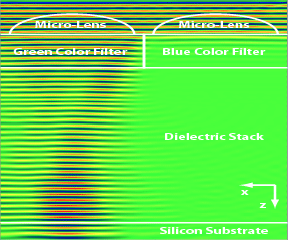
In older image sensor technologies, a geometrical optics analysis typically sufficed; but as technology scales and pixel elements become commensurate with the wavelength of light, more sophisticated modeling is required to achieve accurate results. Electromagnetic field modeling of the light incident on image sensor pixels more appropriately describes the light-matter interaction inside a pixel. Since the electromagnetic field distribution the pixel has a strong and direct influence on sensor performance and image quality, our approach offers the possibility of optimizing the design by modifications to the geometric and material parameters. This research is crucial to the continued development in the field of image sensing. In addition, it can be easily extended to any field in which light interacts with nano-size electronic integrated circuits, e.g., on-chip optical interconnects.
Featured publications:
- (Invited) , "Nanophotonics for CMOS image sensors," Proc. OSA Optics & Photonics Congress on Imaging Systems (IS) '10, 2010.
- Y. Huo, C. C. Fesenmaier, and , "Microlens performance limits in sub-2μm pixel CMOS image sensors," Opt. Express 18, 5861, 2010.
- C. C. Fesenmaier, Y. Huo, and , "Effects of imaging lens f-number on sub-2 μm CMOS image sensor pixel performance," Proc. SPIE Int. Soc. Opt. Eng. 7250, 72500G, 2009.
- (ISI Cited 9 times) C. C. Fesenmaier, Y. Huo, and , "Optical confinement methods for continued scaling of CMOS image sensor pixels," Opt. Express 16, 20457, 2008.
(Featured as World News in Laser Focus World, February 2009)
- C. C. Fesenmaier and , "Mitigation of pixel scaling effects in CMOS image sensors," Proc. SPIE Int. Soc. Opt. Eng. 6817, 681704, 2008.
- and B. A. Wandell, "Roadmap for CMOS image sensors: Moore meets Planck and Sommerfeld," Proc. SPIE Int. Soc. Opt. Eng. 5678, 1, 2005. [pdf]