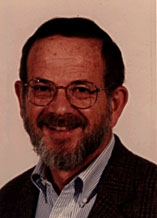
Richard W. Cottle
Professor,A.B., Mathematics, Harvard, 1957
A.M., Mathematics, Harvard, 1958
Ph.D., Mathematics, UC Berkeley, 1964
OR Department Chairman, 1990-96
At Stanford since 1966
|
|
Richard W. CottleProfessor,A.B., Mathematics, Harvard, 1957 A.M., Mathematics, Harvard, 1958 Ph.D., Mathematics, UC Berkeley, 1964 OR Department Chairman, 1990-96 At Stanford since 1966 |
The following biographical material appears as a dedication in Computational Optimization and Applications 5, 95-96 (1996). It is reproduced here with the kind permission of the publisher Kluwer Academic Publishers, The Netherlands.
Richard W. (Dick) Cottle was born in Chicago in 1934. He received his elementary and high school education in the neighboring village of Oak Park. Dick enrolled at Harvard College to take up political science and premedical studies in order to become a physician (or possibly a foreign service officer if that didn't work out). As it happened, both of these alternatives were abandoned because he was strongly attracted to mathematics and ultimately received his bachelor's degree in that field. He stayed on at Harvard and received the master's degree in mathematics in 1958. This was the Sputnik era, and Dick was moved by a passion to teach secondary-level mathematics. In the first of a series of fateful decisions, he joined the Mathematics Department at the Middlesex School in Concord, Massachusetts where for two years he taught grades 7-12. Midway through this period he married his wife Suzanne (Sue). At this time he began to think of returning to graduate school for a doctorate in mathematics. He decided to study geometry at the University of California at Berkeley and was admitted there. Just before leaving Middlesex, Dick received a telephone call from the Radiation Laboratory at Berkeley offering him the part- time job as a computer programmer for which he had applied. Through this job, he became aware of linear and quadratic programming and the contributions of George Dantzig and Philip Wolfe. Before long, Dick left the Rad Lab to join Dantzig's team at the Operations Research Center at UC Berkeley.
Under the tutelage of George Dantzig (and the late Edmund Eisenberg), Dick developed a symmetric duality theory and what was then called the "composite problem". These topics along with a reëxamination of the Fritz John conditions, formed the core of his doctoral dissertation. The composite problem involved a fusion of the primal and dual first-order optimality conditions. It was realized that the resulting inequality system could be studied without reference to the primal-dual structure out of which it was born. The name "complementarity problem" was suggested by Dick and introduced in a joint paper with Habetler and Lemke. After Berkeley, Dick's work took two closely related directions. One was the study of quadratic programming; the other was what we now call "linear complementarity". The interesting role played by classes of matrices in both these areas has always held a special fascination for Dick. In quadratic programming, for instance, with Jacques Ferland he obtained characterizations of quasi- and pseudo-convexity of quadratic functions. Dick (and others) were quick to recognize the importance of matrix classes in linear complementarity theory. It was he who proposed the name "copositive-plus" for a matrix class that arose in Lemke's seminal paper of 1965. The name first appeared in the classic paper of Cottle and Dantzig called "Complementary Pivot Theory of Mathematical Programming". The subjects of quadratic programming and linear complementarity (and the associated matrix theory) remain central to his research interests.
Upon completion of his studies in Berkeley, Dick spent two years as a Member of the Technical Staff at Bell Telephone Laboratories in Holmdel, New Jersey. In 1966 he returned to California to join the Department of Operations Research at Stanford University and has remained there ever since. Dick's professional life has involved a considerable amount of editorial work. He has served on several editiorial boards and was Editor-In- Chief of Mathematical Programming from 1980 to 1986. He is editor or co-editor of eight books and is presently working on a ninth 1. With his former students Jong-Shi Pang and Richard E. Stone, he wrote The Linear Complementarity Problem, a book that was eighteen years in the making. On October 31, 1995, Cottle was awarded the prestigious Lanchaster Prize of the Institute for Operations Research and the Management Sciences (INFORMS), jointly with Jong-Shi Pang and Richard E. Stone, for this book. Dick received the U.S. Senior Scientist Award from the Alexander von Humboldt Foundation in Bonn, Germany, and during the 1978-79 academic year he spent a sabbatical leave at the University of Bonn and the University of Cologne. Since September 1990, Dick has served as chairman of the Department of Operations Research at Stanford 2.
Dick and Sue Cottle have two children, Corinne and David who also live in the San Francisco Bay Area. The Cottles are lovers of classical music and jazz. Dick's principal hobby is woodworking for which he hopes to make more time in the not-too-distant future.
O. L. Mangasarian
Notes