Survey papers
Krautkraemer, Jeffrey A. (1998) Nonrenewable Resource Scarcity, Journal of Economic Literature, Vol. 36, No. 4., pp. 2065-2107.
A very good place to start: Jeffrey Krautkraemer provides a relatively recent survey of the Hotelling model, its applications and empirical evaluation. He also has a number of charts on the real price processes of depletable resources (though the links below are probably better.) I owe much to Krautkraemer in the review that follows.
Devarajan, Shantayanan and Anthony C. Fisher (1981) “Hotelling’s “Economics of Exhaustible Resources”: Fifty Years Later Journal of Economic Literature, 19:1, pg65-73.
An older survey with a little more detail on the work of the first half-century.
Theoretical papers
Harold Hotelling (1931) The Economics of Exhaustible Resources The Journal of Political Economy, Vol. 39, No. 2., pp. 137-175.
The shadow price of the resource stock should rise at the discount rate.The paper that started it all-- just in case you want to refer back!
Sweeney, James L.(1977) Economics of Depletable Resources: Market Forces and Intertemporal Bias The Review of Economic Studies, Vol. 44, No. 1., pp. 125-141.
Sweeney compares the depletion rate that solves the social planner's problem to the rate that emerges from a decentralised market with different policy features. Broadly, he finds that in a competitive market with a discount rate on future monetary flows that matches that on capital investment, socially optimal depletion levels can be sustained. He finds however, that percentage depletion allowances (a la current US policy) and non-internalised externalities (the bane of the environmental economist!) in general lead to current over-extraction. Monopolistic prices have an ambiguous effect on depletion depending on the growth rate of demand.
Pindyck, Robert S. (1978) The Optimal Exploration and Production of Nonrenewable Resources The Journal of Political Economy, Vol. 86, No. 5., pp. 841-861.
This paper is the progenitor of the U-shaped resource price path
theory, used to rescue to Hotelling's principle from the empirical
evidence. Pindyck points out that when the amount of increase in reserves
from exploration is certain, then exploration may aid in decreasing unit
extraction costs. If reserves are initially low or extraction costly, prices
will be high, and exploration will take place. This will result in the
accumulation of reserves.This will in turn reduce extraction costs and,
with stable demand, price will rise.
Over time, however, as reserves accumulate, they
will also depress incentives for further exploration, while lower extraction
costs will concurrently lead to a greater rate of overall depletion of
the resource.The result will be an eventual rise in the price of resource
a la Hotelling.
If exploration outcomes are uncertain, a number of possible price paths can occur, including a saw-tooth pattern (Dasgupta and Heal,1979 and Arrow and Chang 1982) where the price declines during periods in which exploration is successful. Forward-looking agents whose expectations on exploration outcomes are adaptive may also generate a number of price paths, including a general downward trend. (Van Quyen 1991.) Other reasons for differences in price path may result from differences in ore quality (e.g. Sweeney 1993.)
Y. Hossein Farzin (1984) The Effect of the Discount Rate on Depletion of Exhaustible Resources The Journal of Political Economy, Vol. 92, No. 5., pp. 841-851.
This paper argues that an increase in the interest rate operates in
two ways. The traditional Hotelling effect operates by lowering the in
situ value of the resource stock, and thereby encouraging depletion.
At the same time, however, it also discourages capital investments in exploration
or extraction, and thus may discourage depletion. Farzin identifies two
ranges where the effect of an increased interest rate may in fact lead
to conservation-- either when the capital cost as a proportion of extraction
costs is large, or when the cost differential between the resource and
a substitute is small.
Barnett, Harold J. and Chandler Morse (1963) Scarcity and Growth: The Economics of Natural Resource Availability John Hopkins Press for Resources for the Future, Baltimore.
The seminal empirical challenge to Hotelling. Barnett and Morse track the relative prices of exhaustible and non-exhaustible resources and a measure of unit extraction costs between 1870 and 1957. They find that there is a large degree of short-term and intermediate- term variation, but overall no upward trend. The single exception was in forestry. V. Kerry Smith (1978) extends their analysis to 1973, and finds a slight positive but statistically insignificant trend.
Slade, Margaret (1982) Trends in Natural Resource Commodity Prices: an Analysis of the Time Domain Journal of Environmental Economic Management, 9:2, pp.122-37.
This paper tests Pindyck's U-shaped price path hypothesis by fitting a quadratic trend for 11 minerals and an aggregate minerals index. She finds that, though only 7 out of the 12 linear terms are negative and significant, all 12 equations display positive and significant coefficients on the quadratic term. Her estimates suggested that the minimum point had occurred in 1978. Moazzami and Anderson (1994) extend her data to 1988 and use an error-correction model (e.g. with co-integrated trends) to net the effect of short-term deviations. They find a similar outcome (an increase in prices) for the 1970s. However, this result has not been very robust over future time periods and could just be the result of short-term variation once more. Furthermore, fluctuations in prices result in coefficients for the quadratic model that differ widely over sample periods. Berck and Roberts (1996) use a difference-stationary model that yields prices much lower than the earlier trend-stationary specification.
Farrow, Scott Testing the Efficiency of Extraction from a Stock Resource The Journal of Political Economy, Vol. 93, No. 3., pp. 452-487.
Farrow provides an alternative test of the Hotelling model. If a mining firm is efficient, the value of the resource in situ should be computable from the difference between the price of the resource (taken from a time series of the expected resource price path) and marginal cost (from an estimated cost function for a particular firm's proprietory data.) Farrow finds that Hotelling is contradicted in that the in situ value does not rise with rate of interest (in fact, if anything, it falls.) This result has been found to be fairly robust to different specifications of the discount rate, assumptions on the formation of expectations and the imposition of capital constraints (as in Farzin above.) In similar vein, Young (1992) tries to estimate the Euler equation on in situ prices directly using GMM. She finds that her panel on 14 Canadian mines is not provide strong support for the hypothesis.
The sole exception to the rejection of Hotelling from in situ
price patterns comes from Stollery (1983) who provides the example
of Canadian nickel during 1946-49 and 1956-73.
Miller, Merton H. and Charles W. Upton (1985) A Test of the Hotelling Valuation Principle Journal of Political Economy, 93:1, pg 1-25.
One of the first papers to not reject the Hotelling model empirically, Miller and Upton use a result implicit in the model that they call the Hotelling Valuation Principle. This requires that the value of reserves in any operating mineral deposit should depend solely on the spot price net of marginal extraction costs, irrespective of the actual timing of extraction. They test the HVP using a cross-section of financial market valuations of gas and oil reserves for a sample of US companies, and find the results consistent.
M. A. Adelman (1990) Mineral Depletion, with Special Reference to Petroleum The Review of Economics and Statistics, Vol. 72, No. 1., pp. 1-10.
Adelman drops the assumption that there exists a fixed stock of a resource. He argues that the stock of a resource is irrelevant, as the economic usefulness of a resource depends on whether the cost of finding and development exceed the expected net revenues.
Using data on investment outlays per unit of oil/uranium/other minerals
added to the stock as a measure of marginal investment cost, Adelman
estimates a model of resource development decisions, and concludes
that the time path of rising prices and depletion do not resemble the monopoly
pattern postulated under the Hotelling model.
Slade, Margaret E. and Henry Thille (1997) “Hotelling Confronts CAPM: A Test of the Theory of Exhaustible Resources”, The Canadian Journal of Economics, 30:3, pg 685-708.
Another approach has been examine the asset pricing implications of
resource depletion. Slade and Thille develop a model for pricing a risky
natural resource in an environment with risk averse investors. They allow
depletion effects in their cost function, and thereby develop a hybrid
“Hotelling Capital Asset Pricing Model” (HCAPM.) They examine the predictions
of this model on a panel of Canadian copper mines. They fail to reject
the predictions of the HCAPM, though the level of significance of their
results is not very high. They conclude that incorporating risk into the
Hotelling model improves its empirical performance.
Cuddington, John T. and Diana L. Moss (2001) “Technological Change, Depletion and the US Petroleum Industry’, American Economic Review, pg 1134-1148.
This appears to be the most recent published examination of the Hotelling
predictions, this time in the context of technological change. Cuddington
and Moss examine the empirical possibility that technological change in
exploration and exploitation of reserves has offset the increasing scarcity
of exhaustible resources. They develop an index of technological change
at the moment the new technology comes into widespread use. They use this
to identify the unobservable components—the effect on finding costs due
to depletion and the ameliorating effects of technological advance. They
conclude that technology has played a major role in keeping down the prices
of what would have otherwise been sharply escalating prices a la the Hotelling
rule.
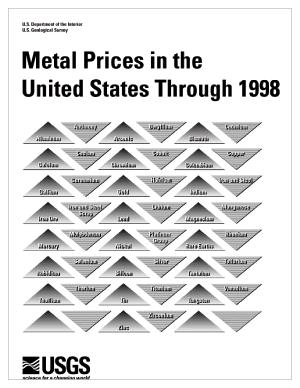
The United States Geological Survey provides a wealth of information on commodity prices for minerals.The adjacent document provides detailed trends (numbers and charts) for over 60 metals (from Aluminium to Zirconium!) "considered essential" to the US economy, from 1959 to 1998. Each metal has its own summary page, allowing you to choose which you would like. The charts super-impose the inflation-corrected (constant 1992 dollar) prices and contemporaneous prices. Another useful feature is the inclusion of a summary of important demand and supply shocks that cause spikes in the prices. The only prices to show upward trends are those of Caesium, Rubidium, and Thallium, which have small markets and for which commercial uses are recent phenomena. All other essential metals exhibit constant or declining real price trends.
A preliminary report that essentially summarises this document is also
provided by the USGS. The aptly named 20th
century mineral prices decline in constant dollars by Daniel E. Sullivan,
John L. Sznopek and Lorie A. Wagner is more general and less technical.
Proven reserves
Statistics on proven reserves for 11 major depletable commodities are
provided below. For most minerals the increases have been considerable.
| Resource | 1950 | 1990 | % change |
| Bauxite | 1,400 | 21,500 | 1,436 |
| Chromium | 70 | 420 | 500 |
| Copper | 100 | 350 | 250 |
| Iron Ore | 19,000 | 145,000 | 663 |
| Lead | 40 | 70 | 75 |
| Manganese | 500 | 980 | 96 |
| Nickel | 17 | 59 | 247 |
| Oil (billion barrels) | 104 | 1,002 | 863 |
| Tin | 6 | 4.2 | -30 |
| Zinc | 70 | 145 | 107 |
As an additional resource, perhaps the most detailed analysis of proven
oil reserves statistics is provided in World
oil reserves: problems in definition and estimation by Ghazi M. Haider,
on behalf of OPEC, 2000. The document also includes a useful chart depicting
the increasing level of proven reserves.
The future for extraction costs
From a more theoretical perspective, some useful insights on the future
of mineral resources are provided by the lecture, Exploring
the Resource Base, given by Brian J. Skinner, a geologist at Yale.
He argues that 1) minerals in the earth's crust are sufficient to provide
for global needs "under any scenario of growth provided that technology
is developed for subsurface prospecting." 2) As demand changes from conventional
ores (iron, aluminum, titanium, magnesium, silicon) to "unconventional"
(copper, lead, zinc, moybdenum, and gold), there will be less low-grade
ores available for exploitation. 3) There may be discontinuities
in the costs of extraction as we delve deeper into the resource base, so
in the absence of new technologies, the price level of particular commodities
may jump.