Routing LLM calls: predict the model, or verify the answer?
The same request can cost a hundred times more on one model than on another, and the expensive model is not always the one that gets it right. Two strategies try to pay only for what a request needs. A router decides before the call: it reads the prompt and predicts which model should answer. A cascade decides after: it lets a cheap model answer first, checks the answer, and calls a stronger model only if the check fails. This post reviews both families in the 2023–2026 literature, what generalizes and what does not, and where my gateway Rung differs. (For how Rung is built and used, see this post.)
Table of Contents
Routers: predict the model from the prompt
A router is a classifier over prompts. It is trained on records of which model did well on which request, and at run time it maps a new prompt to a model, usually with a threshold that trades cost against quality.
- Preference-trained routers. RouteLLM trains strong-versus-weak routers on Chatbot Arena preferences and routes when the predicted win probability of the weak model is high enough; it reports 3.66× cost savings at 95 % of GPT-4's quality on MT Bench (Ong et al. 2024). Hybrid LLM predicts the quality gap between a small and a large model and makes up to 40 % fewer calls to the large one (Ding et al. 2024).
- Bandits and graphs. MixLLM's contextual bandit reaches 97.25 % of GPT-4's quality at 24.18 % of the cost (Wang et al. 2025); GraphRouter predicts effect and cost as edges in a graph of tasks, queries and models (Feng et al. 2024); BaRP trains under the partial feedback a deployed router actually gets (Wang et al. 2025).
- Policies and lookups. Arch-Router maps queries to routes the operator defines in words (Tran et al. 2025), and a well-tuned k-nearest-neighbour router over embeddings matches or beats learned routers (Li 2025).
The best-known figures of this family (RouteLLM, FrugalGPT, Hybrid LLM) are not under licenses that allow reproduction; see Fig. 1 of RouteLLM for its cost–quality curves.
Do routers generalize?
Independent benchmarks are consistently sceptical. On RouterBench's 405,000 outcomes, “none of the routing algorithms significantly outperform the baseline Zero router” (Hu et al. 2024). On LLMRouterBench — over 400,000 instances, 33 models — recent methods and the commercial OpenRouter “do not outperform a simple baseline (the Best Single model)” (Li et al. 2026). RouterArena ranks Not Diamond 12th, largely because it picks expensive models (Lu et al. 2025). RouteLLM's own Arena-trained routers fall to the level of a random router on MMLU, which the authors attribute to MMLU being out of distribution (Ong et al. 2024). Routers conditioned on a budget collapse onto the most expensive model as the budget grows (Lai & Ye 2026).
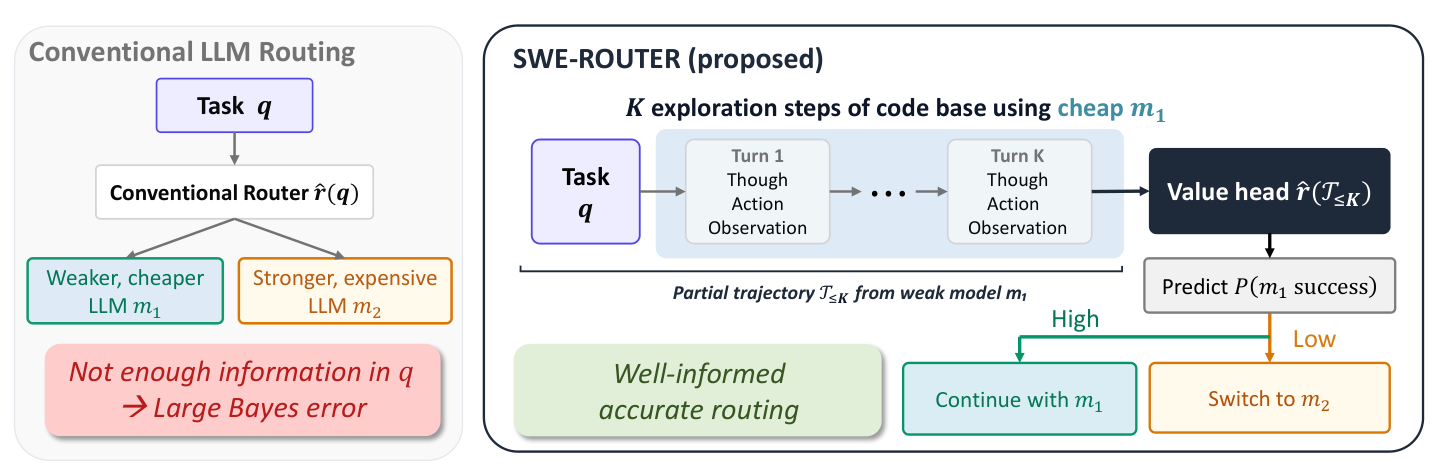
Why? Agent-as-a-Router traces the failure to an “information deficit” in the prompt (Zhou et al. 2026), and SWE-Router argues that prompt-only routing has an error floor it cannot get below, because “a similar issue can hide either a localized typo or a multi-module refactor” (Son et al. 2026). There is counter-evidence — BaRP and RouterEval report routers that generalize (Wang et al. 2025; Huang et al. 2025) — but it relies on feedback gathered during deployment, in-domain data, or a shift in the pool of models rather than in the tasks.
Cascades: let the cheap model try, then check
Which signal decides escalation
A cascade needs a signal computed from the cheap model's answer that says “this is probably wrong”. The literature has tried most of the obvious ones:
| signal | how it works | reported result |
|---|---|---|
| a learned answer scorer | FrugalGPT learns a sequence of APIs and a scorer that stops the cascade (Chen et al. 2023) | up to 98 % cost cut at GPT-4 accuracy |
| self-verification + a decision model | AutoMix has the small model check its own answer against the context, and a POMDP meta-verifier decides, because “self-verification can be noisy” (Aggarwal et al. 2023) | over 50 % cost cut |
| answer consistency | escalate when the cheap model's sampled answers disagree (Yue et al. 2023), building on self-consistency (Wang et al. 2022) | GPT-4 accuracy at 40 % of its cost |
| token-level uncertainty | quantiles of per-token uncertainty feed a learned deferral rule (Gupta et al. 2024) | beats sequence-probability deferral |
| probability margin | only the small model's margin between top answers decides (Ramírez et al. 2024) | best in 25 of 27 setups |
What does not work well as a gate is another model's opinion. Across 26 judges, CodeJudgeBench found “significant randomness” and sensitivity to the order answers are shown (Jiang et al. 2025), and asking a model to correct itself can make answers worse (Huang et al. 2023).
Cascades for code and agents
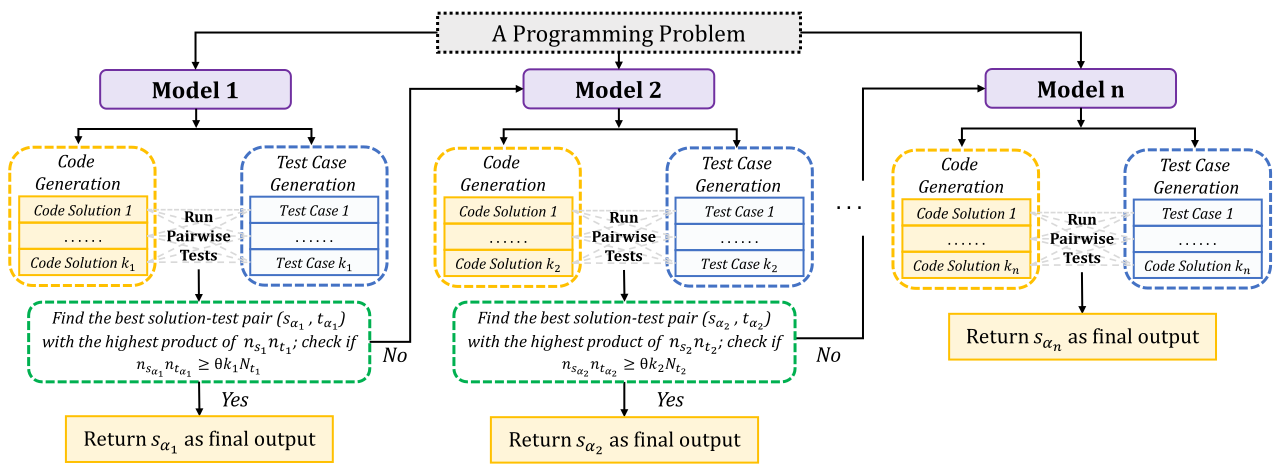
In code, the strongest cascades use cheap, objective evidence. In Model Cascading for Code, each model in a size-ordered family writes solutions and tests for them; the cascade climbs to the next model only when the best solution passes too few of the tests, cutting cost by 26 % on average and up to 70 % (Chen et al. 2024). EcoAssistant runs the code and backs off from GPT-3.5-turbo to GPT-4 “only when the current one fails”, beating GPT-4 by 10 points of success at under half its cost (Zhang et al. 2023).
The closest relative to Rung in agentic coding is SWE-Router. A weak model takes a few exploratory turns on the task; a 7B value model reads that partial trajectory and predicts whether the weak model will succeed; if not, the task goes to a stronger model. It reaches a routing AUC of 0.780 on SWE-bench Verified, 15.3 points above the prompt-only baseline, and the authors prove that conditioning on the trajectory never hurts (Son et al. 2026).
One theory for both
Dekoninck et al. unify routing and cascading as “cascade routing” and prove which strategies are optimal. Their conclusion is the one that matters for practice: everything rests on the quality estimate, and “for cascading, robust post-hoc quality estimation … is critical” (Dekoninck et al. 2024). A router lives or dies by what the prompt reveals; a cascade, by what its check can see in the answer.
Where Rung differs
Rung is a cascade: an OpenAI-compatible gateway that tries the cheapest model, checks the answer, and escalates only on a verified failure. Its own measurements line up with the literature above. Predicting the best model from the prompt — with summaries, full prompts, TF-IDF, embeddings or a fine-tuned small model, tested with leave-one-repository-out splits and permutation baselines — never beat a policy that predicts nothing, and on 6,891 (task, configuration) cells from an agentic-coding corpus it recovered none of the available gain (our measurement). That is the RouterBench result again, in agentic coding and under a stricter shift test. Five things together set Rung apart; to our knowledge no reviewed paper has all five:
- Verified escalation under a hard cap per task. FrugalGPT's budget is a total over a dataset; RouteLLM and Hybrid LLM expose thresholds. Rung escalates only when a check shows the answer wrong, and never spends more than the task's budget.
- Gates compared head to head on the same cells. On 404 (task, model) cells: executed tests correlated 0.85 with actually being correct; the same model sampled three times and required to agree correlated 0.78–0.98, for about 3 % of one top-model call; a same-tier LLM judge was negatively correlated — it preferred fluent fabrications. With two samples instead of three, consistency fell to 0.00: two answers can split one against one, with no majority (our measurement). We have not seen that collapse reported elsewhere.
- Route by kind of task, from a table the operator can read. The cost per correct answer differed 163× across models, and the expensive model's advantage was 58 points on one task category and 2 on another (our measurement). Rung looks up the category in a table built offline from the operator's own traffic — close in spirit to Arch-Router's policies and Agent-as-a-Router's per-dimension lookup, which already reaches about 83 % of the oracle — but auditable rather than learned.
- A record of every attempt in every response. Each response lists every attempt, what it cost and whether it was verified; papers report aggregate curves.
- Matched-spend comparisons. The ladder beat every single model in 37 of 39 comparisons at the same spend on HumanEval+ (our measurement) — a stricter framing than an area under a cost–quality curve.
Where the literature is ahead
- Breadth. Rung's evidence is 164 HumanEval+ tasks and one agentic-coding corpus. The benchmarks above have hundreds of thousands to two hundred million records.
- Theory. Cascade routing proves optimal strategies; SWE-Router proves the value of reading the trajectory and tests it on all 500 tasks of SWE-bench Verified.
- Learned routers that help. Where the mix of tasks is stable, RouteLLM and MixLLM do save money; Rung's null result is about predicting across a shift.
- Learning from the trajectory. SWE-Router reads intermediate evidence as Rung does, with a learned value model instead of a check; for agent tasks without tests, that may reach places a consistency gate cannot.
- Comparisons we cannot make. No paper reports a cost-per-correct spread to compare with Rung's 163×, and commercial gateways publish no peer-reviewed description of their escalation logic, budgets or audit records.
References
- Ong, I. et al. “RouteLLM: Learning to Route LLMs with Preference Data.” 2024. arXiv:2406.18665
- Ding, D. et al. “Hybrid LLM: Cost-Efficient and Quality-Aware Query Routing.” 2024. arXiv:2404.14618
- Wang, X. et al. “MixLLM: Dynamic Routing in Mixed Large Language Models.” 2025. arXiv:2502.18482
- Feng, T. et al. “GraphRouter: A Graph-based Router for LLM Selections.” 2024. arXiv:2410.03834
- Wang, W. et al. “Learning to Route LLMs from Bandit Feedback: One Policy, Many Trade-offs” (BaRP). 2025. arXiv:2510.07429
- Tran, C. et al. “Arch-Router: Aligning LLM Routing with Human Preferences.” 2025. arXiv:2506.16655
- Li. “Rethinking Predictive Modeling for LLM Routing: When Simple kNN Beats Complex Learned Routers.” 2025. arXiv:2505.12601
- Hu, Q. J. et al. “RouterBench: A Benchmark for Multi-LLM Routing System.” 2024. arXiv:2403.12031
- Li, H. et al. LLMRouterBench. 2026. arXiv:2601.07206
- Lu, Y. et al. RouterArena. 2025. arXiv:2510.00202
- Lai, G. & Ye, H.-J. “When Routing Collapses: On the Degenerate Convergence of LLM Routers.” 2026. arXiv:2602.03478
- Zhou, P. et al. “Agent-as-a-Router: Agentic Model Routing for Coding Tasks.” 2026. arXiv:2606.22902
- Son, S. et al. “SWE-Router: Routing in Multi-turn Agentic Software Engineering Tasks.” 2026. arXiv:2607.00053
- Huang, Z. et al. RouterEval. 2025. arXiv:2503.10657
- Chen, L., Zaharia, M. & Zou, J. “FrugalGPT: How to Use Large Language Models While Reducing Cost and Improving Performance.” 2023. arXiv:2305.05176
- Aggarwal, P. et al. “AutoMix: Automatically Mixing Language Models.” 2023. arXiv:2310.12963
- Yue, M. et al. “Large Language Model Cascades with Mixture of Thoughts Representations for Cost-efficient Reasoning.” 2023. arXiv:2310.03094
- Wang, X. et al. “Self-Consistency Improves Chain of Thought Reasoning in Language Models.” 2022. arXiv:2203.11171
- Gupta, N. et al. “Language Model Cascades: Token-level Uncertainty and Beyond.” 2024. arXiv:2404.10136
- Ramírez, G. et al. “Optimising Calls to Large Language Models with Uncertainty-Based Two-Tier Selection.” 2024. arXiv:2405.02134
- Jiang, H. et al. “CodeJudgeBench: Benchmarking LLM-as-a-Judge for Coding Tasks.” 2025. arXiv:2507.10535
- Huang, J. et al. “Large Language Models Cannot Self-Correct Reasoning Yet.” 2023. arXiv:2310.01798
- Chen, B., Zhu, M., Dolan-Gavitt, B., Shafique, M. & Garg, S. “Model Cascading for Code: A Cascaded Black-Box Multi-Model Framework for Cost-Efficient Code Completion with Self-Testing.” 2024. arXiv:2405.15842
- Zhang, J. et al. “EcoAssistant: Using LLM Assistant More Affordably and Accurately.” 2023. arXiv:2310.03046
- Dekoninck, J. et al. “A Unified Approach to Routing and Cascading for LLMs.” 2024. arXiv:2410.10347
Citation
Cited as: Qu, Shuhui. (Oct 2026). Routing LLM calls: predict the model, or verify the answer? Shuhui Qu's blog. https://shuhuiq.github.io/blog/review-routing-cascades.html
@article{qu2026routingcascades,
  title   = "Routing LLM calls: predict the model, or verify the answer?",
  author  = "Qu, Shuhui",
  journal = "shuhuiq.github.io",
  year    = "2026",
  month   = "Oct",
  url     = "https://shuhuiq.github.io/blog/review-routing-cascades.html"
}