s_humanSafetyBlueLight
Calculate the safety of blue lights for exposure to the eye and to skin.
The safety function curves used in these calculations are stored in data/human/safetyStandard.
blueLightHazard - Eye (retinal) safety (retinal photochemical injury
                  from chronic blue-light exposure).  There are
                  different functions for large and small field lights
                  (4.3.3 and 4.3.4)
There are two other types of safety calculations that we include in related scripts
Actinic         - UV hazard for skin and eye safety The limits for
                  exposure to ultraviolet radiation incident upon the
                  unprotected skin or eye (4.3.1 and 4.3.2)
burnHazard - Retinal thermal injury (4.3.5 and 4.3.6)
The data for the safety function curves were taken from this paper
?IEC 62471:2006 Photobiological Safety of Lamps and Lamp Systems.? n.d.
Accessed October 5, 2019. https://webstore.iec.ch/publication/7076
J.E. Farrell has a copy of this standard
Notes: Near UV is also called UV-A and is 315-400nm.
Calculations We load in a radiance (Watts/sr/nm/m2), convert it to irradiance
Irradiance = Radiance * pi
This was used for the Oral Eye project, but we can not expect that the repository will always be on the path. So for this test we commented out that part of the script
See also Oral eye project
Contents
%{
% Plot the three different functions and explain them here
% Make sure the formulae for hazards are implemented for

    Actinic UV hazard exposure limit skin and eye (4.3.1)
    Near UV hazard limit for the eye (4.3.2)
    Retinal blue light hazard exposure (4.3.3)
    Retinal blue light small source (4.3.4)
    Retinal thermal hazard (4.3.5)
    Retinal theermal hazard for weak visual stimulus (4.3.6)
    Infrared exposure for the eye (4.3.7)
    Thermal hazard for the skin (4.3.8)
%}

%{
We checked two ways if radiance -> irradiance is multiplied by 2pi or 1pi

From: Peter B. Catrysse <pcatryss@stanford.edu>
Sent: Wednesday, August 21, 2019 11:02 AM
To: Joyce Eileen Farrell <jefarrel@stanford.edu>
Subject: RE: spectroradiometric measurements

Hello Joyce,

 It is definitely pi.
 There is 2*pi solid angle for the hemisphere, but when you integrate
 you end up getting pi as factor.

See you next week,

Peter

From: Joyce Eileen Farrell [mailto:jefarrel@stanford.edu]
Sent: Tuesday, August 20, 2019 10:58 PM
To: Peter Bert Catrysse <pcatryss@stanford.edu>
Subject: Re: spectroradiometric measurements

Hi Peter,

Thanks so very much for giving me the conversion from radiance to
irradiance.

is it
E = pi*L/R (where E is irradiance, L is radiance and R is reflectance)
or
E=2pi*L/R

See also this exchange

https://physics.stackexchange.com/questions/116596/convert-units-for-spectral-irradiance

The person multiplies b6000 by pi, not 2pi

%}
Create a radiance and convert it to irradiance
wave       = 300:700;
radiance   = blackbody(wave,3000);
irradiance = radiance*pi;

% ieNewGraphWin; plot(wave,irradiance);
Load the safety function
fname = which('Actinic.mat');
Actinic = ieReadSpectra(fname,wave);

% The formula is
%
%    sum (Actinic(lambda,t) irradiance(Lambda)) dLambda dTime
%
% Our stimuli are constant over time, so this simplifies to
%
%    T * sum(Actinic(lambda) irradiance(lambda) dLambda
%
% where T is the total time.  Follow the units this way:
%
%     Irradiance units: Watts/m2/nm
%     Watts = Joules/sec
%
%     Watts/m2/nm * (nm * sec)         % Irradiance summed over nm and time
%     Joules/sec/m2/nm * (nm * sec)
%     Joules/m2                        % Becomes Joules/area
%
dLambda  = wave(2) - wave(1);
duration = 1;                  % Seconds
hazardEnergy = dot(Actinic,irradiance) * dLambda * duration;

% This is the formula from the standard to compute the maximum daily
% allowable exposure
fprintf('Maximum exposure duration per eight hours:  %f (min)\n',(30/hazardEnergy)/60)
Maximum exposure duration per eight hours: 6249.267510 (min)
An example of a light measured in the lab
radiance = ieReadSpectra('LED385nm.mat',wave);
%{
radiance = ieReadSpectra('LED405nm.mat',wave);
radiance = radiance(:,1);
%}

irradiance = pi*radiance;

fname = which('Actinic.mat');
Actinic = ieReadSpectra(fname,wave);
dLambda  = wave(2) - wave(1);
duration = 1;                  % Seconds
hazardEnergy = dot(Actinic,irradiance) * dLambda * duration;
%{
The maximum permissible exposure time per 8 hours for ultraviolet radiation
incident upon the unprotected eye or skin shall be computed by:

t_max = 30/E_s   (seconds) (Equation 4.2)

E_s is the effective ultraviolet irradiance (W/m^2).  The formula for E_s
is defined in Equation 4.1.  It is the inner product of the Actinic
function and the irradiance function, accounting for time and wavelength
sampling.

%}
fprintf('Maximum exposure duration per eight hours:  %f (min)\n',(30/hazardEnergy)/60)
Maximum exposure duration per eight hours: 8.913732 (min)
An example of the 385nm light in the OralEye camera
%{
fname = fullfile(oreyeRootPath,'data','lights','OralEyeBlueLight.mat');
load(fname,'wave','radiance');
radiance = mean(radiance,2);
irradiance = pi*radiance;

fname = which('Actinic.mat');
Actinic = ieReadSpectra(fname,wave);
dLambda  = wave(2) - wave(1);
duration = 1;                  % Seconds
hazardEnergy = dot(Actinic,irradiance) * dLambda * duration;
fprintf('Maximum exposure duration per eight hours:  %f (min)\n',(30/hazardEnergy)/60)
%}
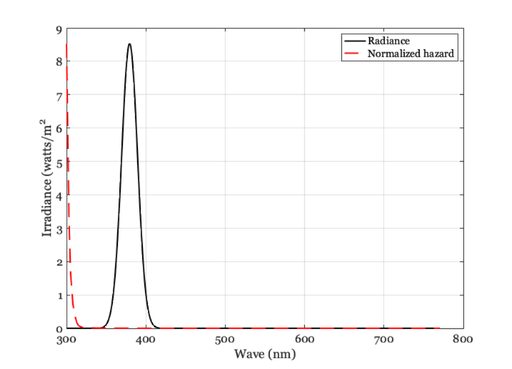
Start with a monochromatic light luminance
% Suppose we know the luminance of a 380 nm light with a 10 nm bin width
lum = 10; thisWave = 380; dLambda = 10;

% We convert the luminance to energy
[radiance,wave] = ieLuminance2Radiance(lum,thisWave,'sd',dLambda); % watts/sr/nm/m2

% Now read the hazard function (Actinic)
Actinic = ieReadSpectra(fname,wave);

% Convert radiance to irradiance and calculate the hazard for 1 sec
% duration
duration = 1;                  % Seconds
hazardEnergy = dot(Actinic,radiance*pi) * dLambda * duration;

% Conver the hazard energy into maximum daily allowable exposure in minutes
fprintf('Maximum exposure duration per eight hours:  %f (min)\n',(30/hazardEnergy)/60)
Maximum exposure duration per eight hours: 1.074360 (min)
Plot the Actinic hazard function
ieNewGraphWin;
mx = max(radiance(:));
dummy = ieScale(Actinic,1)*mx;
plot(wave,radiance,'k-',wave,dummy,'r--','linewidth',2);
xlabel('Wave (nm)');
ylabel('Irradiance (watts/m^2');
grid on
legend({'Radiance','Normalized hazard'});
Near-UV hazard exposure limit
%{
This calculation has no weighting function.

For times less than 1000 sec, add up the total irradiance
from 315-400 without any hazard function (Equation 4.3a).  Call this E_UVA.
Multiply by time (seconds).  The product should be less than 10,000.

For times exceeding 1000 sec, add up the total irradiance, divide by the
time, and the value must be less than 10 (Equation 4.3b).
%}