s_humanSafetyUVExposure
Calculate the safety of UV lights for eye and skin exposure.
The safety function curves used in this and related calculations are stored in data/human/safetyStandard.
Actinic         - UV hazard for skin and eye safety The limits for
                  exposure to ultraviolet radiation incident upon the
                  unprotected skin or eye (4.3.1 and 4.3.2)
There are two other types of safety calculations that we include in related scripts
blueLightHazard - Eye (retinal) safety (retinal photochemical injury
                  from chronic blue-light exposure).  There are
                  different functions for large and small field lights
                  (4.3.3 and 4.3.4)
burnHazard      - Retinal thermal injury (4.3.5 and 4.3.6)
The data for the safety function curves were taken from this paper
?IEC 62471:2006 Photobiological Safety of Lamps and Lamp Systems.? n.d.
Accessed October 5, 2019. https://webstore.iec.ch/publication/7076
J.E. Farrell has a copy of this standard
Notes: Near UV is also called UV-A and is 315-400nm.
Calculations We load in a radiance (Watts/sr/nm/m2), convert it to irradiance
Irradiance = Radiance * pi
See also
Contents
- General parameters
- An example of a light measured in the lab
- An example of the 385nm light in the OralEye camera
- The mean daylight we measured in California
- If you only know the luminance of an LED (monochromatic) and its bandwidth (s.d.)
- Now check the other safety metric from Section 4.3.2
- Blue light hazard calculation
- This is an extremely bright blackbody with a lot of short wave energy
General parameters
wave = 300:700;
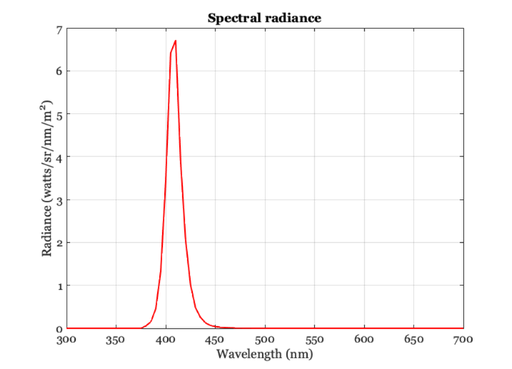
An example of a light measured in the lab
fname = which('LED405nm.mat');
radiance = ieReadSpectra(fname,wave);
ledRadiance = mean(radiance,2); %
ledRadiance(wave > 500) = 0;  % Only noise was measured above 500 nm

lum405 = ieLuminanceFromEnergy(ledRadiance,wave);
plotRadiance(wave,ledRadiance);
irradiance = pi*ledRadiance;

exposureMinutes = humanUVSafety(irradiance,wave);
fprintf('Maximum exposure duration per eight hours:  %f (min)\n',exposureMinutes)
Maximum exposure duration per eight hours: 219.366986 (min)
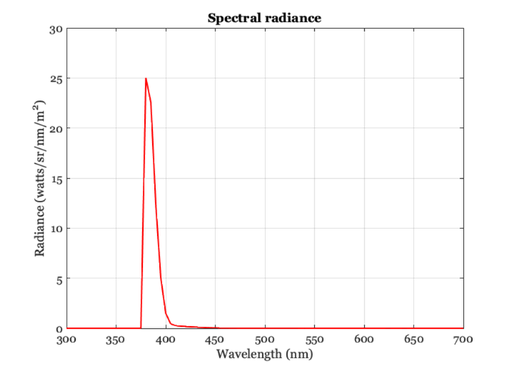
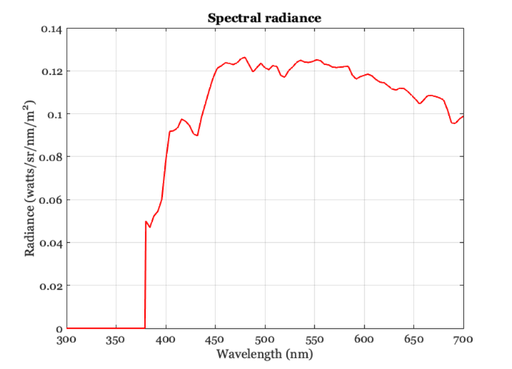
An example of the 385nm light in the OralEye camera
fname = which('LED385nm.mat');
radiance = ieReadSpectra(fname,wave);
plotRadiance(wave,radiance);
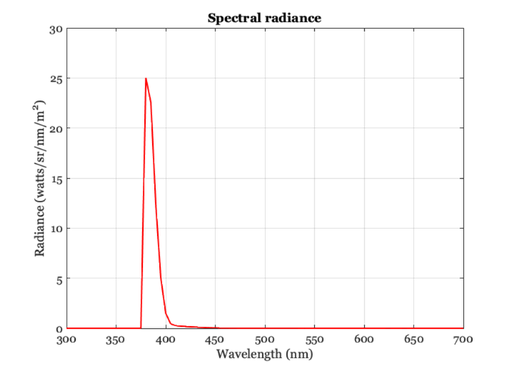
radiance = mean(radiance,2);
plotRadiance(wave,radiance);

irradiance = pi*radiance;
exposureMinutes = humanUVSafety(irradiance,wave);
fprintf('Maximum exposure duration per eight hours:  %f (min)\n',exposureMinutes)

% Each exposure is very brief.  So you can safelty take this many exposures
fprintf('For a 30 ms exposure, you can take %d exposures in an eight hour period.\n',round((exposureMinutes*60)/0.030));
Maximum exposure duration per eight hours:  8.913732 (min)
For a 30 ms exposure, you can take 17827 exposures in an eight hour period.
The mean daylight we measured in California
[radiance,wave] = ieReadSpectra('DaylightPsychBldg.mat',wave);
plotRadiance(wave,radiance);

% Convert radiance to irradiance
irradiance = radiance*pi;

exposureMinutes = humanUVSafety(irradiance,wave);
fprintf('Safe exposure (hours) for 8 hour period is %.2f minutes (%.2f hours)\n',exposureMinutes,exposureMinutes/60);
Safe exposure (hours) for 8 hour period is 3096.79 minutes (51.61 hours)
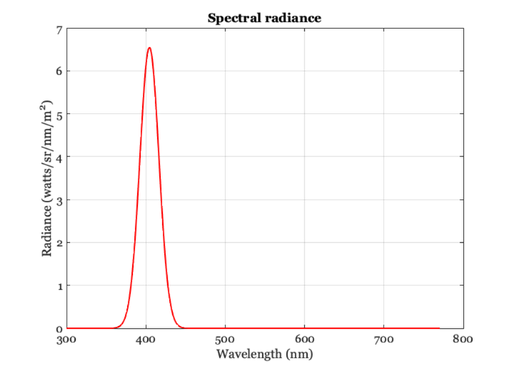
If you only know the luminance of an LED (monochromatic) and its bandwidth (s.d.)
% The band width matters a lot for matching the curves.  The luminance
% always matches correctly.
lum       = lum405;  % cd/m2, luminance of the 405 LED
thisWave  = 405;     % nm, center wavelength of the LED
bandwidth = 12;      % nm, Gaussian standard deviation, FW at roughly 1/2 of the max
[estRadiance,estWave] = ieLuminance2Radiance(lum,thisWave,'sd',bandwidth);
plotRadiance(estWave,estRadiance);

% Check the luminance match
assert(ieLuminanceFromEnergy(estRadiance,estWave) - lum405 < 1e-10)

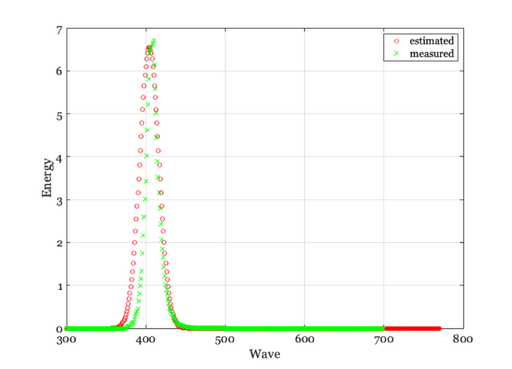
% Compare the curves
ieNewGraphWin;
plot(estWave,estRadiance,'o',wave,ledRadiance,'x');
grid on; xlabel('Wave'); ylabel('Energy');
legend({'estimated','measured'});

% Calculate the safety
irradiance = pi*estRadiance;
exposureMinutes = humanUVSafety(irradiance,estWave);
fprintf('Maximum exposure duration per eight hours:  %f (min)\n',exposureMinutes)
fprintf('For a 30 ms exposure, you can take %d exposures in an eight hour period.\n',round((exposureMinutes*60)/0.030));
Maximum exposure duration per eight hours:  52.496761 (min)
For a 30 ms exposure, you can take 104994 exposures in an eight hour period.
Now check the other safety metric from Section 4.3.2
fname = which('LED385nm.mat');
radiance = ieReadSpectra(fname,wave);
radiance = mean(radiance,2);

irradiance = pi*radiance;
duration = 8;   % Secs
safe = humanUVSafety(irradiance,wave,'method','eye','duration',duration);

if safe
    fprintf('Safe at a duration of %d secs\n',duration);
else
    fprintf('Not safe at a duration of %d secs\n',duration);
end
Safe at a duration of 8 secs
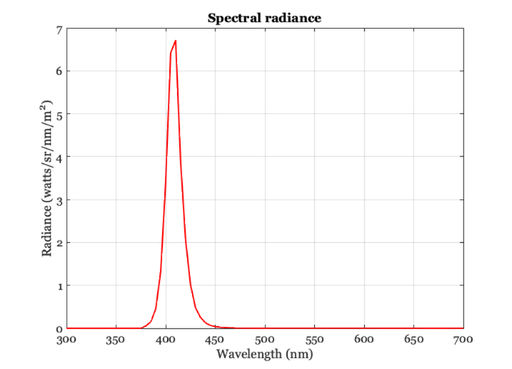
Blue light hazard calculation
fname = which('LED405nm.mat');
radiance = ieReadSpectra(fname,wave);
radiance = mean(radiance,2);
plotRadiance(wave,radiance);

duration = 8*60*60;   % Secs
safe = humanUVSafety(radiance,wave,'method','blue hazard','duration',duration);

if safe
    fprintf('Blue hazard: Safe at a duration of %d secs\n',duration);
else
    fprintf('Blue hazard: Not safe at a duration of %d secs\n',duration);
end
Safe time: Inf minutes (Inf seconds)
Blue hazard: Safe at a duration of 28800 secs
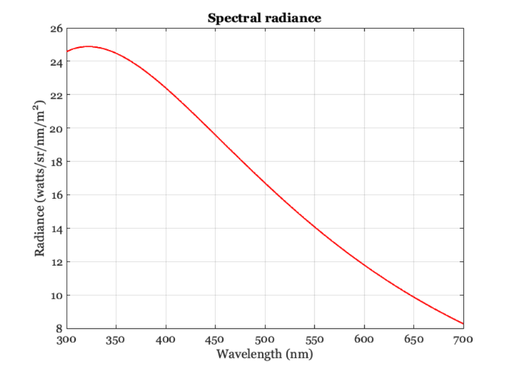
This is an extremely bright blackbody with a lot of short wave energy
radiance = blackbody(wave,9000)*1e4;
plotRadiance(wave,radiance);

duration = 1000;   % Secs
safe = humanUVSafety(radiance,wave,'method','blue hazard','duration',duration);

if safe
    fprintf('Blue hazard: Safe at a duration of %d secs\n',duration);
else
    fprintf('Blue hazard: Not safe at a duration of %d secs\n',duration);
end
Safe time: 12.21034 minutes (732.6 seconds)
Blue hazard: Safe at a duration of 1000 secs