Contents
% t_wvfPupilSize
%
% Explore the effect of changing the pupil size in the calculation.
%
% Description:
%    We load the Thibos wavefront data for various pupil diamters and
%    caclulate and plot psfs for various other pupil diameters.
%
%    We then set the calculated pupil size and compute the expected
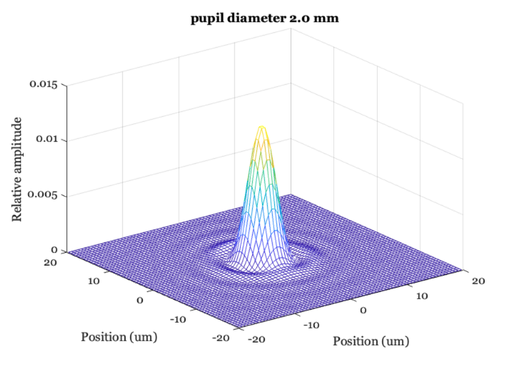
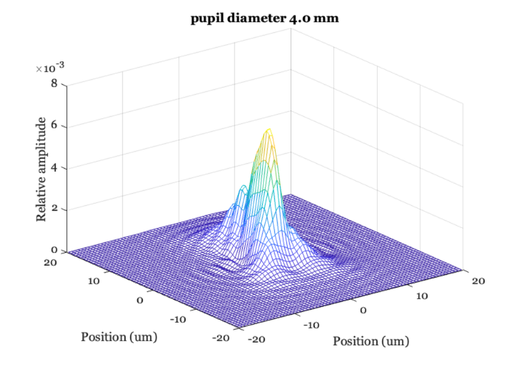
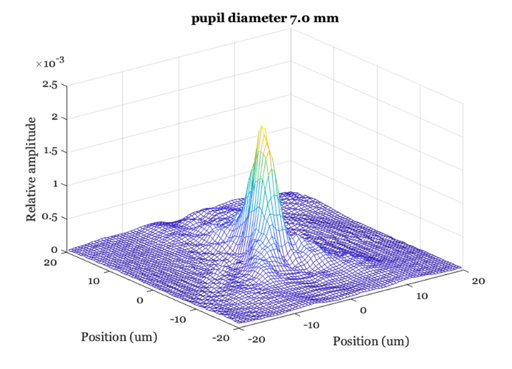
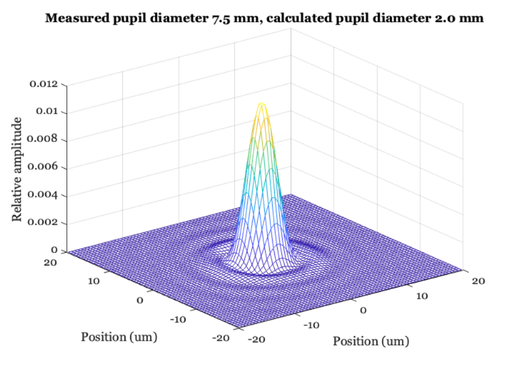
%    pointspread function. That function changes as the pupil diameter gets
%    smaller, and also varies a little with the measured size for a fixed
%    calculation size.
%
% Inputs:
%    None.
%
% Outputs:
%    None.
%
% Optional key/value pairs:
%    None.
%

% History:
%    xx/xx/14  BW   (c) Wavefront Toolbox Team, 2014
%    12/20/17  dhb  Add exploration of different measurement sizes.
%    09/25/18  jnm  Formatting
Initialize
ieInit;
Load the Thibos data for one of the measured pupil diameter sizes
Measured pupil size can be 7.5 6, 4.5, or 3 mm. Here we load the largest available size, so that we can vary the size of the calcualated pupil and see its effect. See below to examine the effect of measured pupil size.
measPupilMM = 7.5;
zCoefs = wvfLoadThibosVirtualEyes(measPupilMM);

% Create the wvf parameter structure with the appropriate values
wave = 520';
wvfP = wvfCreate('wave',wave,'zcoeffs',zCoefs,'name',sprintf('%d-pupil',measPupilMM));
wvfP = wvfSet(wvfP, 'lcaMethod', 'human');
wvfP = wvfCompute(wvfP);
wvfP = wvfSet(wvfP,'measured pupil diameter',measPupilMM);
Calculate the effect of varying the pupil diameter
cPupil = [2,4,7];
for ii=1:sum(cPupil<=measPupilMM)
    wvfP = wvfSet(wvfP,'calc pupil diameter',cPupil(ii));
    wvfP = wvfSet(wvfP, 'lcaMethod', 'human');
    wvfP = wvfCompute(wvfP);
    wvfPlot(wvfP,'psf','unit','um','wave',wave,'plot range',20);
    title(sprintf('pupil diameter %.1f mm',cPupil(ii)));
end
Create the wvf parameter structure with the appropriate values Be sure to set both measured pupil size and the pupil size for calculation. It's true that we'll vary it below, but initializing both explicitly is a good habit to get into.
The calculated pupil size must be equal to or smaller than the measured pupil size.
wave = (400:10:700)';
index550 = find(wave == 550);
wvfP = wvfCreate('calc wavelengths', wave, 'zcoeffs', zCoefs, ...
    'measured pupil size', measPupilMM, 'calc pupil size', measPupilMM, ...
    'name', sprintf('%d-pupil', measPupilMM));
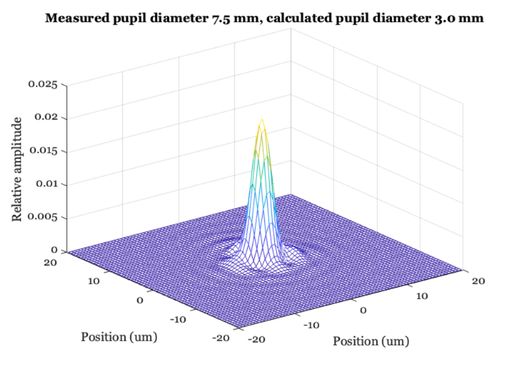
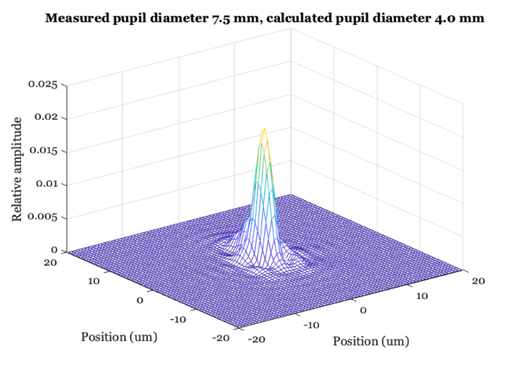
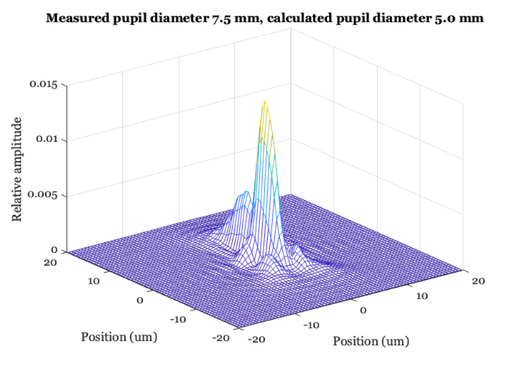
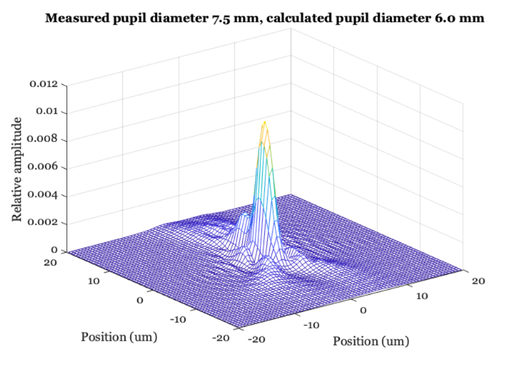
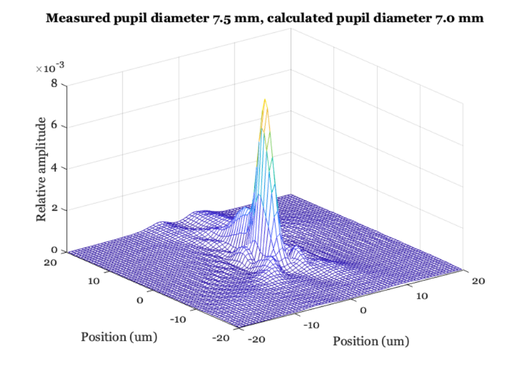
Explore the effect of varying the pupil diameter used in the calculation
% This is done with the measured pupil size fixed.
measPupilMM = 7.5;
calcPupilMM = [2, 3, 4, 5, 6, 7];
for ii = 1:sum(calcPupilMM <= measPupilMM)
    wvfP = wvfSet(wvfP, 'calc pupil size', calcPupilMM(ii));
    wvfP = wvfSet(wvfP, 'lcaMethod', 'human');
    wvfP = wvfCompute(wvfP);
    wvfPlot(wvfP, 'psf', 'unit','um', 'wave', 550, 'plot range', 20);
    title(sprintf(strcat("Measured pupil diameter %0.1f mm, ", ...
        "calculated pupil diameter %.1f mm"), measPupilMM, ...
        calcPupilMM(ii)));
end
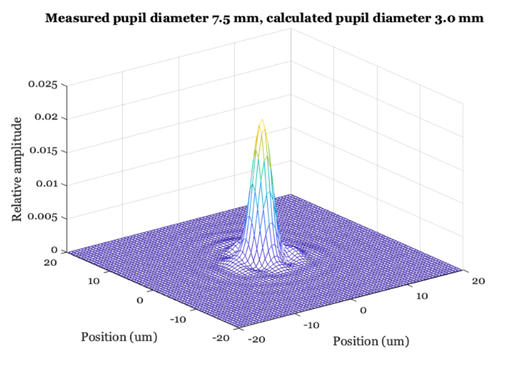
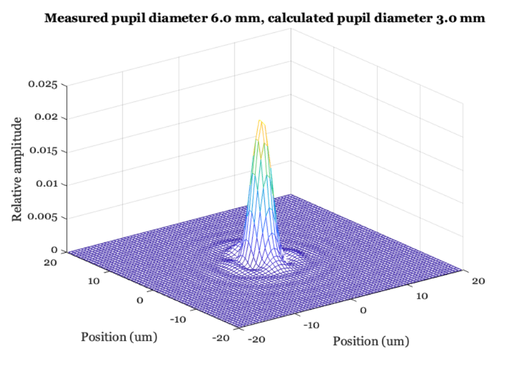
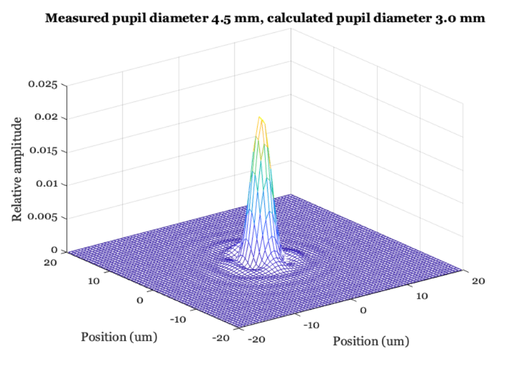
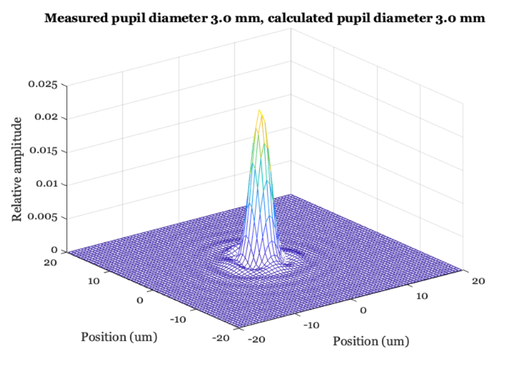
Now fix the calcuated pupil size at 3 mm and vary the measured size.
% We are not sure whether the Thibos data contains measurements made of
% real eyes for different pupil sizes, or whether the measurements were
% made for the largest pupil size and then the Zernike coefficients
% computed from the measured pupil function over various diameters.
%
% In either case, in an idealized world, we think that the central (e.g.) 3
% mm of the pupil function would be the same no matter how large a pupil
% the measurements were made for. Measurement or calculation error could
% cause deviations from this prediction, however. We do find differences in
% the psfs computed for 3 mm from various measured pupil sizes, but they
% are not large.
%
% Here, each time through the loop, we load new zcoeffs according to the
% specified measurement pupil size.
clear psf
measPupilMM = [7.5 6 4.5 3];
calcPupilMM = 3;
for ii = 1:sum(measPupilMM >= calcPupilMM)
    zCoefs = wvfLoadThibosVirtualEyes(measPupilMM(ii));

    % Uncomment the next line if you want to try this with diffraction
    % limited rather than Thibos optics. This shows that we get the same
    % psf no matter what pupil size we say was measured, as expected.
    % zCoefs = zeros(size(zCoefs));

    wvfP = wvfCreate('calc wavelengths', wave, 'zcoeffs', zCoefs, ...
        'measured pupil size', measPupilMM(ii), ...
        'calc pupil size', calcPupilMM, ...
        'name', sprintf('%d-pupil', measPupilMM(ii)));
    wvfP = wvfSet(wvfP, 'lcaMethod', 'human');
    wvfP = wvfCompute(wvfP);
    psf{ii} = wvfGet(wvfP, 'psf');
    if (ii > 1)
        maxAbsDiff = max(abs(psf{1}{index550}(:) - psf{ii}{index550}(:)));
        if (maxAbsDiff > 1e-7)
            fprintf(strcat("Psf calculated at 550 nm for %d mm ", ...
                "differs for measured pupil %g mm and %g mm\n"), ...
                calcPupilMM, measPupilMM(1), measPupilMM(ii));
            fprintf(strcat("\tMax abs difference is %0.2g, max of psf", ...
                " 1 is %0.2g\n"), maxAbsDiff, max(psf{ii}{index550}(:)));
        else
            fprintf(strcat("Psf calculated at 550 nm for %d mm ", ...
                "matches for measured pupil %g mm and %g mm\n"), ...
                calcPupilMM, measPupilMM(1), measPupilMM(ii));
        end
    end
    wvfPlot(wvfP, 'psf', 'unit','um', 'wave',550, 'plot range', 20);
    title(sprintf(strcat("Measured pupil diameter %0.1f mm, ", ...
        "calculated pupil diameter %.1f mm"), measPupilMM(ii), ...
        calcPupilMM));
end
Psf calculated at 550 nm for 3 mm differs for measured pupil 7.5 mm and 6 mm
	Max abs difference is 0.0033, max of psf 1 is 0.021
Psf calculated at 550 nm for 3 mm differs for measured pupil 7.5 mm and 4.5 mm
	Max abs difference is 0.0031, max of psf 1 is 0.022
Psf calculated at 550 nm for 3 mm differs for measured pupil 7.5 mm and 3 mm
	Max abs difference is 0.0037, max of psf 1 is 0.023