I have worked on several mini projects for my coursework and for fun. A few of them are listed in this page.
Schlieren imaging system
Schlieren imaging can be used to photograph fluid-flow. A 2f optical system consisting of a LED light source and a concave mirror can be used for Schlieren imaging. A knife edge is placed at the point where the LED comes to a focus. The knife edge cuts out half of the light reflected from the mirror. A digital camera is placed behind the knife edge to capture the image.
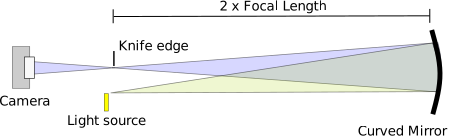
Any fluid-flow that occurs between the light source and the mirror is imaged by the camera. The fluid flow creates a density gradient which causes the refractive index vary. This creates a distortion in the light. As the knife-edge cuts out half of the light, the distortion/spatial variation of the light is converted to intensity variation. This intensity variation is imaged by the camera.
The first video shows Schlieren imaging of compressed air released from a can. The second video shows hot air flow coming
from the tip of a soldering iron.
Three-body problem: Earth-Jupiter-Sun gravitational system
A three-body gravitational system can be used to represent the planetary orbits in a solar system. Such a system is useful in analyzing how the orbit of one planet is affected by another neighboring planet. A Earth-Jupiter-Sun system can be modeled as a three-body system. A hypothetical case is simulated where Jupiter is replaced with a planet having 500 times the mass of Jupiter (referred here as Super Jupiter). The effect on the orbit of the Earth due to such a massive planet is easily noticeable from the simulation shown in the video.
Newton's law of universal gravitation is used to model the forces. The equations of motion are numerically solved using the Runga-Kutta method. The program is coded in python (Jupyter notebook). The codes are available on my GitHub page (https://github.com/zaman13/Three-Body-Problem-Gravitational-System) along with more details about the project.
Electromagnetically induced transparency
Electromagnetically induced transparency (EIT) refers to the formation of a narrow transparency window inside a wide absorption band due to destructive interference between two excitation pathways. EIT like transmission can occur in metallic nano-structure due to interference between plasmonic modes.
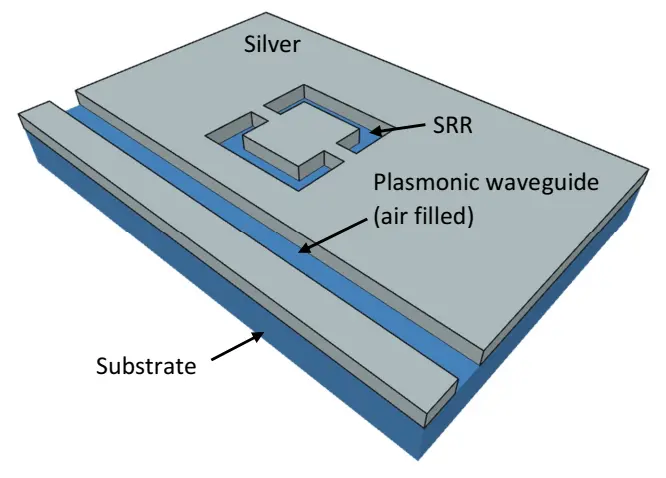
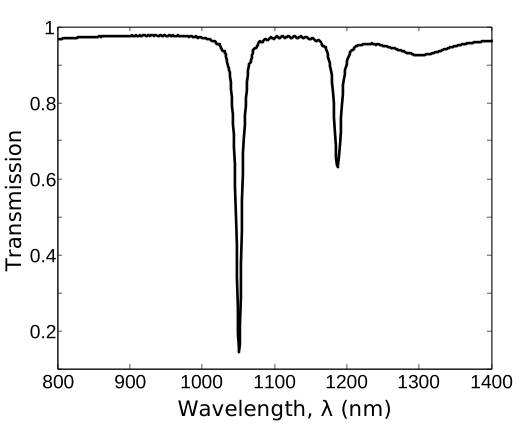
A split-ring resonator (SRR) coupled plasmonic waveguide can demonstrate EIT like transmission. By controlling the gap between the split rings, it is possible to design the stop-band and pass-band of the system. Finite Difference Time Domain (FDTD) methods are used to design and simulate such a system. The video on top shows the power profile as the wavelength is swept. Dips in the power level in the waveguide can be observed at wavelengths of approximately 1050 nm and 1200 nm.
Achromatic objective lens design for endomicroscopy
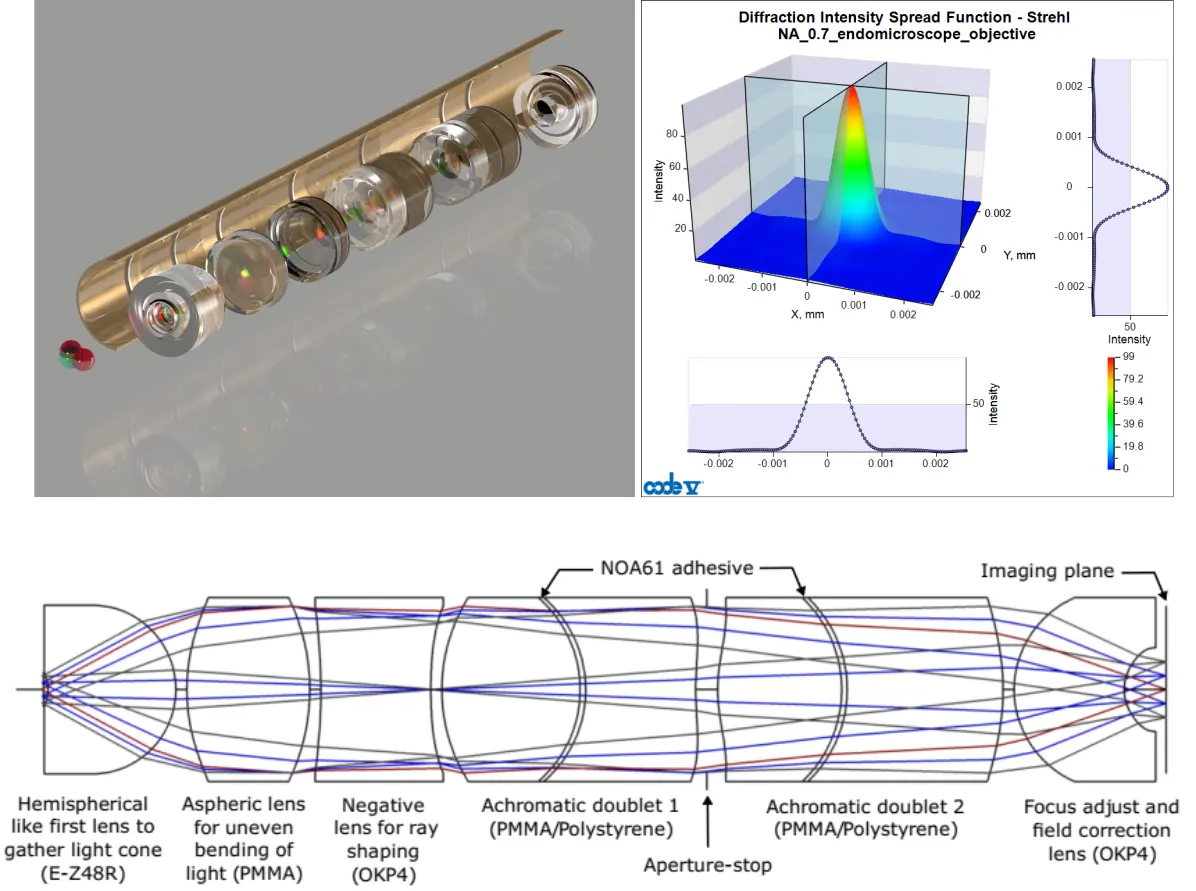
Endomicroscopy allows real-time in vivo imaging with microscopic resolution. Endomicrscopes can be used to perform for optical biopsy for diagnosing breast carcinoma. The challenge is to design optical elements that can fit inside a packaging whose size is no larger than conventional biopsy needles. An achromatic objective lens for endomicroscopy is designed where the elements diameters are limited to 1.5 mm. The operating wavelength range is 452-623 nm, which contains emission peaks of the fluorescent dyes used for breast cancer detection (Proflavine, Cresyl-Violet etc.) As the system is achromatic, two dyes can be imaged simultaneously.
The optical design was done using Code V optical design software developed by Synopsys. The lens elements are assumed to be injection molded optical plastics. Aspherical surfaces are used to correct for aberrations and field-curvature. The final optimized design satisfied all the imaging requirements.
This work was selected as one of the winners of Robert S. Hilbert Memorial Optical Design Competition organized by Synopsys. More details about the project can be found in: https://doi.org/10.1117/1.OE.58.7.075101.
Optimizing fiber Raman amplifier
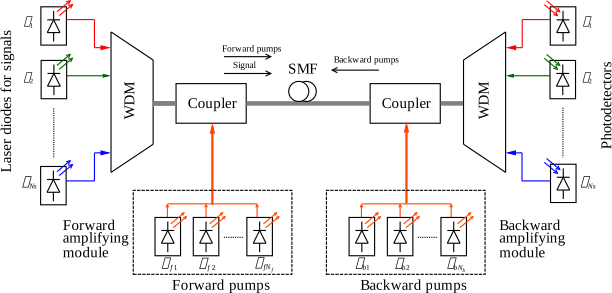
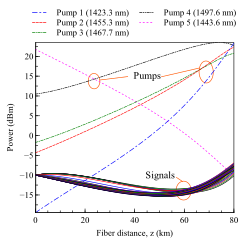
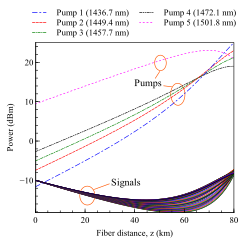
In a Fiber Raman Amplifier (FRA), signal amplification is achieved by feeding pumps through the same transmission fiber where the signals are propagating. Through stimulated raman scattering (SRS), the signals interact with the pumps. Power is transferred from the pump wavelengths to the signal wavelengths and amplification is achieved. The entire transmission fiber acts as a distributed amplifier. Designing a FRA involved selecting the wavelengths and the power levels of the pumps for a desired gain profile.
Two different configurations of FRA are designed and optimized. Type I configuration consists of 5 backward propagating pump and Type II configuration consists of 4 backward propagating pump + 1 forward propagating pump. The power profile of the signals and the pumps though the fiber for these two configurations are shown in the figures above. The numerical solver to analyze the system was coded in Matlab. More details about the project can be found in: https://doi.org/10.1117/1.OE.55.4.046103.
Chaotic motion of a double pendulum
A double pendulum can exhibit chaotic motion. At low energy states, the angular displacement is small and the system is linear. At higher energy, the system becomes chaotic as shown in the video. The code used to solve the system was written in Julia (Jupyter notebook). The codes are available on my GitHub page (https://github.com/zaman13/Double-Pendulum-Motion-Animation) along with more details about the project.