Assignment 2: Oh well, it was a growth experience!
Note: this is a multi-part assignment, so to make things easier, we’ve highlighted deliverables in green!
Overview
In this assignment, you will learn firsthand what it is like to lead a community through a period of growth. Specifically you will create, scale, and moderate your own online discussion community from scratch, simulate its growth with real and synthetic engagement, moderate its evolving culture, and reflect on how your design decisions ripple out across social dynamics. What happens when people don’t act the way you expected? What behaviors become common, and which ones fade away? What’s worth preserving—and what needs to change—as the community grows?
You’ll also conduct a historical investigation using the Wayback Machine to analyze how an actual online community evolved over time, focusing on the design changes and emergent behaviors that occurred as the community grew.
Part 1: Set Up Your Community
Navigate to: https://cs278-reddit-clone-fd128b1084df.herokuapp.com/
Create an account with your Stanford email address and a custom username (ex. cs278fan). Note we’ll be asking you to submit your email and your Seddit username later for grading purposes.
Create a community centered around a shared identity or interest among Stanford students. Feel free to choose a theme that's personally meaningful to you, whether it connects to your life, studies, or something you’re passionate about. Just remember that others in the class will be signing up and participating, so it needs to be something that at least some others in the class can identify with and participate meaningfully in. Your community should be a space where classmates can join as themselves. (Reminder: People will actually be signing up for these!)
Your community must include:
- A clear name and description
- A set of initial rules (at least 2–3, but more if needed)
- A description on your channel indicating your active moderation days, such as “Moderated on Saturday and Sunday” or “Moderated on Friday and Sunday.” You will select any two 24-hour periods between now and Tuesday to actively moderate your communities, and by putting this description, students will be able to pick which communities they want to engage in (ideally when they engage, that community will be moderated at the time).
Example communities
- NotActuallyTomHolland: Michael Bernstein sightings on campus.
- StanfordVolleyballFans: a space where students share intramural match recaps, memes, and watch party info for volleyball matches.
- StudySnacks: students post photos, recipes, and reviews of snacks they eat while studying. Cozy, fun, and snack-centric.
- LeftoverLore: for stories based on leftover food in your fridge.
Keep your theme manageable and relevant — you’ll be moderating it throughout the week, and your goal is to understand how online communities evolve when scaled. If your topic is too niche, it may not spark enough discussion for meaningful reflection on community behavior and growth.

Deliverables: Create your community and submit a link to your community here [Google form] as soon as you create the community.
Important: Submitting too late in the week may prevent others from joining your community and will make it significantly more difficult for you to complete the assignment. We recommend creating a community before Sunday, so there is a 48 hour window for you to complete the next part of the assignment.
Phase 2: 48-Hour Moderation Challenge
You will participate in 2x 24 hour phases where students and bots will be actively engaging with your community (note: the bots will go live on Wednesday morning). You can choose any two days between now and Tuesday for this moderation challenge.
Join 10 communities on Seddit that you want to engage in over the course of the 48 hours by clicking the “Join” button on the community page. First come, first serve! Each community will be capped at 11 members (including the moderator), please do not join more than 10 communities.
In the next phase, you will actively grow your Seddit community and participate in others’ communities.
For EACH day, on each community, complete any 5 points worth of the following interactions.
- Write 1 post - 2 pts
- Write 1 comment on any other post - 1pt
- Reply to 1 comment on your post or on any other post - 1pt
Upvoting/downvoting is highly encouraged!
B. Community Moderation
Your community will soon begin receiving activity—from both your classmates and simulated agents (bots) that we've introduced into the system. These simulated users are designed to behave like real internet participants. Some are helpful and engaged, while others may post spam, provoke arguments, ignore rules, or test the limits of your community norms. Each bot has been assigned a personality profile and set of goals, such as seeking attention, trying to fit in, or intentionally pushing boundaries. Your job is to moderate. That means:
- Setting clear rules and communicating them visibly on your community page.
- Modeling the kind of participation you want to see.
- Responding to misbehavior—by warning, downvoting, or removing posts.
- Deciding what kind of community culture you're trying to build, and how to enforce it.
You must manage this activity using any tools at your disposal. Specifically, we provide you Mod Tools which can be accessed by going to your main SubSeddit page, and clicking Mod Tools.
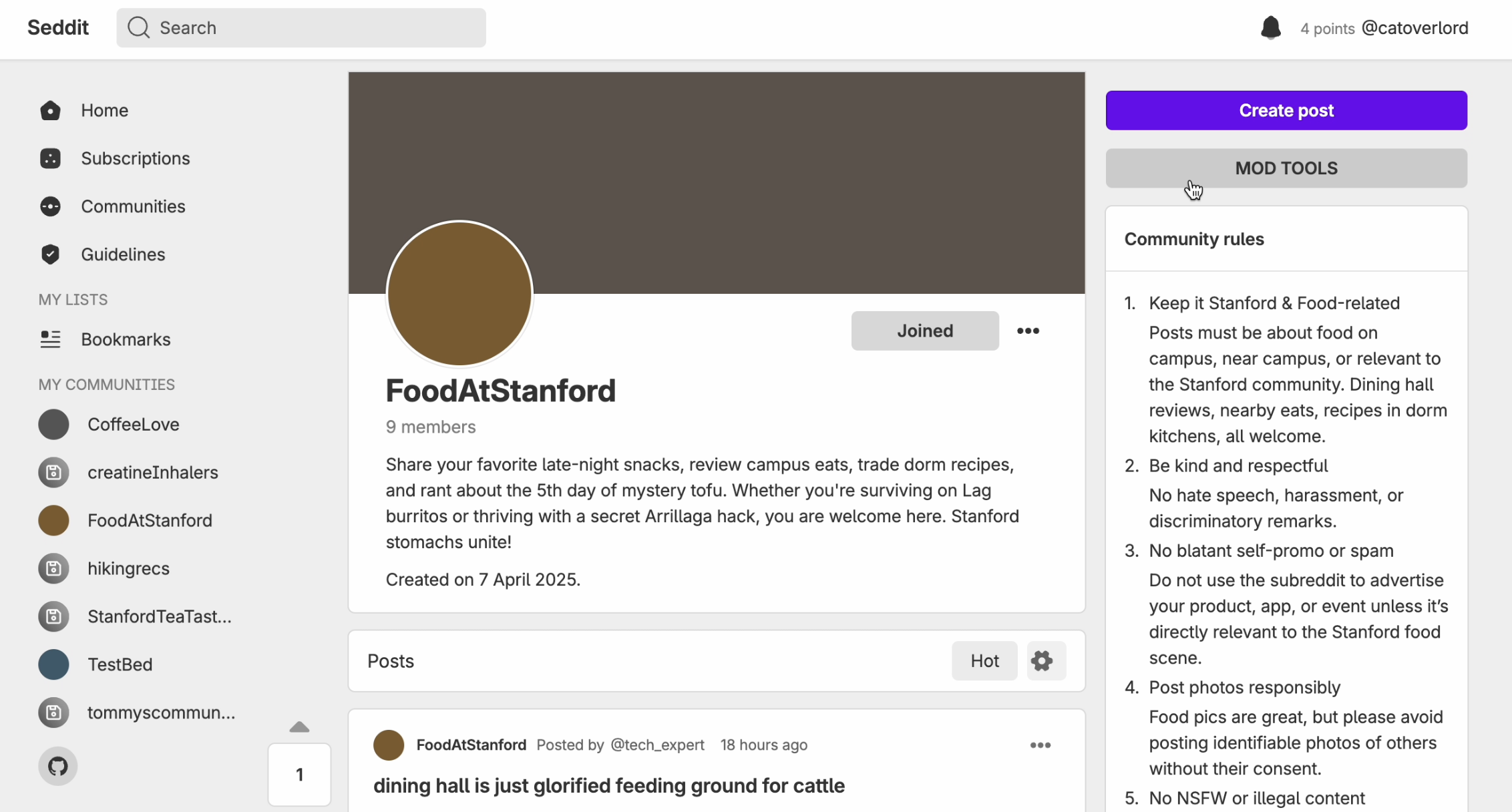
Specific courses of action you can take include:
- Adding rules / norms by by going to your main SubSeddit page, clicking Mod Tools, then Rules.
- Deleting, locking, or pinning posts by clicking on a post -> Mod Actions -> Delete/Lock/Pin. Note that "hiding" a post means removing the post for you, not everyone else, you will need to click "Delete".
- Banning users or bots by going to Mod Tools -> Ban
- Bootstrapping content, by creating posts, replies, and engagements yourself.
- Community-based moderation (e.g. asking members to report posts), which you can access via the Mod Tools -> Reports
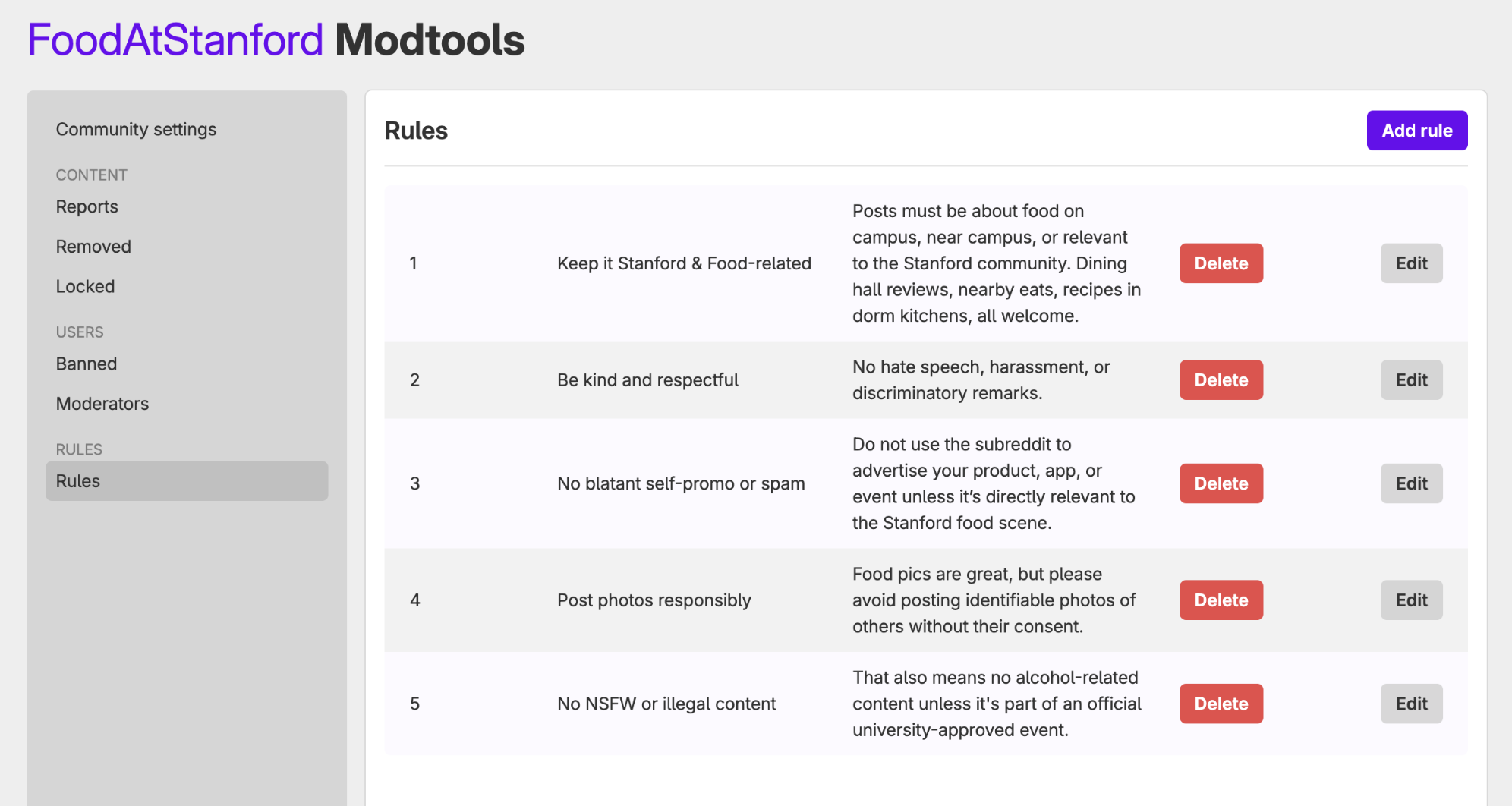
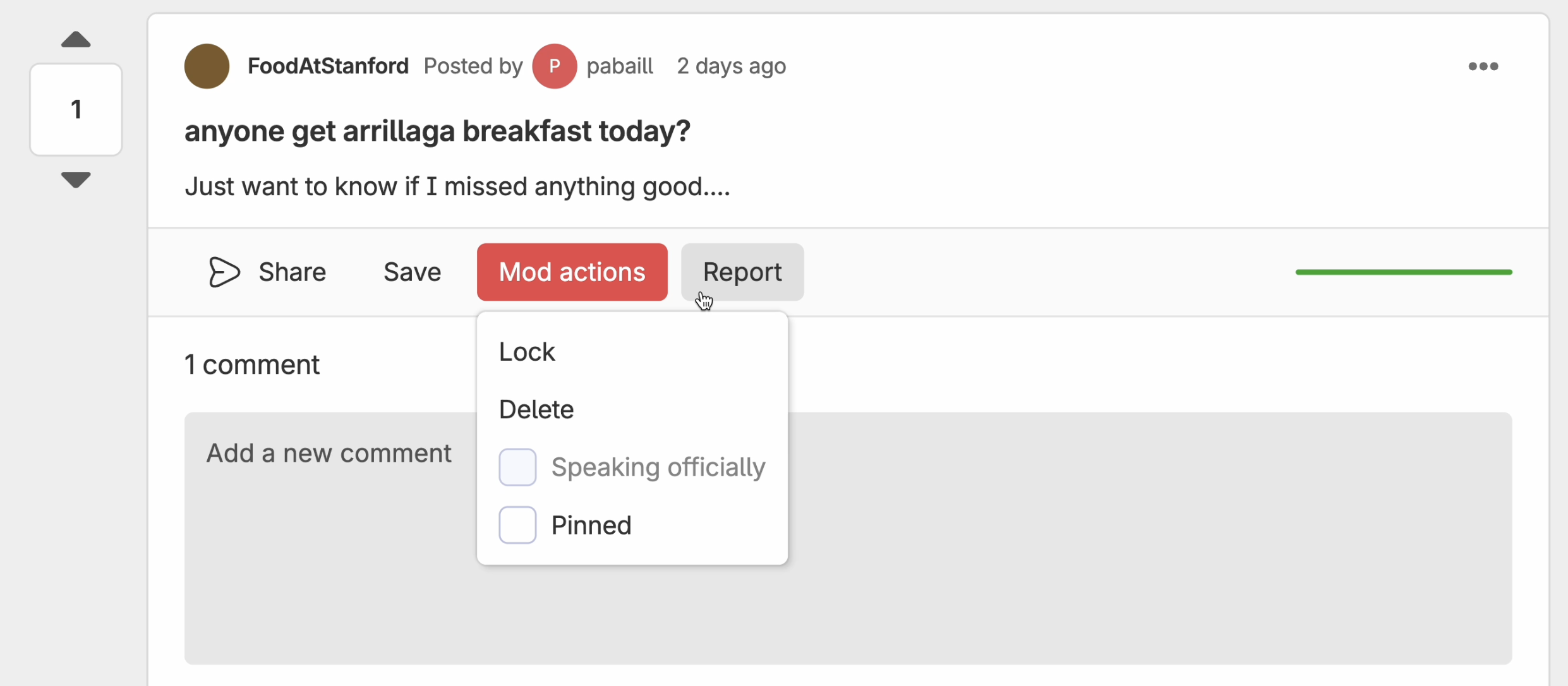
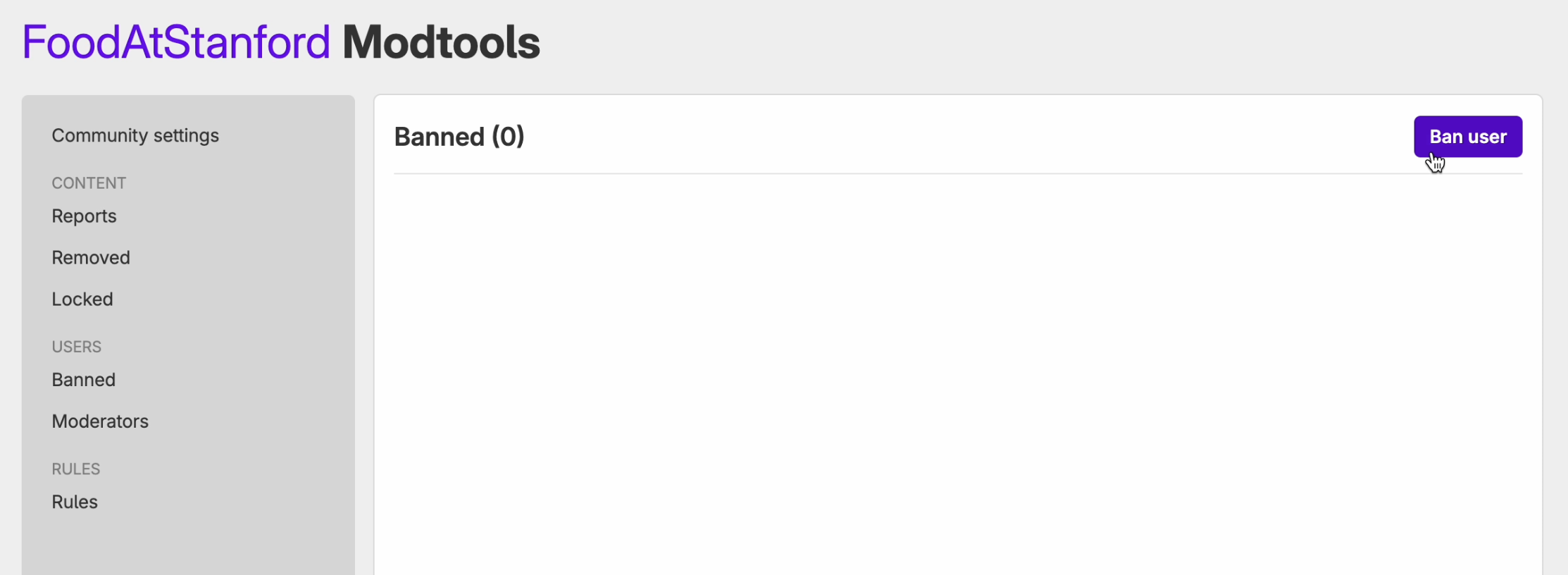
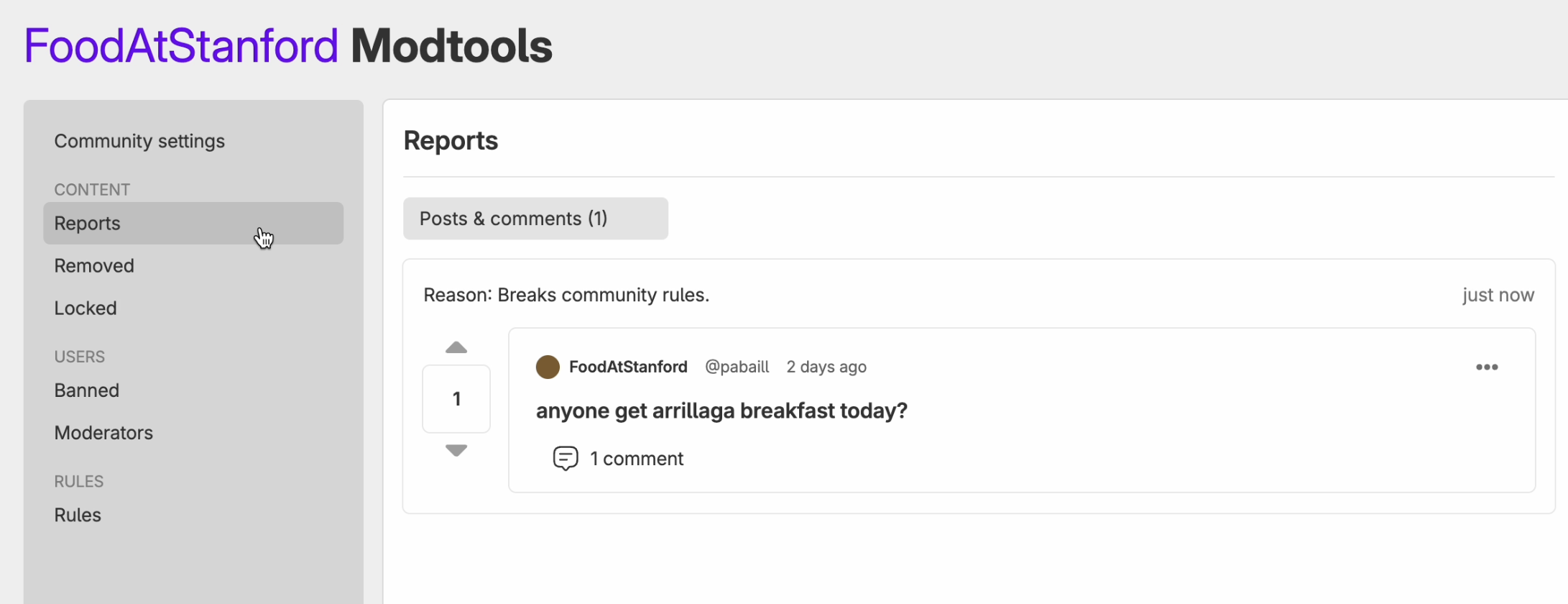
You are also welcome to iterate on your community’s rules, structure, or layout at any point in response to the bot activity or human users. Note and record documentation (ex., screenshots) of any changes you make and how this impacts your community, for later reflection.
This moderation process is meant to simulate the challenge of scaling values and behavior enforcement as community activity increases. Use your judgment to maintain a healthy and engaging space.
Part 3: Reflection
In approximately 1000 words, write a reflection on the experience, including the following:
What was the core purpose or vision of your community, and how did you design the rules and structure to support that vision?
Referencing the learning goals in the “Growing Pains” lecture, reflect: what kinds of issues arose in your community as it grew? What were the decisions you made, and how did they shape your community? What worked well—and what didn’t—in your approach to building and moderating the community? What are some limitations of using a classroom community as a stand-in for real online communities? How might these constraints affect the kinds of moderation decisions you made, or the types of feedback you received?
Describe your experience participating in other communities as they grew. What behaviors made you feel more or less welcome? What did you observe other students doing that worked, or didn’t work? How did these interactions influence your understanding of community dynamics and moderation?
Part 4: Wayback Machine
Finally, we will do a bit of digital archaeology to understand how a real community responded to growth. Pick a subreddit that is now fairly large (e.g., at least 100,000 members). You will investigate the subreddit at three time points in its history: (1) when it was still small, (2) when it was undergoing massive growth, and (3) today.
This part of the assignment will likely be easiest to complete if you pick a community that is public on the web without login (e.g., a community on Reddit, Hacker News, Usenet, or an online forum). If you are unsure of a good community to use, you may use the r/NoSleep subreddit, which underwent massive growth starting in late 2014. Using a public forum such as this will enable you to use The Way Back Machine to rewind time and look at the community at earlier timepoints in history. For example, here is (1) NoSleep before it grew, (2) NoSleep as it was suddenly thrust into massive growth, and (3) NoSleep today. If your community isn't publicly available (e.g., a Facebook Group, a Discord server, a Twitch channel), you may need to manually scroll back through its history (use the timeline at the top to switch dates).
In approximately 300 words, use course concepts to analyze what changed about the community as it grew. Include screenshots of the community at each time point.
Did its norms shift? Did the community get more specific about those norms? Did it add rules, and if so, why?Use concepts from the Growing Pains and Feed Me lectures to explain your observations: e.g., newcomers challenging norms, causing cultural clashes, challenging authenticity, and prompting more aggressive moderation strategies. Or perhaps any errors the community made, for example, by assuming that their existing design would scale automatically.
Final Submission Checklist
- ✅ Seddit community link
- ✅ 1000-word final reflection/writeup with documentation
- ✅ 300-word Wayback Machine write-up with 3 timepoint screenshots
File format: Combine everything into one PDF and submit to Gradescope by Tuesday, April 22nd, 2025.
Grading Rubric
| Category | Insufficiency | Adequacy | Proficiency | Mastery |
|---|---|---|---|---|
| Moderation Decisions 5 points |
Little to no moderation effort or unclear responses to issues. | Some responses, but inconsistent or lacking context. | Clear moderation decisions made, with reasoning explained. | High-quality moderation; thoughtful responses that maintain tone, clarify rules, and engage the community. |
| Participation in Other Communities 5 points |
Fewer than the expected number of engagements are fulfilled, or engagements are superficial or off-topic. | All expected posting engagements fulfilled. | N/A | |
| Reflection 10 points |
Ineffective analysis of the implications of community design and changes due to growth. | Surface-level analysis of the community's changes due to growth and the implications of community design, or no integration of course concepts. | Appropriate analysis of the implications of the community's design and changes due to growth, or facile/incomplete use of course concepts. | Strong analysis of implications of community design, integrating course concepts. |
| Wayback Machine Use 5 points |
Ineffective analysis of the community's changes due to growth. | Surface-level analysis of the community's changes due to growth, or no integration of course concepts. | Appropriate analysis of the community's changes due to growth, or facile/incomplete use of course concepts. | Strong analysis, integrating course concepts. |
❓ FAQs
Q: Are we participating as ourselves? Are students expected to break rules, or is that mostly the role of the bots?
A: Yes, you’re participating as yourself, just like in a real online community. To simulate the semi-anonymity of online platforms, you may create a custom username, but please note: we have access to the list of usernames tied to each student account.
While each Seddit community has its own rules and evolving culture, you're also operating within a Stanford classroom setting. That means the Stanford Honor Code and Code of Conduct apply, and any harmful, harassing, or discriminatory behavior—whether directed at bots or classmates—will not be tolerated and may result in action. Because we know who you are, you are accountable for your conduct, even under a pseudonym.
That said, moderation only becomes meaningful when it’s tested. You’re encouraged to explore edge cases, play with the boundaries of norms, and observe how different types of behavior shape the community. This kind of “good trouble” is valuable for understanding the dynamics of online spaces, as long as it’s done respectfully and constructively.
Most of the “rule-breaking” will come from simulated users (bots) seeded with different personalities and behaviors. But your classmates may also experiment with tone, norms, or interaction style, and that’s part of the learning experience.
🔔 If you see something that feels off or crosses a line, please flag it immediately by posting privately on Ed under Assignments > Assignment 2.
Q: How exactly are we being graded?
A: This assignment is designed to reflect the complexity of real-world online community management. There is no single “correct” way to succeed, but we are looking for evidence of thoughtful, engaged participation across three main areas:
- Application of course concepts
Your decisions and reflection should demonstrate an understanding of key ideas from lecture and readings—such as norm formation, cultural drift, moderation strategies, scaling challenges, or tensions between authenticity and growth. These concepts should be evident both in how you manage your community and how you analyze its evolution. - Iteration and responsiveness
We expect you to make at least three meaningful changes or interventions during your 48-hour moderation window. These may include updating rules, changing the community description, creating pinned posts, or adjusting your engagement strategy. You should document each change and reflect on how the community responded. Passive moderation will not meet expectations. - Depth and clarity of reflection
Your writeup should go beyond summarizing events. We are looking for insight into what worked, what didn’t, what felt challenging or surprising, and how you decided when to intervene or step back. Strong reflections will connect your experiences to broader questions about designing and maintaining online communities at scale.
Ultimately, we are grading your ability to think critically about the challenges of community design, respond to evolving dynamics, and support your decisions with clear reasoning grounded in course material.
For example, did you:
- Change your rules after seeing unexpected behavior?
- Refine your description or layout to better align with how people were using the space?
- Notice a shift in tone or audience, and steer it intentionally?
Q: How many iterations are required during the moderation window?
A: You are expected to make at least three meaningful changes or interventions during your 2 moderation windows. These may include updating rules, changing moderation strategies, or adjusting community guidelines based on observed interactions.
Q: I have an extenuating circumstances that may make it difficult for me to participate or complete the simulation, what should I do?
A: Please reach out to the course staff directly (via a private post on EdStem - Assignments > Assignment 2) with an explanation of your situation, and we’ll do our best to accommodate you. We want to support you and make sure you can still get the learning value out of this assignment.
Final Note
This assignment is intentionally messy! Communities are messy. Growth is hard. There’s no perfect solution, and your role here is to observe and adapt. We hope you’ll come away with a better understanding of what it truly means to design for social computing at scale, and how our values shape the spaces we build.