|
Design, Technology, and Engineering benefitting individuals
with disabilities and older adults in the local community |
February 2, 2026 |
|
|
|
|
Perspectives is the newsletter of the
Stanford course,
Perspectives in Assistive Technology.
Course Enrollment Update
Week 5 Class Sessions &
Assistive Technology Faire Solicitation
This newsletter issue describes Week 5
class sessions.
|
Perspectives in Assistive
Technology is a Winter Quarter Stanford course - embarking on its
nineteenth year - that explores the design, development, and use of
assistive technology that benefits people with disabilities and older adults.
It consists of semi-weekly in-person discussions; lectures by
notable professionals, clinicians, and assistive technology users; a
tour of an accessible inclusive playground; student project
presentations and demonstrations; and an Assistive Technology Faire.
Students pursue team-based projects that address real challenges faced by
people with disabilities and older adults living in the local community. Check
out the course website. |
Week 5
Course News

Student Enrollment -
The course has enrolled 30 students, 26 have opted to work on a total of 7 team
projects. There are 2 Freshmen, 2 Sophomores, 8 Juniors, 12 Seniors, and 6
Graduate students.
Participating
Exhibitors - There are 8 confirmed exhibitors for the
Assistive Technology Faire.
Community
Attendance - Community members are most welcome to attend class
sessions on campus, enrollment is not required. There will not be a Zoom
participation option this year. |
Week 5 In-person Class
Sessions
|
Tuesday, February 3rd at
4:30pm PST
|
|
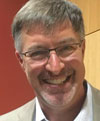
Thoughts on Assistive
Robotics
Steve B. Cousins, PhD & Michelle
Q. Wang Baldonado, PhD
Executive
Director of the Stanford Robotics Center & Research Engineer at the
Stanford Robotics Center |
Abstract: "Human beings are remarkable for the
many ways we can impact the world. We move through and interact with the world
directly, or with the help of tools, using our brains and our muscles to
control those tools. Robots can be thought of as tools, often with computers
instead of brains, and motors instead of muscles. Robots were invented to serve
humanity and can be great assistive technologies. They can augment and extend
our capabilities, whether to replace functions we no longer have (or never
had), or to give us new powers. Additionally, they can support healthy
behaviors that contribute to longevity, from physical activity to social
connection. In this talk, we'll give examples of how robots can and do help
people, from the Robots for Humanity project and other work at Stanford and
beyond, in order to explore what makes robots different from other assistive
technologies. We'll also present the new SOAR (Stanford Older Adult Robotics)
project that we're launching at the Stanford Robotics Center."
Biosketch: Steve B. Cousins is the
Executive Director of the Stanford Robotics
Center. He founded Relay
Robotics, formerly Savioke, serving as CTO and CEO, where he led the
development and deployment of Relay - an autonomous delivery robot that works
in human environments to help people. Steve was previously President and CEO of
Willow Garage, and is
a founding board member of the Open
Source Robotics Foundation. Steve received the
IEEE
/ IFR Award for Invention and Entrepreneurship in Robotics and Automation
in 2017.
Steve earned his PhD in
Computer Science at Stanford
University under the direction of
Terry Winograd,
and also holds BS and MS computer science degrees from Washington
University.
Biosketch: Michelle Baldonado is a
Research Engineer at the Stanford Robotics Center. She leads the Stanford Older
Adults Robotics (SOAR) project at the SRC. Michelle earned her PhD in
Computer Science at Stanford
University under the direction of
Terry Winograd.
She also earned an MPhil in Computer Speech and Language Processing from
Cambridge University and an AB in Computer Science (joint with Linguistics)
from Harvard University. |
|
Thursday, February 5th at
4:30pm PST
|
|
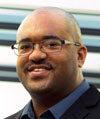
Assistive
Robotics
Monroe Kennedy III, PhD
Assistant Professor of Mechanical Engineering and,
by courtesy, of Computer Science - Stanford University |
Abstract: The development of Assistive Technology
benefits from the contributions of many areas of study. Engineering of physical
devices plays a crucial role in meeting the needs of the user and improving the
human experience. There are many user needs however, that would greatly benefit
from systems capable of not only performing passively, but also from devices
that can take action to directly help the user. The question becomes "How can
an assistive device capable of taking action, determine the best action to
take, in order to help the user at a given moment?". This question leads to the
field of Robotics, which is the development of 'thinking' machines. While the
term 'thinking' here is used very broadly, it can be simplified to the ability
to observe a scenario (perception), 'think' or plan about what action to take
(this could range from a simple feedback control principle to a machine
learning model), then perform some action on the world to change the scenario
in some way. Assistive Robotics is the field of study of applying all the
advancements of robotics to assistive technology solutions that would benefit
from 'thinking' devices. In this talk, I will highlight basic principles of
'thinking' machines and discuss the application of these principles to
assistive technology with a primary focus on work performed in the Stanford
Assistive Robotics and Manipulation Laboratory (ARMLab).
Biosketch: Monroe Kennedy III is an
assistant professor in Mechanical Engineering and by courtesy, Computer Science
at Stanford University. Monroe is the recipient of the
NSF
Faculty Early Career Award. He directs the Assistive Robotics and
Manipulation Laboratory ARMLab, where
the focus is on developing collaborative, autonomous robots capable of
performing dexterous, complex tasks with human and robotic teammates. Monroe
received his Ph.D. in Mechanical Engineering and Applied Mechanics and
master’s in Robotics from the University of Pennsylvania. |
Upcoming In-person Class Sessions
Assistive Technology Faire - Call for
Exhibitors

Product manufactuers and
service providers are invited to participate in the Assistive Technology
Faire - This fourteenth annual course event is scheduled for
Thursday, February 19th and will provide an opportunity for students and
community members to get an up-close look at a variety of assistive technology
devices and learn about available services. Users of assistive technology
products as well as small companies and agencies serving
individuals with disabilities and older adults are encouraged to join in on
this event. Browse to the Call for Assistive Technology
Faire Participants webpage for more information and contact me to
register.
Everyone is welcome to attend this event. Here is the
current line up and
slides from last year's
Faire. |
Please contact me with your ideas, questions, comments,
and project suggestions - or just to say hello. Please continue to stay safe
& healthy.
Dave Jaffe - Course Instructor
|
To unsubscribe from this newsletter, please email
Dave. |
|