|
Class Sessions |
| Week
1 |
Week
2 |
Week
3 |
Week
4 |
Week
5 |
Week
6 |
Week
7 |
Week
8 |
Week
9 |
Week
10 |
|
|
|
|
|
|
|
|
|
|
|
Thursday, February
5th
|
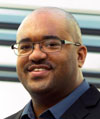
|
Assistive
Robotics
Monroe Kennedy III,
PhD
Assistant Professor of Mechanical Engineering
and, by courtesy, of Computer Science - Stanford University |
Abstract: The development of
Assistive Technology benefits from the contributions of many areas of study.
Engineering of physical devices plays a crucial role in meeting the needs of
the user and improving the human experience. There are many user needs however,
that would greatly benefit from systems capable of not only performing
passively, but also from devices that can take action to directly help the
user. The question becomes "How can an assistive device capable of taking
action, determine the best action to take, in order to help the user at a given
moment?". This question leads to the field of Robotics, which is the
development of 'thinking' machines. While the term 'thinking' here is used very
broadly, it can be simplified to the ability to observe a scenario
(perception), 'think' or plan about what action to take (this could range from
a simple feedback control principle to a machine learning model), then perform
some action on the world to change the scenario in some way. Assistive Robotics
is the field of study of applying all the advancements of robotics to assistive
technology solutions that would benefit from 'thinking' devices. In this talk,
I will highlight basic principles of 'thinking' machines and discuss the
application of these principles to assistive technology with a primary focus on
work performed in the Stanford Assistive Robotics and Manipulation Laboratory
(ARMLab).
Biosketch: Monroe Kennedy
III is an assistant professor in Mechanical Engineering and by courtesy,
Computer Science at Stanford University. Monroe is the recipient of the
NSF
Faculty Early Career Award. He directs the Assistive Robotics and
Manipulation Laboratory ARMLab, where
the focus is on developing collaborative, autonomous robots capable of
performing dexterous, complex tasks with human and robotic teammates. Monroe
received his Ph.D. in Mechanical Engineering and Applied Mechanics and
master’s in Robotics from the University of Pennsylvania.
- Contact
information:
- Stanford
Profile
- Lecture Material:
- Pre-lecture slides - 941 Kb pdf file
- 10 Commandments of Making -
(10:03)
- Slides - 18.3 MB pdf filr
- Photos - 754 Kb pdf file
- Links:
|

