[Menu] [Previous] [Next]

TUTORIAL: Principles of Tracer Modeling

Image Quantitation

Use the "Menu" button to jump to the Let's Play PET Main Menu or click on the Next (right arrowhead) and Previous (left arrowhead) buttons to proceed sequentially through the topics and tutorials. Or, you can return to the Department of Molecular and Medical Pharmacology's Home Page.

Contents:
Topics: Qualitative vs. Quantitative Image Analysis
Approaches to Quantitative Image Analysis
  1. Radioactivity Image
  2. Mean Value in Region of Interest
  3. Time-Activity Curve for ROI
  4. Normalized ROI Curve
  5. Tracer Modeling of ROI Curve
Criteria for Quantitative Image Analysis
  1. Speed
  2. Radioactivity Image
  3. Mean Value in Region of Interest
  4. Time-Activity Curve for ROI
  5. Normalized ROI Curve
  6. Tracer Modeling of ROI Curve
  7. Precision
  8. Radioactivity Image
  9. Mean Value in Region of Interest
  10. Time-Activity Curve for ROI
  11. Normalized ROI Curve
  12. Tracer Modeling of ROI Curve
  13. Comparability with Other PET Studies
  14. Radioactivity Image
  15. Mean Value in Region of Interest
  16. Time-Activity Curve for ROI
  17. Normalized ROI Curve
  18. Tracer Modeling of ROI Curve
  19. Comparability with Other Kinds of Results
  20. Radioactivity Image
  21. Mean Value in Region of Interest
  22. Time-Activity Curve for ROI
  23. Normalized ROI Curve
  24. Tracer Modeling of ROI Curve
Parameter Estimation Flowchart

Qualitative vs. Quantitative Image Analysis


Click on image above to view full-size image.

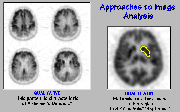
Image analysis approaches span the spectrum from what we would call "Qualitative" to what we would call "Quantitative." This tutorial focuses on quantitative approaches to image analysis.

Approaches to Quantitative Image Analysis

Listed below are PET image analysis approaches, which, from top to bottom, incorporate increasing degrees of quantitation. The greatest degree of quantitation involves modeling of the PET tracer in the tissue. Before learning about tracer modeling, one needs to understand the simpler analysis approaches.

1. Radioactivity Image
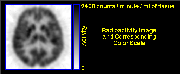

Click on image above to view full-size image.

With the "Radioactivity images" approach, "what you see is what you get." Immediately following reconstruction, PET images are in units of counts per minute per pixel (or counts per second per pixel). However, the images are typically calibrated in units of counts per minute per milliliter of tissue. This calibration can be performed by scanning a tracer-filled cylinder of known activity and volume. The PET images are then displayed on a computer display, with each pixel assigned a display color according to a color look-up table. Throughout this tutorial "radioactivity image" will be used interchangeably to refer to images with units of counts/time/pixel or with units of counts/time/volume.

2. Mean Value in Region of Interest
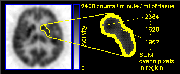

Click on image above to view full-size image.

In the "Mean value in region of interest" approach, one uses a computer to draw a region (ROI) around a contiguous set of pixels in the PET image. The computer then computes the mean value of the pixels in the ROI. In the above image, the left striatum is outlined. Note that one just as appropriately could have reported the ROI mean value in counts per minute per pixel.

3. Time-Activity Curve for ROI
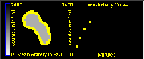

Click on one or more of the images above to view full-size image(s).

The "Time-activity curve for ROI" approach generates a plot of the mean radioactivity value in an ROI across a sequence of PET images (i.e., across time). For example, one might plot a left striatal time-activity-curve, as illustrated above. Each data point corresponds to the mean pixel value in a common region of interest at a given time. In this example, eight sequential PET scans were made. Thus, there are eight data points. Review "Mean value in region of interest" to learn how one data point would be calculated.

4. Normalized ROI Curve
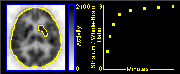

Click on image above to view full-size image.

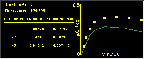
The "Normalized ROI curve" approach involves plotting, across time, the ratio of one ROI's time-activity curve to another ROI's time-activity curve. The above example shows a hypothetical plot of the ratio of left-striatal activity to whole-brain activity; i.e., the left striatal time-activity curve has been "normalized" to the radioactivity in the whole brain in this imaging plane.

5. Tracer Modeling of ROI Curve
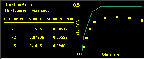

Click on one or more of the images above to view full-size image(s).

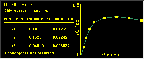
In the "Tracer modeling of ROI curve" approach, one fits a mathematical model to an ROI time-activity curve, based on a known input function (e.g., from well-counted arterial plasma samples taken during the PET study). The fitting produces estimates of the model's parameters. These parameters might be rate constants, blood flow, or receptor density.

Criteria for Quantitative Image Analysis
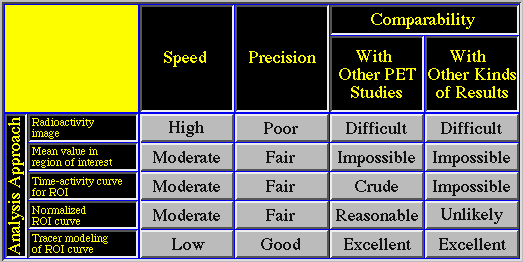

Each of the five listed approaches to quantitative image analysis can be described according to four criteria. A sixth approach to quentitative image analysis is parametric imaging, which as illustrated in the Clinical PET Cardiology tutorial. Briefly, the value of each pixel of a parametric image represents the mobel estimate of the parameter of interest at that location in the image. To generate such an image, the tracer model is applied individually to each pixel of the radioactivity image.

  1. Speed
  2. Radioactivity Image "Radioactivity image" is the fastest among the five analysis approaches. This is what the reconstruction (+ calibration) process gives us.
  3. Mean Value in Region of Interest "Mean value in region of interest" requires a moderate amount of time. This involves drawing, with the aid of a mouse, trackball, or joystick, a region around a structure of interest in a PET image and then commanding the computer to compute the mean of the values of the pixels within the region of interest (ROI).
  4. Time-Activity Curve for ROI "Time-activity curve for ROI" requires only slightly more time than "Mean value in region of interest." It involves commanding the computer to apply ROI analysis to a temporally sequential set of PET images and to plot that sequence of mean values over the time intervals during which the PET images were obtained.
  5. Normalized ROI Curve "Normalized ROI curve" requires only slightly more time than "Time-activity curve for ROI." It involves plotting the ratio of the structure-of-interest's ROI curve to a "normalizing" structure's ROI curve. (For example, the cerebellum is often used as the normalizing or "reference" structure.)
  6. Tracer Modeling of ROI Curve "Tracer modeling of ROI curve" is the slowest among the five analysis approaches. Based on a plasma curve (which acts as the model input function), the ROI time-activity curve is fitted by a tracer model to estimate parameters that are biochemically or physiologically meaningful.
  7. Precision
  8. Radioactivity Image Among the approaches, "Radioactivity image" suffers from the poorest precision. Given identical subject and experimental conditions, the value of a given pixel in a given plane at a given scan will vary from study to study due to the Poisson nature of radioactive decay. The other analysis approaches use more information, resulting in relatively better precision.
  9. Mean Value in Region of Interest "Mean value in region of interest," relative to the other analysis approaches, enjoys fair precision. Statistical theory demonstrates that the mean from repeated samples of a population (e.g., of pixels in a region) has less variance (i.e., greater precision) than does the sample operator itself (e.g., of individual pixels in a reconstructed image).
  10. Time-Activity Curve for ROI "Time-activity curve for ROI" has fair precision, due to the fair precision of "Mean value in region of interest," from which it is derived.
  11. Normalized ROI Curve "Normalized ROI curve" has fair precision, due to the fair precision of "Time-activity curve for ROI," from which it is derived.
  12. Tracer Modeling of ROI Curve "Tracer modeling of ROI curve" has the best precision among the five analysis approaches. For this approach, precision refers to the reproducibility of the parameter estimates. Because these estimates derive from the ROI curve and from the plasma curve, one could think of this approach as using the most information from a study. As a rule of thumb, more information means better reproducibility.
  13. Comparability with Other PET Studies
  14. Radioactivity Image Using the "Radioactivity image" approach, it is difficult to compare one study with other PET studies. The only comparability available is of a "global" nature Ð one can compare the overall pattern (of low-to-high pixel values) of one PET image to that of one or more other PET images (e.g., to decide whether the pattern matches a pattern that is characteristic of a disease).
  15. Mean Value in Region of Interest Using the "Mean value in region of interest" approach, it is impossible to compare one study with other PET studies. The inherent variability in a PET system (e.g., tomograph calibration) prevents this.
  16. Time-Activity Curve for ROI Using the "Time-activity curve" approach, one can crudely compare one study with another PET study. How is this possible, given that this approach is derived from the "Mean value in region of interest" approach? Although absolute values of curves from two PET studies cannot be compared, shapes of curves can be compared.
  17. Normalized ROI Curve The "Normalized ROI curve" approach provides for reasonable comparability of one PET study with another such study. A normalized ROI curve is the plot of a ratio across time, and biological ratios have been found to be reasonably comparable throughout biochemistry and physiology.
  18. Tracer Modeling of ROI Curve The "Tracer modeling of ROI curve" approach allows for excellent comparability among PET studies. With this approach, what is being compared are the estimates of the model parameters. Assuming that the model is sensitive & specific for the PET tracer, the parameter estimates are easily compared from study to study.
  19. Comparability with Other Kinds of Results
  20. Radioactivity Image The "Radioactivity image" approach makes it difficult to compare a PET study with other kinds of results. The only comparability available is of a "global" nature Ð one can compare the overall pattern (of low-to-high pixel values) of the PET image, perhaps known to be characteristic of a disease, with other results (e.g., a neurological test battery or a treadmill test).
  21. Mean Value in Region of Interest The "Mean value in region of interest" approach produces a value that is impossible to compare with results from other kinds of studies. For example, how can one compare mean counts per pixel over a scan duration, from a PET study, with, say, heart rate on a treadmill? Even correlative indicators would be sensitive to administered dose of PET tracer, etc.
  22. Time-Activity Curve for ROI Using the "Time-activity curve" approach, one cannot compare a PET study with quantitative results from another kind of study. Too much is not known about the PET study - plasma input function, tomograph calibration, and so forth.
  23. Normalized ROI Curve It is unlikely that one would be able to compare the results from taking the "Normalized ROI curve" approach to a PET study with results from other kinds of studies often performed to complement the PET study because these other kinds of studies do not often deal with ratios.
  24. Tracer Modeling of ROI Curve "Tracer modeling of ROI curve" produces results - parameter estimates - that are easily compared with results from other kinds of exams, tests, and studies. For example, the regional blood flow estimate from a PET study can be compared with blood flow estimates from a SPECT study or a catheterization exam.

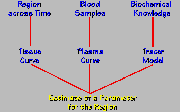
Parameter Estimation Flowchart


Click on image above to view full-size image.

This flowchart shows how the components of a PET study lead to the estimate of a biochemical or physiological parameter for a tissue region of interest. In a dynamic cardiac study, a left-ventricular blood-pool region can be analyzed across a sequence of images to generate a blood-curve input-function in substitution for a plasma curve obtained by drawing blood samples.

Return to Top of Tutorial


[Menu] [Previous] [Next]