
Archive for the ‘Web Tools’ Category
NIH Open Access Links/Info
Monday, March 17th, 2008- Public Access Homepage (National Institutes of Health)
- NIH Grants Policy & Guidance
- Includes: Notice of Public Meeting: Seeking Comments on Implementation of the NIH Public Access Policy (Comment Receipt Date: on or before March 17, 2008)
- Revised Policy on Enhancing Public Access to Archived Publications Resulting from NIH-Funded Research
- NIH Extramural Nexus — January 2008
- Top Stories include “What the New Public Access Requirement Means to the NIH-Supported Investigator”
Learn at Your Laptop
Wednesday, March 12th, 2008The Oxford African American Studies Center
Monday, March 3rd, 2008
Celebrate Black History Month all year, learn about African American scientists and engineers
The Oxford African American Studies Center combines the authority of carefully edited reference works with sophisticated technology to create the most comprehensive collection of scholarship available online to focus on the lives and events which have shaped African American and African history and culture.
Precise search and browse capabilities allow users to refine their results by specific eras and subject categories. And users can choose to view biographies, subject entries, primary sources, images, maps, or charts and tables when searching or browsing. The site’s thematic timelines and Learning Center resources also provide users with powerful tools for navigating the content.
Writing Guidelines for Engineering and Science Students
Monday, March 3rd, 2008Crafting meaningful and articulate lab presentations and correspondence can be difficult for anyone, including engineers and other scientists. The Virginia Tech Writing Guidelines site is designed to teach engineering and science students about creating and writing materials such as resumes, formal laboratory reports, presentation slides, and so on. The guidelines are gathered into several different sections, including “Introduction”, “Presentations”, “Correspondence”, and “Formal Reports”. There is material for instructors here as well, and the offerings include pieces on the design of writing assignments, the interactive teaching of writing, and the evaluation of writing assignments. Finally, the site also contains a number of writing exercises on grammar, punctuation, and word usage. [KMG] Source: The Scout Report, February 15, 2008.
Library of Congress: Science Reference Services
Monday, March 3rd, 2008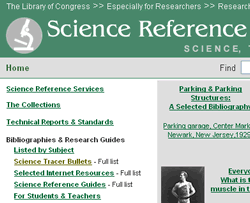
As one of the world’s premier libraries, the Library of Congress has many staff members dedicated to helping members of the general public find the information they need. Along with providing in-person assistance in Washington, D.C., they also maintain this nifty Science Reference Services site designed for persons looking for science reference material online. There is not much that isn’t included on the site, as visitors can view webcasts on creating a school garden, look over research guides, and learn about “Everyday Mysteries”. The “Everyday Mysteries” feature provides answers to questions such as “Who invented electric Christmas lights?” and it can be quite addictive. Visitors should also click on over to the “Science Reference Guides” area. Here they can look at comprehensive research bibliographies on chocolate, astronomy, electric power, and dozens more. With all of this material, visitors may also want to sign up for their RSS feed. [KMG] Source of review: The Scout Report, February 15, 2008.
Science and Engineering Statistics
Monday, March 3rd, 2008National Science Foundation — Division of Science Resources Statistics (SRS)
Publications, data, and analyses about the nation’s science and engineering resources

Education
Degrees, Disabilities, Elementary and Secondary, Graduate Students, International, Minorities, Postdoctorates, Universities and Colleges, Women
CAS Source Index (CASSI) — Networked CD-ROM via Web
Monday, March 3rd, 2008Identify journal titles and abbreviations quickly with CASSI.
Login on the CD Server with your SUNet ID to search a networked CD version of CASSI.
CASSI includes:
- Bibliographic information for approximately 80,000 publications indexed by CA since 1907
- Serial and non-serial scientific and technical publications
- Complete publication titles for abbreviations used in CA
- More than 155,000 entries, mainly for periodicals
- A choice of many search terms, i.e., author name, keyword, CODEN, etc., for easy access to the bibliographic information
Scintilla
Monday, March 3rd, 2008Scintilla collects data from hundreds of news outlets, scientific blogs, journals and databases and then makes it easy for you to organize, share and discover exactly the type of information that you’re interested in. For example, you can keep track of life science podcasts, or the latest papers on schizophrenia, DNA methylation or immunology. Interested in physics blogs? Scintilla can help. You can rate items and recommend them to any colleagues who’ve also signed up to the site. You can also create or join groups centered around particular areas of interest (like bioinformatics or open science).
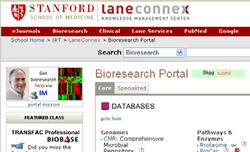
Bioresearch Portal at Lane
Monday, March 3rd, 2008Maintained by Yannick Pouliot, a member of the Lane Library’s Knowledge Management Center, the Bioresearch Portal is a one-stop collection of high quality software research tools and databases, primarily oriented toward Life Sciences laboratory researchers. Its purpose is to raise awareness and understanding of these resources. The Bioresearch Portal is a product of the Lane Library’s Bioresearch Informationist program.