01 · Focus
Self-improvement, challenged by consistency
Last week
Self-improvement
This week
…is challenged by consistency
Because of
Busy schedules, overwhelming apps, low short-term motivation
02 · New interviews
Two more people
Average user
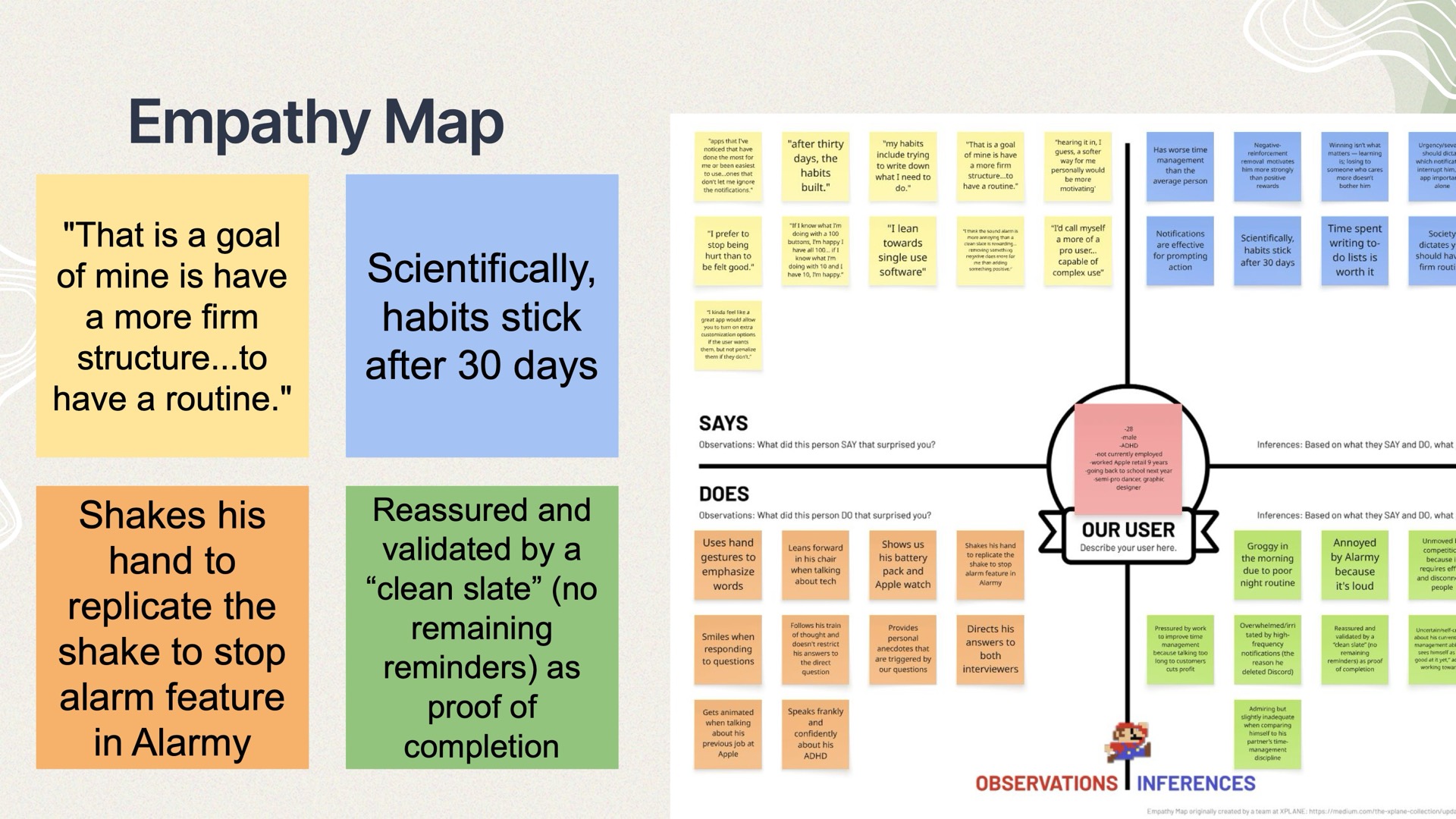
"Adam", 28, ex-Apple retail
San Mateo. Has ADHD, going back to school, semi-pro dancer and graphic designer. Uses Alarmy to wake up, and feels validated by a "clean slate" of finished reminders.
"That is a goal of mine, to have a more firm structure… to have a routine."
Normal user
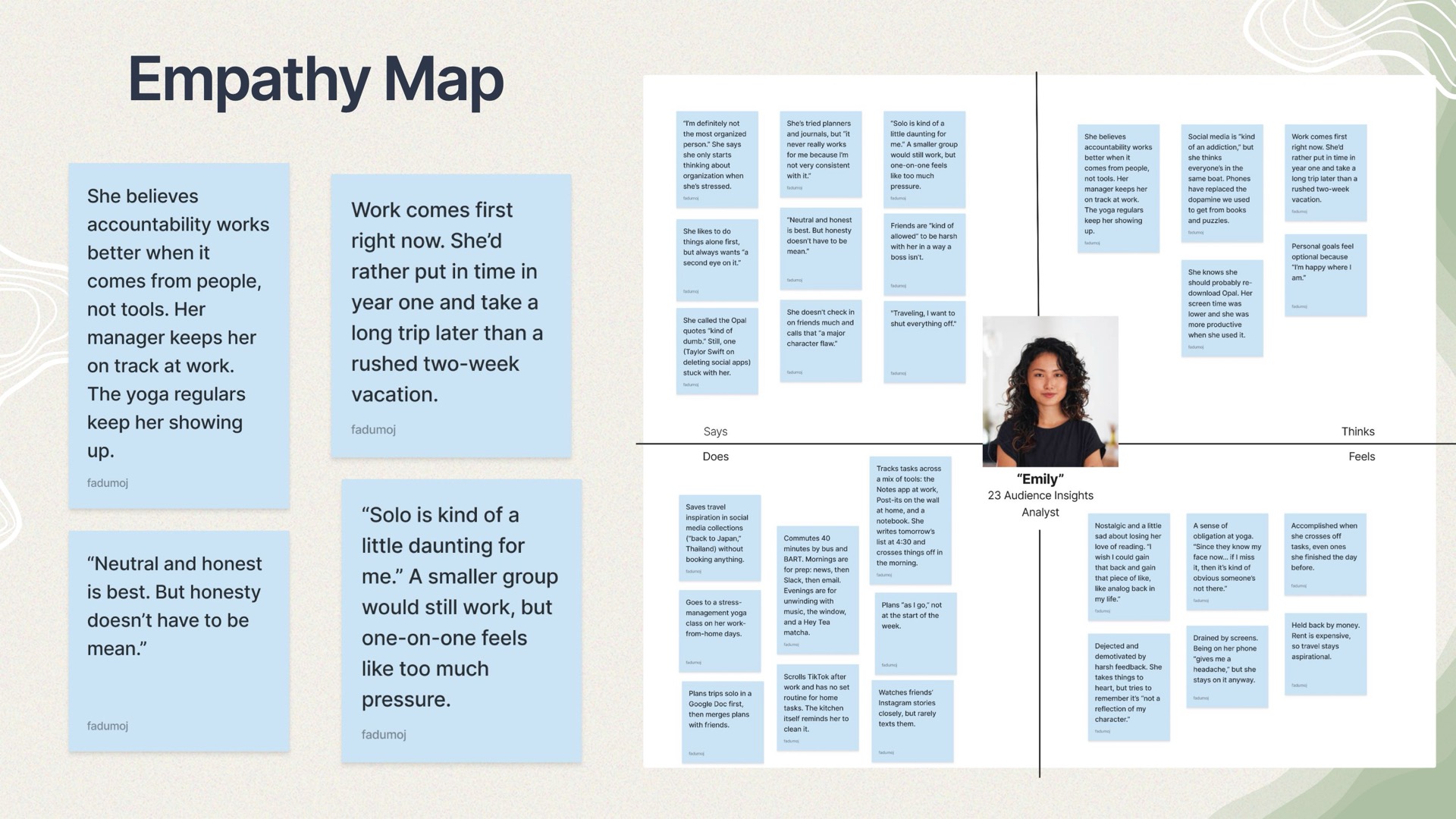
"Emily", 23, audience insights analyst
Recent Stanford grad working at a radio station. Loves yoga, matcha and K-pop; wants less screen time.
"I feel like there's an obligation, since they know my face now, that I also have to be there."
03 · POVs & HMWs
Three points of view
POV · Bob
We met Bob, a 34-year-old marriage and family therapist working on nutrition and fitness. We were surprised that he uses simple to-do lists, but the habits he schedules are the ones that get done. We wonder if he'd like to schedule tasks, but current apps make it too much work. It would be game-changing if scheduling a habit took no more work than adding a to-do.
POV · Peter
We met Peter, a 34-year-old mental health therapist working on fitness and nutrition. We were surprised that personal rewards work best for him, even though his biggest challenge is energy after work. We wonder if short-term rewards can overcome low energy. It would be game-changing if he could reach his goals even on busy, low-energy weeks.
POV · Anne
We met Anne, a 43-year-old legislative aide who games and travels often. We were surprised that she knows untracked habits don't get done, yet tracking tools overwhelm her. We wonder if she'd track habits if it didn't feel overwhelming. It would be game-changing if she could track habits without being overwhelmed.
Our first POV, about Bob preferring soft love but responding to tough love, was revised once we saw scheduling mattered more.
04 · Solutions
Three ideas and their risks
Solution 1
Anonymous accountability partners
Assumption: people respond to accountability from anonymous sources.
Risks: unmoderated partners could be rude, which may hurt marginalized communities; leaves out people uneasy with strangers.
Solution 2 · chosen
Goal breakdown + check-in notifications
Assumptions: telling people how makes them likelier to succeed, and they'll read the breakdowns.
Risks: notifications can cause shame or encourage unhealthy behavior without limits.
Solution 3
Earn social media minutes
Assumptions: people will work for a quick dopamine boost, and for social media time.
Risks: may encourage social media use, which can harm mental health.
All three need a phone and leave out people with visual impairments who can't use iPhone accessibility features well.
05 · Experience prototypes
Testing the critical assumptions
Prototype 1 · anonymous accountability
A note mid-scroll
While an ambitious Stanford student scrolled TikTok, we slid her a paper note: "Hey, did you stick to your plan today? You said you would go to the gym…"
Result: she felt "light shame", and cared about the message, not who wrote it. Assumption supported.
Prototype 2 · goal breakdowns
A four-goal quiz
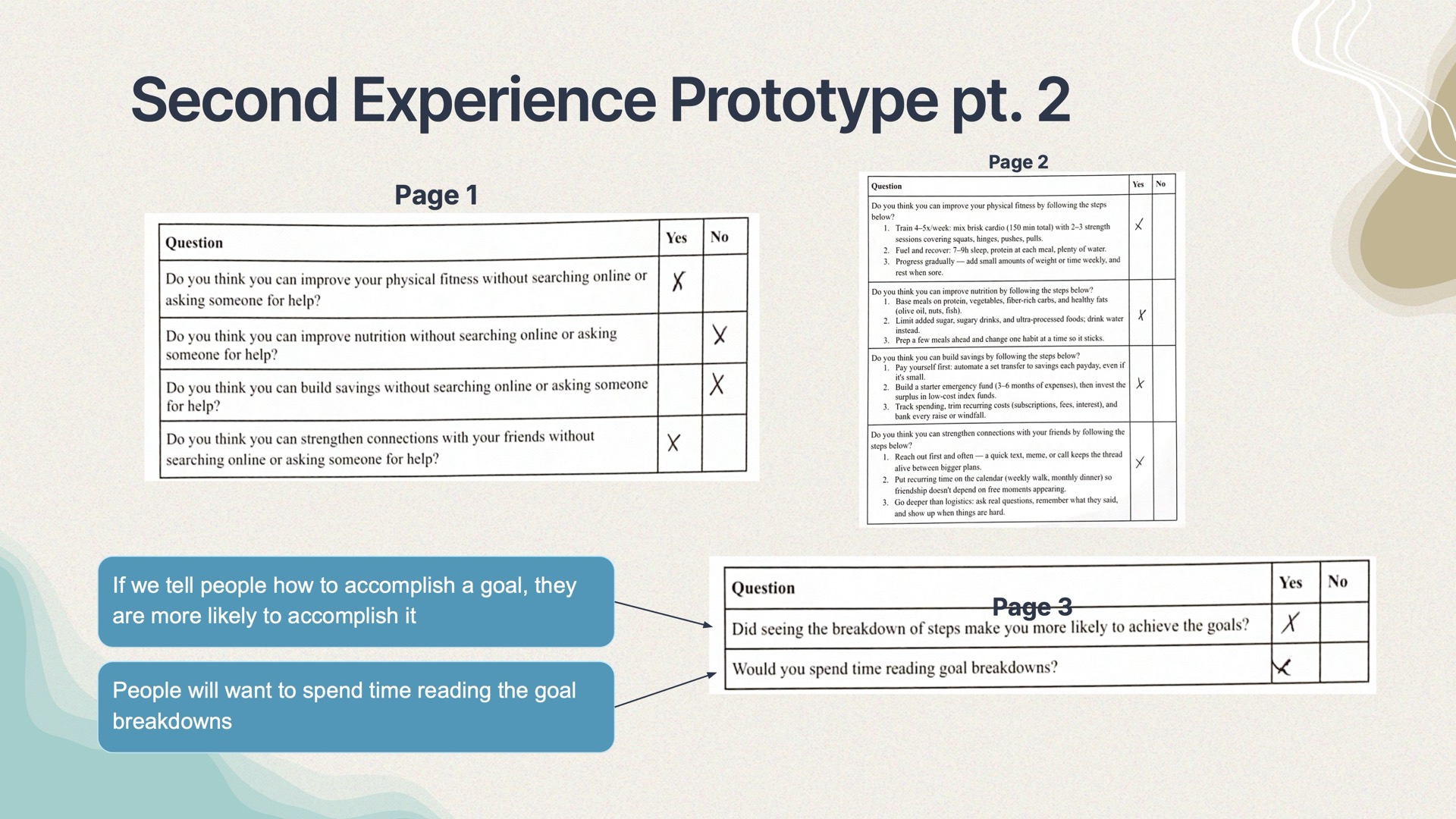
A busy, tired lab technician said whether they could do four goals alone, then again with AI-generated breakdowns.
Result: confidence rose from 2 of 4 goals to 4 of 4, and they'd spend time reading breakdowns. Both assumptions supported.
Prototype 3 · work for rewards
Push-ups for candy
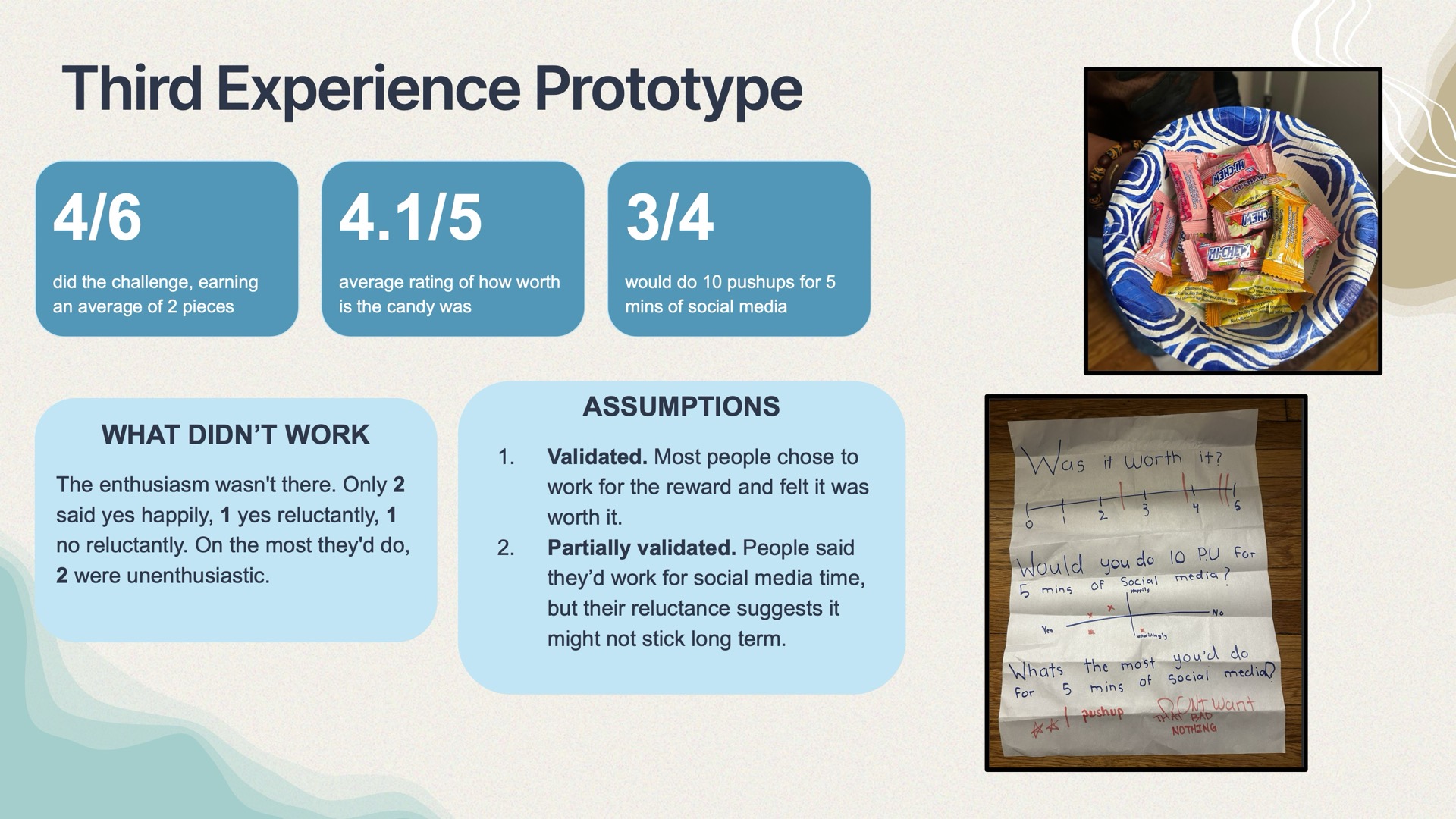
Passersby did push-ups for candy, then answered whether they'd do 10 for 5 minutes of social media.
Result: 4 of 6 took part (about 2 pieces each, worth 4.1/5); 3 of 4 would work for social media time, but reluctantly. Partly supported.
06 · What's next
The goal breakdown wins
Chosen: goal breakdown + notifications
Breakdowns raised confidence from 2/4 to 4/4 goals, and the participant was willing to read them. It supports two of our three POVs: Anne, by making apps less overwhelming, and Bob, by prompting his unscheduled tasks.
Ethics & communities
Serves busy professionals and students with self-improvement goals. Leaves out people without a phone, or without the physical, mental or financial means for a goal. Reminders could hurt self-image, so users control their notifications.
Slides
The full A2 presentation
Use the arrows, the thumbnails or your keyboard's arrow keys.