A Page for the T'enna team
Final Product: Proposed Design of Preschool Classroom
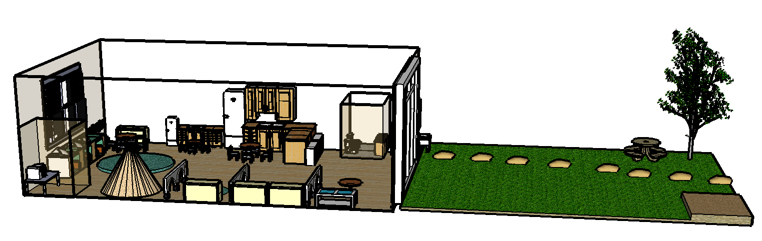
See the original using Google Sketch-up and searching for DLS
Process: 4/24/07
We met today to discuss goals. At this point, we are exploring the options for this project. Since both of us are passionate about the topic, we want to observe as many preschools as possible. Ideally we would love to provide one site with a new learning design. Along with this we would create a list prioritizing which design changes should be made and in what order. That way all preschools could benefit from our learning. Most of the preschools we have seen are very similar. We were wondering if this is because research specifies preschools should be designed a certain way or if everyone is just following a given model (most likely some iteration of Reggio Emilia). By next class we intend to conduct some preliminary research in order to understand why preschools are designed the way they are. Christy
Process: 05/05/2007
On Thursday we went to our site (T'enna) for the first time. We had a chance to visit all of the classrooms and talk to Zvi (our contact). We took pictures of the spaces but considering the age of the children who attend the school, Zvi asked us not to post them on the internet. Therefore, I will bring a CD with the pictures to class for people who are interested in seeing the space. With Zvi, I talked about the goals/mission of T'enna as well as the history and future of the spaces of T'enna. Zvi said that T'enna is family focused and sees the whole family as their client. Also, children are considered explorers and investigators and therefore the T'enna is child-centered. T'enna incorporates Jewish traditions and rituals into their classrooms, and they even offer 2 Hebrew immersion classrooms. Zvi made a special point to mention that he values an indoor/outdoor space and the use of natural products in the classrooms. Zvi pointed out the compost and recycling bins and talked about how the center is kept mostly kosher by not allowing meat products. Zvi gave us a booklet of information that includes daily routines of the classrooms, T'enna philosophy, how the space is used for after school enrichment programs, and information about their lunch program. The classrooms are all identical spaces and are fairly large. However, there was a lot of clutter in the rooms which Christy and I feel can be resolved by a system of organization that is easy to use. Also, the classrooms, although identical architecturally were set up in different ways. Therefore, I think it will be important for us to return to T'enna and talk more to the teachers to find out their methods of arranging their classrooms. Overall i think we got a really good feel for the space, the mission, and the users of the space and I think the visit made us even more excited to jump into this project. Christy and I walked away from T'enna talking about how impressive the teachers were in their interactions with the children and how rearranging the space could potentially be a complimentary component to the social interactions that occur at T'enna.
Also, Christy and I met with Susan Neuman, former Assistant Secretary of Education and Early Childhood Education Advocate and Researcher. She has sent us an article and a chapter of her book that is not yet published because she thought it could be relevant to our project. Also, she gave us the names of some great resources to consider in the field of ecological psychology. Her own principle of physical and psychological proximity sounds like it could be useful for us as well. She also pointed us to research on activity settings, something that she said might be tangentially helpful to us. She served as a great resource to us and our talk with her was very inspiring. Sara
Process: 5/6/07
We are also talking to preschool directors from throughout the country to understand how new sites are designed. Today I had an interesting conversation with a montessori teacher at a low income preschool in Florida. She mentioned an upper end facility in Miami and all of the resources they had available (spotlights, custom made applicances that were child sized,etc). Her preschool is a nonprofit and they have outgrown their site. While they do not have the resources of this other school, she intends to learn from their model and adapt certain aspects to her new site. She also has been assigned a mentor through the NAYEC to help with the planning phase. The ultimate goal is to create something that is the children's home. this is helpful as Sara and I have discussed our desire to create something beneficial to all children, regardless of what their parents can afford. Christy
Sara Adelmann Christy Johnson
NABC for the advance of physical support for social and emergent learning at T’enna Preschool
Need Researchers have found that the purposeful use of space for learning in preschool settings has resulted in a higher level of science and number concepts, more creativity, better use of oral language and an earlier sense of conservation (Nash, 1981). Also, the space that is set up for learning and interaction should reflect program goals and philosophy (Neuman, not yet published). The space and the program should be so connected that they effectively “become like another ‘teacher’ in [the] room” (ibid). In order to accomplish this task, careful consideration must be given to the function and the materials of each space (ibid). T’enna Preschool aims to provide a high-quality program for young children and their families that is child-centered yet community oriented (Interview with Zvi Weiss, 05/03/2007). This mission seems to be reflected in the interactions between the teachers and children, as one parent states, “there is an atmosphere of professionalism tempered with warmth and caring that begins with the administration and filters down” (tour information packet T’enna Preschool). However, the physical space needs to be altered in order to better support social and emergent learning at T’enna.
Currently, the space at T’enna Preschool lacks organization and storage. Since “good storage maximizes the use of resources (because you can find them); builds up more resources (because you can store them); teaches children how things go together; extends and elaborates their play (because they can locate objects readily); teaches children to take responsibility in the upkeep of the classroom; and creates a sense of order and harmony” the T’enna space would benefit greatly from a new storage system (Neuman, not yet published). The T’enna space also needs to use color to aid in mood of the classroom (Horowitz and Otto 1973) and heighten the use of ‘soft space’ (Sommer and Olsen 1980), which has been shown to result in a higher participation in classrooms. Together, the space and the rich social interactions that occur at T’enna have the potential of providing a complete environment that facilitates active teaching and learning. Also, assessment tools to measure the learning that takes place within these spaces will be considered.
Approach
Currently we are researching best practices for creative design. Over the course of this quarter we will continue to talk to experts and comb the research for best practices. We will observe T'enna and similar preschools, interview teachers and students who work in preschools and redesign a classroom so it supports child development and active learning. At this point, some of our ideas include:
- Create a storage system that is easy to use and provides enough space for all resources (Neuman, not yet published)
- Cluster props in ways that kids are likely to use them
- Provide enough space per child
- Use natural materials and incorporate inside / outside space
- Use color (Horowitz and Otto 1973)
- Heighten the use of ‘soft space’ (Sommer and Olsen 1980)
- Create a common space available to all children in the school that includes dramatic play areas and work tables for children from different classrooms to come together
- Design recommendations: colorful, well lit, well ventilated, minimal outer distractions, minimum glare, sufficient space, variety in education tools, appropriate scale furniture, flexible furniture arrangements, multiplicity of spaces, variety in space sizes, flexible space (Gabr)
- Maintain groups of children of 14 or less. These groups have children who demonstrate more initiative and more concentration on the tasks. (Stankovic, 2006)
- Create at assessment tool that does not disrupt the daily activities but provides feedback on learning spaces
Benefits
High quality preschool education has been shown to improve test scores, heighten social skills, produce higher graduation rates, increase later income, produce adults with lower crime rates, teen pregnancy, abortion, and smoking (Barnett and Masse, In press, retrieved from http://nieer.org/resources/files/Benefits.pdf). In short, it is not only the children who can benefit from a space that is well planned as a learning environment but all of society. In particular, T’enna will be able to better serve their families with a properly planned learning space.
Competition
There are many preschools with different philosophies, but the layout of each is surprisingly similar. Even highly touted facilities do not incorporate all of the best practices from ecological psychology and learning. The biggest source of competition is somewhat the lack of competition. Parents placing their children in preschool may be looking for a particular type of environment because this is what they know. Teachers often organize the school in a similar fashion to what they attended or where they performed their practicum (Interview, Susan Neuman 05/01/2007). With the high level of collusion, how can a preschool do something different and still enroll students? Most childcare centers include a checklist for how parents should evaluate a childcare facility. These list traits that have been accepted for years. Status quo has been used for years, but why? It is time to apply what is known about learning spaces to actual preschool spaces; it is time to change the status quo.
References
- Barnett, W. S. & Masse, L. N. (In press). Early childhood program design and economic returns: Comparative benefit-cost analysis of the Abecedarian program and policy implications, Economics of Education Review. Retrieved from http://nieer.org/resources/files/Benefits.pdf.
- Gabr, H. & Al-Sallal, (2004 school design and child behavior: post occupancy evaluation of kindergartens in Al-Ain City. Fourth annual U.A.E university research conference.
- Horowitz, P. and Otto, D. (1973). The Teaching Effectiveness of an Alternative Teaching Facility. (ERIC Document Reproduction Service No. El) 083 242.) Alberta, Canada:University of Alberta.
- Nash, B. C. (1981). The effects of classroom spatial organization on four- and five-year-old children's learning. British Journal of Educational Psychology, 51, 144-55.
- Gabr, H. & Al-Sallal, ., (year?) school design and child behavior: post occupancy evaluation of kindergartens in Al-Ain City. Fourth annual U.A.E university research conference.
- Neuman, Susan. Interview, 05/01/2007
- Neuman, Susan. Chapter of a book that is not yet published. Retrieved from Susan Neuman on 05/02/2007.
- Sommer, R. and Olsen, H. (1980). The soft classroom. Environment and Behavior, 12, 3-16.
- Stankovic, D., Milojkovic, M., Tanic, M. (2006). Physical environment factors and their impact on the cognitive process and social behavior of children in the preschool facilities. Architecture and civil engineering. 4(1), 51-57.
- Weiss, Zvi. Interview, 05/03/2007.
Process: 5/21/07
Design process: Note: brainstorming is dispersed within and btwn each phase.
1.common interest..goals...experiences...philosophy
build a model. take the model and look at actual facilities / client
2. observations: client, parents, preschoolers, other sites
modify the model. Then take the model and comb best practices
3. best practices: reserach , expert interviews
test the model
4. develop personas and scenarios
modify the model and present
Scenarios and personas: 5/24/07
T’enna Scenarios 9:15am Activity Time
- Teachers – Create a safe environment for children to explore the materials in the room, maintain a calm atmosphere in the room, provide choice for children, facilitate social interactions and learning with children, provide opportunities for children to engage in a project
- Children – Investigate the materials in the room, interact in a social manner with classmates, engage in a project, choose activities
- Parents – Check status of their child
Saul
Saul is a stay-at-home dad who values the social aspect of school and therefore sends his children to school as soon as they turn three. Currently he has two children at T’enna preschool and one child who has already graduated to elementary school. Saul makes sure to talk to the teachers every morning to give and receive an update. Saul often requests to visit the classroom to read a story to the children or to do a project. He also is known to send snacks for the children to share. Saul heads the parent association. Being especially interested in child development, Saul specifically requests that an update be sent home in writing everyday with his children.
At 9:15am Saul sits down on the couch in his house to rest. Since dropping his two children off at T’enna, Saul has already gone to the grocery store, folded the laundry and put cookies in the oven. Saul realizes that his children are starting their activity time at school and wonders if either of them will send him a video message. He decides to turn on the computer and check. As soon as he turns on the computer there is message on his screen and a ringing sound alerting him that someone is trying to video call him. He answers the call; it is his youngest child, Lael who just wanted to check to make sure daddy had kept his promise to make cookies that would be waiting for her after she got home from school.
Lael
Lael is three years old and has recently started school at T’enna. She is hesitant to interact with other children but feels comfortable talking to the teachers and other adults. Lael has a lot of anxiety in the morning about her parents leaving but usually easily becomes immersed in her favorite activities of art and listening to stories. Lately Lael has been having accidents. Lael would prefer to spend time inside and has recently become interested in cooking.
At 9:15am the teachers announce that it is activity time at school. Lael immediately runs to the window seat in the back of the classroom and curls up with a pillow to look at a book. After a few minutes Lael decides to go look outside with binoculars to see if she can see a bird like in the book she was looking at. On her way to the binoculars, Lael feels her dress becoming wet and she starts to cry. Henry, a classmate, notices Lael’s accident and tells a teacher. Embarrassed, Lael starts to cry even harder. While the teacher gets Lael in dry clothes, she asks Lael what she is going to do today. Lael explains that after school her daddy promised to have fresh baked cookies waiting for her. Lael asks the teacher if she can give her daddy a call to make sure he didn’t forget about the cookies. The teacher helps Lael make a video call to her dad, who reassures her that the cookies are in the oven. Lael, feeling uplifted, goes to find the binoculars.
Henry
Henry is three years old and has been at T’enna for a year. Henry has trouble controlling his body but can be very focused when doing something he enjoys. Henry particularly loves to play outside and partake in physical activity and is obsessed with cars, trucks, and trains. Henry is large in size for his age and sometimes gets overwhelmed by social interactions and needs a quiet place to recover. Henry has shown little interest in art projects but is starting to become interested in writing, especially his name.
At 9:15am when the teacher announces that it is activity time Henry jumps up and runs outside. After digging in the sandbox for a few minutes, Henry realizes he needs to go to the bathroom, so he runs inside. Once inside Henry sees Lael walking toward him with a wet dress and he decides to inform a teacher that Lael had another accident. After that, he uses the bathroom and then surveys the happenings in the room. He notices that there is a group of children building a castle. He goes over and puts on a construction worker costume and helps his friends build the castle out of blocks, paper towel rolls and aluminum foil. After a while Henry feels tired and the castle area is becoming loud, so he goes over and rests in the resting box that is set up with a mat and pillows and a flashlight.
Rebecca
Rebecca is the lead teacher in the three-year-old class at T’enna. She has been teaching at the school for four years. She spends a lot of time creating and implementing curriculum and loves every moment she spends in the classroom. Other teachers have called her the glue that holds the classroom together. Rebecca moves around the room and searches for opportunities to facilitate interactions and learning between children. She has very little time to get and put away materials. Rebecca sets up the classroom in the morning for the daily activities and is in charge of providing updates to families.
At 9:15 am Rebecca announces to her class that it is activity time. She catches the eye of her co-teacher, Brian, and silently signals him to open the sliding doors so that the children can easily move between indoor and outdoor time. Rebecca and Brian have been co-teachers for two years and have a rhythm for working together. Rebecca lets Sarah, her other co-teacher who is new to T’enna, know that she can help children who are interested in digging in the garden outside. Soon after, Henry approaches her and tells her that Lael had an accident. After taking care of Lael, Rebecca moves close to where children are constructing a castle. When there are so many children at one activity, Rebecca usually situates herself nearby in case she needs to facilitate any social interactions. After a while Rebecca notices Henry covering his ears and yelling. Rebecca acknowledges that the castle building area is getting loud and suggests that Henry might want to go rest for a while in the alone box.
Brian
Brian is a teacher in the three-year-old classroom at T’enna. He has been a teacher there for two years. Brian spends time with children in small groups or individually and usually leaves the classroom management aspect to Rebecca to whom he provides support. Brian creates and implements some curriculum and helps children do specific projects.
At 9:15am when Rebecca announces to the children that it is activity time, Brian goes to open the doors to the yard. Afterward, Brian notices that Jonah, a quiet child in the class is drawing a picture and talking to himself. Brian tries to get closer to hear what Jonah is saying but cannot hear. Brian is interested in hearing what Jonah is saying because he has been very quiet since the death of his pet dog. Brian writes himself a note on his wiki page to remember to listen to the amplified recording of Jonah’s conversation to better understand Jonah’s grief. When Jonah is finished Brian suggests that he can hand up his picture in the art gallery and Jonah agrees. A few children approach Brian and tell him that they are hungry. Brian helps the children prepare a snack in the kitchen and sits with them to facilitate a conversation while they eat.
Sarah
Sarah is a teacher in the three-year-old classroom at T’enna. She just started working there two weeks ago. Sarah just graduated from Mills College and is excited about her job at T’enna. She looks for help from Brian and Rebecca who have been teaching for a longer time. Although Sarah does not have much direct classroom experience, she is eager to learn the skills of classroom management.
At 9:15am when Rebecca announces to the class that it is activity time, Sarah goes outside to help children dig in the garden. Today they are planting vegetables. After they dig for a while, Sarah notices that there are strawberries growing on the plants nearby. The children look closely at the strawberries and then carefully collect the ripe fruit. Sarah sends them in to Brian who helps the children wash and cut the fruit for a snack. In the meantime, Sarah helps children get the water table filled. After the fresh fruit snack, the same group of children come back outside. Sarah asks them how their snack was and how the strawberries tasted. Noticing that the children seemed unable to chose an activity, Sarah suggests that they create a painting of the strawberries and sets them up to paint on the outside easel. After activity time Sarah goes back inside and writes a quick note to Alice’s mother (one of the children who was involved in the strawberry activity). She lets Alice’s mother know that Alice had a wonderful day exploring strawberries.
Vivian Vivian is Henry’s mother. Henry is three and attends T’enna preschool. Vivian is a working single mother who feels pulled in several different directions. Vivian wishes she had more time to spend volunteering at her son’s preschool but knows that she cannot take time off from work.
At 9:15am Vivian is in a meeting at work but it is not work that is on her mind, it is the message she read on her parent wiki page this morning at T’enna. Rebecca, Henry’s teacher, had written to Vivian explaining that Henry has been making progress in controlling his body. He had not been kicking or biting in the last few weeks. Rebecca explained that Henry spending time alone during times of sensory overload seemed to help him with his social interactions. Vivian wondered if she could make a similar place for Henry to go when he was overloaded at home because he often loses his temper with his four brothers. Vivian decided to ask for Rebecca’s advice on the wiki.
Process: 5/26/07
Final Presentation
2 minute pitch
Materials needed: personals, adult props, kid props, teacher props, rope,
Banners (noise, goals, beliefs), signs (action words, names, gallery, webcam), visual (3-d mock version created in sketchup), pyramid, open depot materials
set-up:
- tape action words to the floor
- pull up webcam teleconference on the left screen ; post 3-d mock up on the right screen
- Post banners: goals behind us, belief above the door, noise explanation opposite the door.
- Post signs: gallery / names in the back left; webcam in the back right
- Arrange the rope in a circle and secure. Have two chairs for Sara / Christy in the front
- Draw plants on the board behind two chairs so class can gain a sense for the indoor / outdoor space
Intro: As people enter, hand them a persona and a prop. Explain that this is how they will experience the space. Guide them to the circle
- Ask: how many of you have visited preschools? Did you notice what we noticed? Most look exactly the same... While some best practices are implemented, there are other areas of research which are ignored. As we delved deeper, it became apparent that there are two or three learning theories upon which a preschool is created.
- Worked with T’enna to design a space organized by activities, as you can see by the verbs placed around the room
- The space and the program should be so connected that they effectively “become like another ‘teacher’ in [the] room” In order to accomplish this task, careful consideration must be given to the function and the materials of each space .
Pass out materials from home depot so students can get sense of color, texture
- Give you a short tour: point out webcam, indoor / outdoor space, noise
Webcam captures student / teacher interactions
Webcam tracks / sorts lessons
Webcam offers two way communication btwn parents / teachers /children.
- You’re only experiencing the preschool part. There is an additional faculty lounge that would foster collaboration amongst teaches
- Open it up for Q&A
