 March 1st


March 1st
 and
and  scores we have a
notion of correlation or dependence, knowing one
tells us something about the other,
here we are going to look at another type
of information about people: categorical variables.
These are not measurements that can take on any value
but just a few possible.
scores we have a
notion of correlation or dependence, knowing one
tells us something about the other,
here we are going to look at another type
of information about people: categorical variables.
These are not measurements that can take on any value
but just a few possible.
Our first example will be colorblindness which we study in conjunction with gender. But to begin with we need an extra new concept.
Suppose that you have to guess
the suit of a playing card drawn
from a  pack at random,
you probability of guessing
correctly is
pack at random,
you probability of guessing
correctly is  .
Now suppose I tell you that it is red.
You then have a
.
Now suppose I tell you that it is red.
You then have a  chance, because there
are less choices, you can use the additional information
to restrict the space of possible outcomes.
chance, because there
are less choices, you can use the additional information
to restrict the space of possible outcomes.
We write the probability of A given that A happened
as the probability of A given B:  .
.
Definition of the conditional probability
of  given
given  :
:
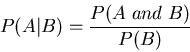
Intuitive definition:
Knowing that another event B occurs does not affect
the probability of the event A of occurring, this
means that A and B are independent.
As a formula:


The only inequality that is always true is

Example of how the conditional probabilities can both
be bigger or smaller:
Types and description and statistics
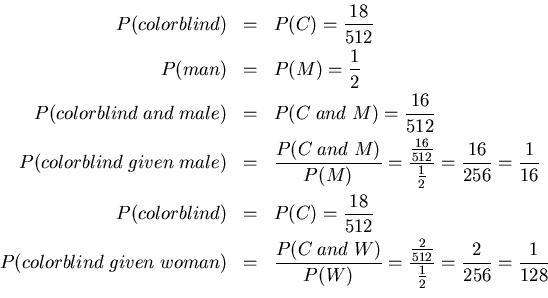
Study the world of of the colorblind
We rounded the numbers for a large group
of people tested in the US,
(results vary from region to region in the world,
there is an island in micronesia with
most people color blind
 ).
).
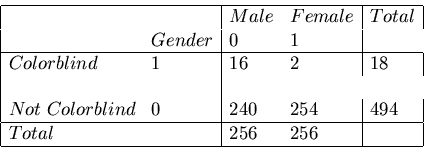
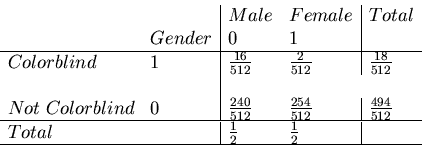
In considering colorblindedness, suppose I consider the binary random variables associated to color blindness and gender (associate 0 if male, 1 if female), these are called indicator variables, we can tabulate the probabilities of all 4 possible pairs of outcomes as:
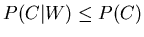
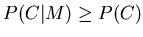
When and are not independent
Sometimes we have
 ,
,
Sometimes we have
 ,
,
When two events are independent the probability of them both occurring is just the product of their probabilities.
The probability of throwing a double three with two dice is the result of throwing three with the first die and three with the second die. The total possibilities are, one from six outcomes for the first event and one from six outcomes for the second, Therefore (1/6) * (1/6) = 1/36.
The two events are independent, since whatever happens to the first die cannot affect the throw of the second, the probabilities are therefore multiplied, and remain 1/36.
Definition:Two events  and
and  are said to be independent
if
are said to be independent
if

Examples:
We draw two cards one at a time from a
shuffled deck of cards.
In class we looked at the following two events:
 .
. .
.
We saw that
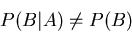
Usually it is quite useful when two variables are not independent, because we can predict one from another.
 .
.
I is a set of people ill with the disease.
(+) the set of people who test positive for the disease.
There is a test for
this disease which has no false negatives:
if you have the disease,
you will test positive 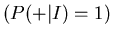 .
However, there are
occasionally false positives; 1 person in 1000 who doesn't have the
disease (is healthy, H) will test positive anyway
.
However, there are
occasionally false positives; 1 person in 1000 who doesn't have the
disease (is healthy, H) will test positive anyway
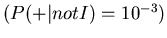 .
.
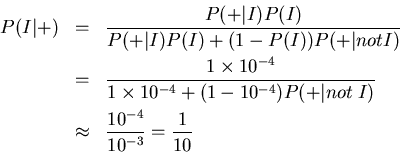
We want to know the probability that someone who has a positive test is actually ill.
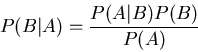
Let's replace B in Bayes' rule with ``is ill'' (I)
and A with ``tests positive'' (+). Then
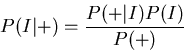
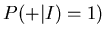 and
and 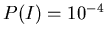 ,
but we have to figure out
,
but we have to figure out  ,
the overall probability of testing positive.
This is
,
the overall probability of testing positive.
This is

 .
We can then say
.
We can then say

 .
Putting it all together,
.
Putting it all together,
| True state | |||
| Ill-Disease | Not Ill | ||
| (+) | Error= False Positive | ||
| Prediction | |||
| (-) | Error= False Negative | ||
 for a certain test called the Western blot.
http://www.ama-assn.org/special/hiv/library/scan/sep98/sep98a.htm
for a certain test called the Western blot.
http://www.ama-assn.org/special/hiv/library/scan/sep98/sep98a.htm
|
 test for independence of this table computes
 distribution.
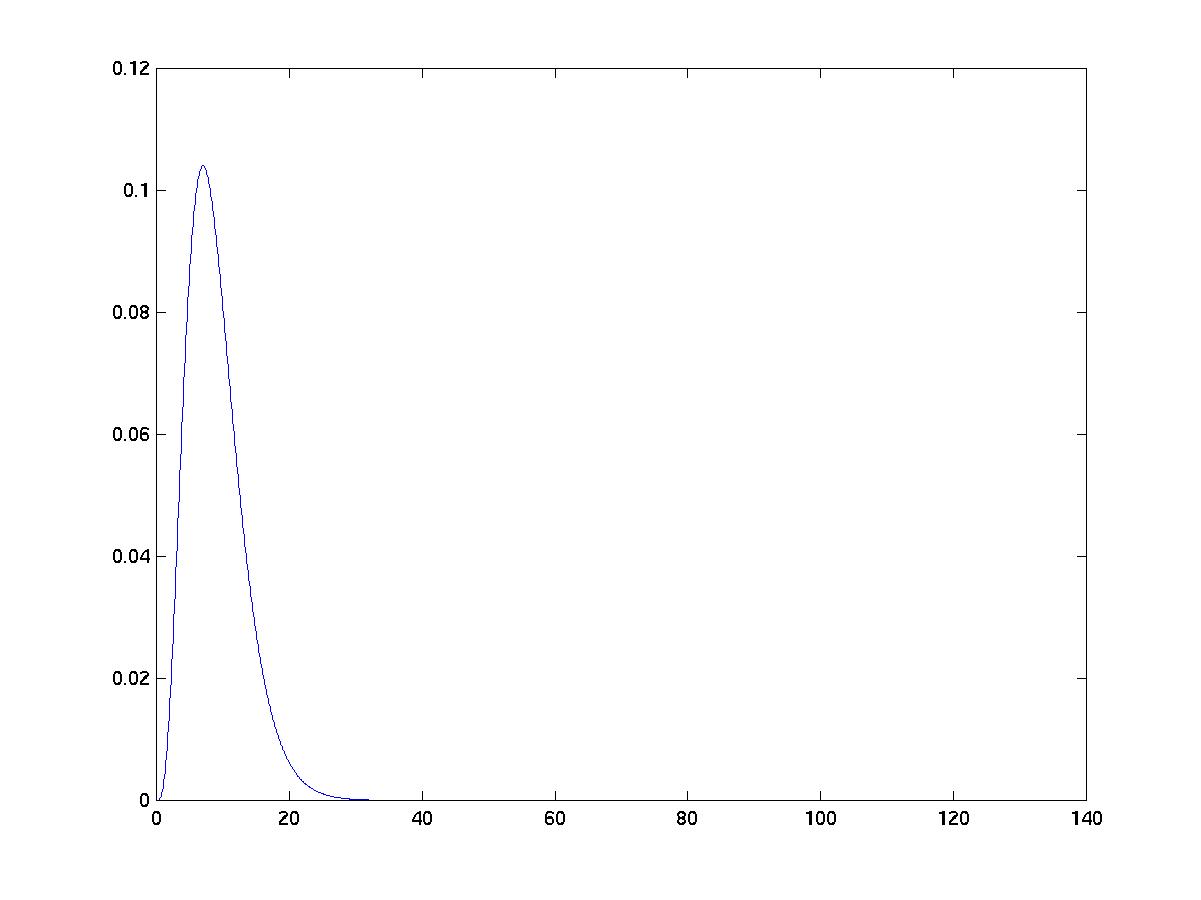
The probability of seeing such a high value for the
statistic is tiny,
(much smaller than , so we can safely reject the
null hypothesis of independence between hair color
and eye color.
+-------------------------------------------------------------------+
|                                                                   |
|  Sex  Age    POISON     GAS    HANG   DROWN     GUN    JUMP       |
|                                                                   |
|   M  10-20     1160     335    1524      67     512     189       |
|   M  25-35     2823     883    2751     213     852     366       |
|   M  40-50     2465     625    3936     247     875     244       |
|   M  55-65     1531     201    3581     207     477     273       |
|   M  70-90      938      45    2948     212     229     268       |
|                                                                   |
|   F  10-20      921      40     212      30      25     131       |
|   F  25-35     1672     113     575     139      64     276       |
|   F  40-50     2224      91    1481     354      52     327       |
|   F  55-65     2283      45    2014     679      29     388       |
|   F  70-90     1548      29    1355     501       3     383       |
|                                                                   |
+-------------------------------------------------------------------+
Want to play by chunks of a thousand?