

Professor Richard Saller,
Professor Gordon H. Chang,
Professor Shelley Fisher Fishkin,
Leaders of Chinese History Society of America,
Dear friends, ladies and gentlemen,
It is my great pleasure to be with you at prestigious Stanford University to commemorate the 150th anniversary of the introduction of large number of Chinese workers into the construction of the western portion of the first transcontinental railway across the United States, and also to celebrate the wonderful research conducted by Chinese Railroad Workers in North America Project at Stanford and the Chinese History Society of America.
As Consul General of the People’s Republic of China in San Francisco, I’d like to take this opportunity to send our warm greetings to all the participants, scholars and researchers, volunteers and descendants of Chinese railroad workers on behalf of the Chinese Consulate General as well as in my own name. I am pleased to know that Professor He from Guangxi, China joins us in today’ celebration. Welcome you to San Francisco Bay Area.
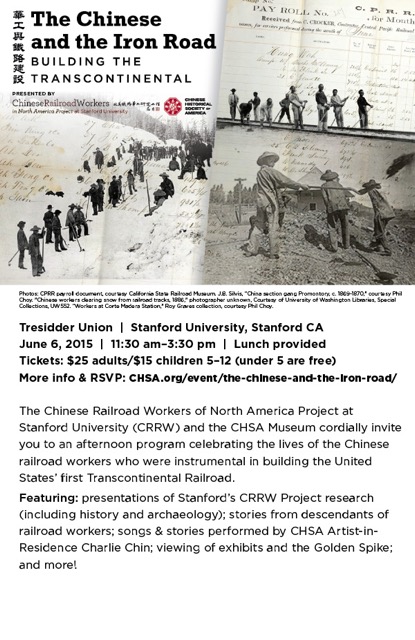
Ladies and Gentlemen, 150 years ago, shortly after the United States began to build the first transcontinental railroad, it was faced with a labor shortage because the daunting circumstances had driven the Irish workers away. Then about 10 to 15 thousand Chinese workers were recruited into the construction work. At one time, Chinese workers accounted for 80% of all the railroad workers. They worked in extremely harsh, difficult and dangerous conditions far beyond our imagination. Thousands of them died during the construction due to either extreme weather or hazardous geographical conditions. It’s fair to say that it is the Chinese railroad workers who made the construction of the western part of the transcontinental railway possible. The Chinese workers’ participation in the railroad is of great historic significance. Without their contribution, America’s development and progress as a nation would have been delayed by years.
These railway workers are the predecessors of the early Chinese immigrants in California. They not only helped reshape the geographic and social landscape of the West, but also blazed a trail for the very existence and development of overseas Chinese living in the U.S. Their diligence, dedication, team spirit and commitment represent the traditions and personalities of the Chinese nation. They are pioneers for the people-to-people exchanges and friendship between China and the U.S.
Today, as a closer political, economic, and social relationship is being developed between China and the U.S., it is essential for us to recall and remember this dramatic episode in history.
Ladies and Gentlemen, today, the United States is the biggest developed country in the world while China stands as the biggest developing country and a rising power. The China-U.S. relationship is regarded as the most important bilateral relationship in the world. A good relationship not only meets the fundamental interests of our two peoples, but also contributes to peace, stability and development of the Asia-Pacific region and the world as a whole. And of course for this purpose, it takes two sides to work together.
As you may already know, upon the invitation of President Obama, Chinese President Xi Jinping will pay a state visit to the U.S. this September. Both leaders have agreed to build a new model of major-country relations featuring no conflict, no confrontation, mutual respect and win-win cooperation, and I firmly believe that President Xi’s coming visit will inject new momentum into our efforts to build the relationship.
Finally, I’d like to take this opportunity to salute to the Chinese Railroad Workers in North America Project at Stanford and Chinese History Society of America. It is through your project that the Chinese railroad workers’ contribution is and will be remembered by more and more people, both here in the U.S. and in China. I also appreciate the Center for East Asia Studies of Stanford for its efforts to strengthen academic and people-to-people exchanges with Chinese sides. I am sure that your work will certainly help inject new and positive energy in the current China-U.S. relationship. If we can be of any help to promote such exchanges, please feel free to let us know.
Thank you!