Testing gravity at micron scales

Fundamental physics with levitated microspheres

Theories that attempt to unify gravity with the Standard Model or to explain the nature of dark energy suggest that gravity may deviate from the Newtonian form 1⁄r2 at micron length scales. We use mesoscopic optomechanical systems to measure sub-attonewton forces at micron length scales to test these theories.

Our current work uses optically levitated microspheres to measure gravitational interactions between masses separated by less than 20 microns. Optically levitated microspheres provide a powerful probe for short-range forces because they can be precisely controlled with optics and do not need to be mechanically coupled to the surrounding environment.

We are also exploring the use of mesoscopic optomechanical force sensors to search for other new particles and interactions. Recently, we have used optically levitated microspheres to search for millicharged particles (charged particles with much less than an electron's charge) bound in the bulk of the microspheres.

The physics of levitated microspheres turns out to be very rich and diverse, with our group recently reporting progress in controlling their rotation and possible application to gyroscopes, and the exploration of various ideas in the area of quantum sensing. Some more information can be found in the recent talk given at DAMOP.

IMG_4518
Our most advanced optical trap. In the foreground is the 3-axis stage used to scan the gravitational attractor in front of the microsphere.
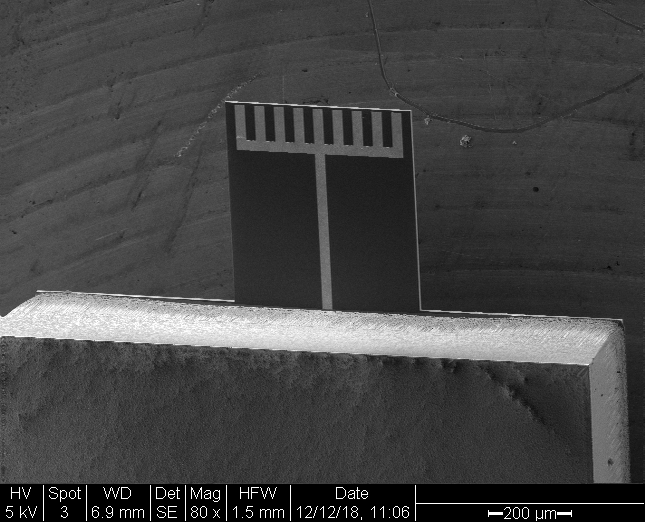
20181212_s2_bottom-side_25deg
First generation microfabricated gravitational attractor. Gravity contract is obtained by alternating Si and Au “fingers”.
20191010_shield_v2_dev11_1000x_40deg
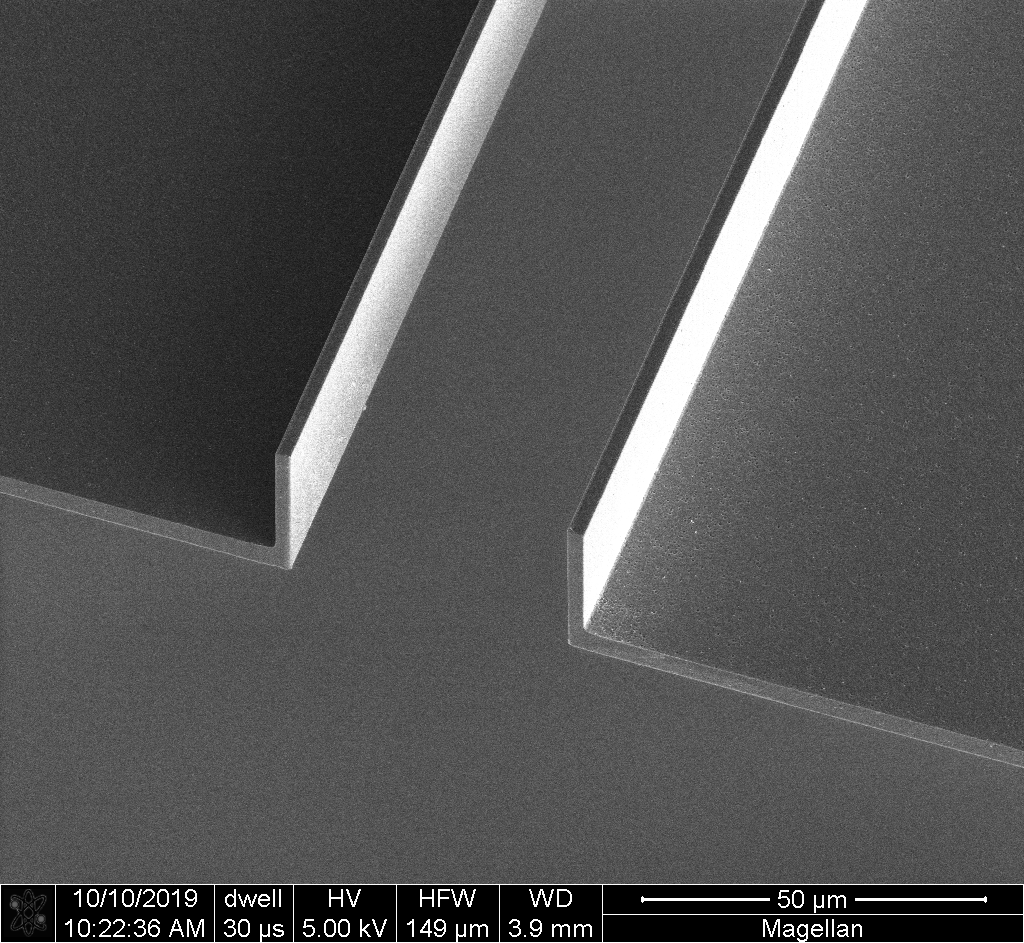
Electrostatic shield, microfabricated in silicon. The trapping laser focus is positioned in the slot, while the attractor in the previous image is scanned inside one of the two side-pockets.
Picture1
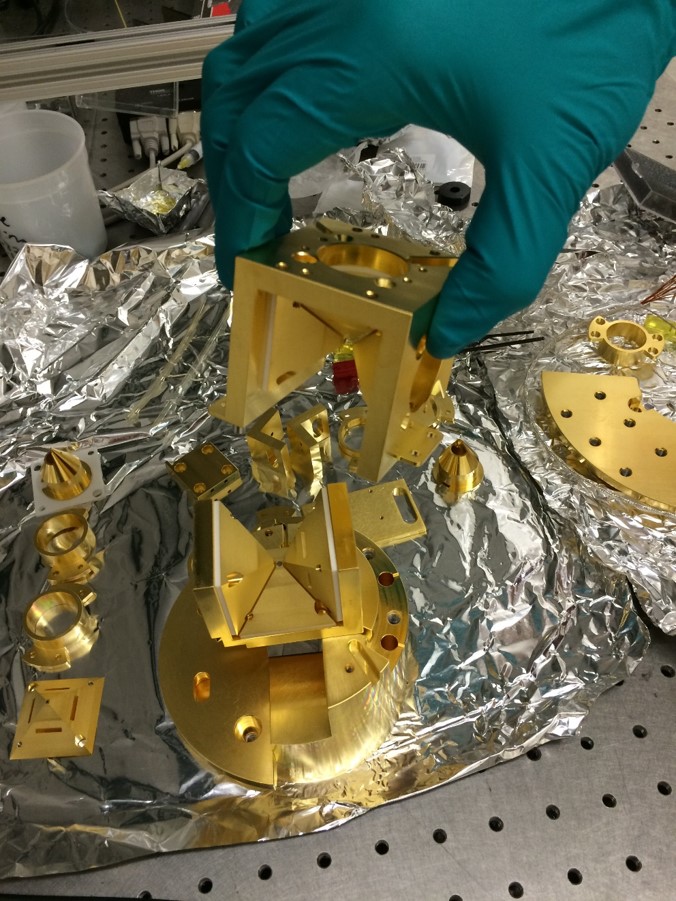
Our MarkII trap, being assembled. This trap is now used to study rotation and various cooling ideas.
Picture2
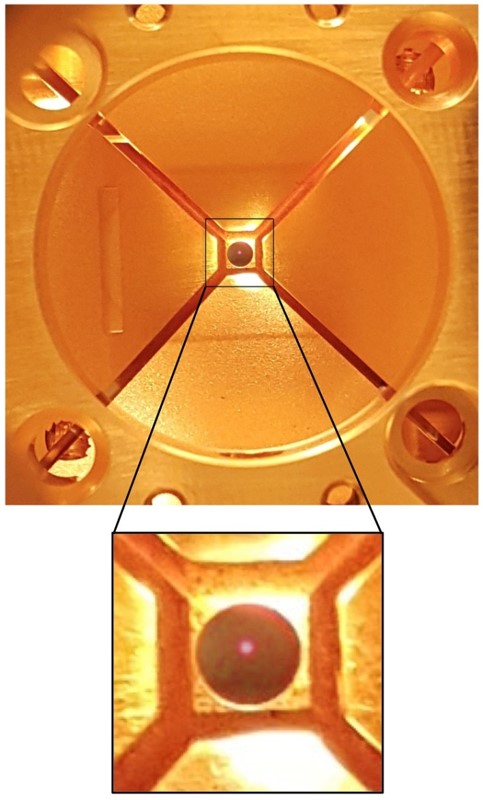
The MarkII trap in action. One side is removed so that a trapped microsphere can be seen. This is way back when we used an auxiliary, visible laser to provide feedback in the vertical DOF.
Trapped Bead
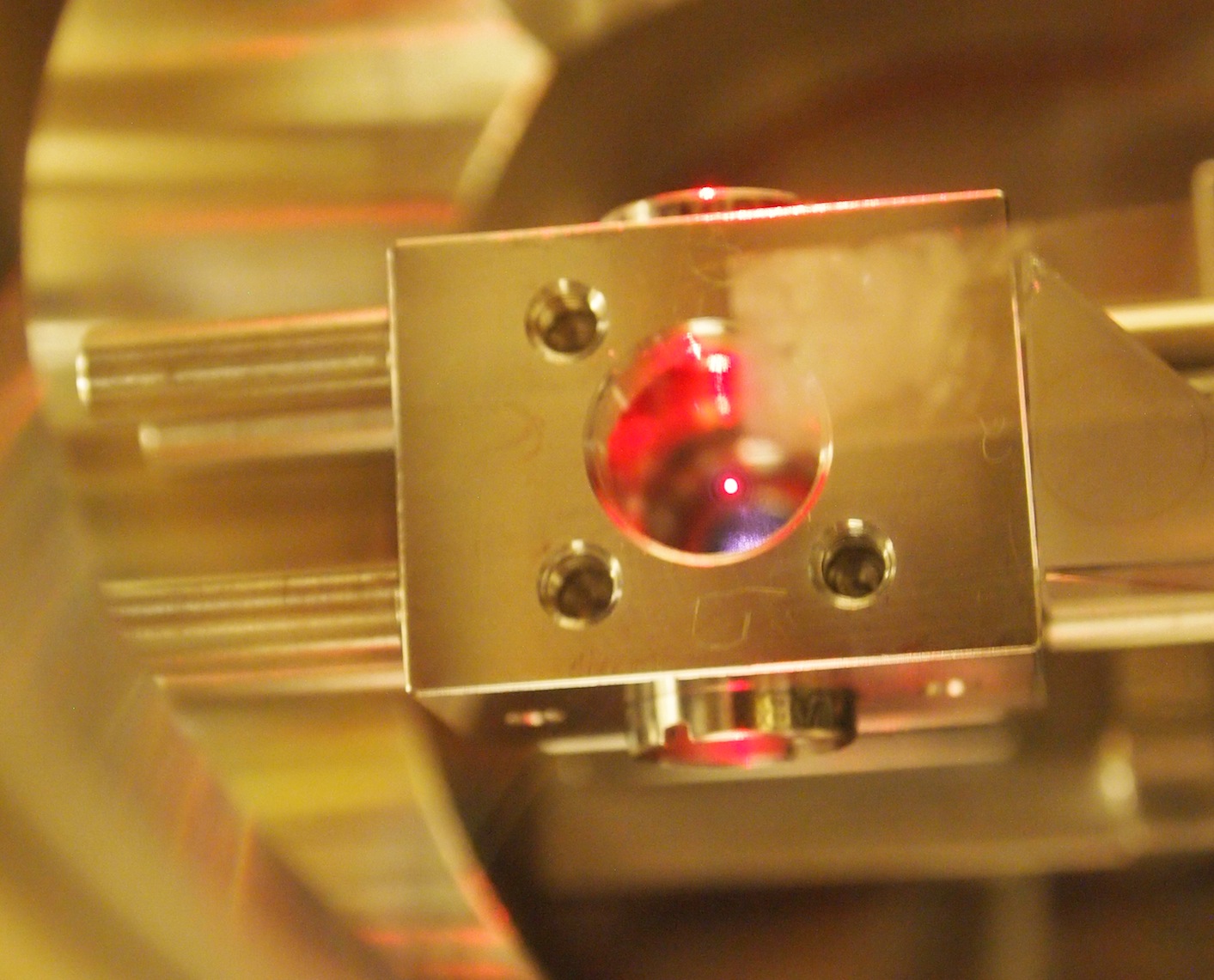
Our very first optical trap, with a microsphere levitated in it.

Our Sponsors

Publications

  • G. Venugopalan et al., "Optomechanical vector sensing of new forces at 6 micron separation"
  • https://doi.org/10.1038/s41598-026-35656-6 PDF
    C. P. Blakemore et al. "Librational Feedback Cooling"
    Phys Rev A 106 (2022) 023503 10.1103/PhysRevA.106.023503 arXiv:2203.11390v1 PDF
    N. Priel et al. "Dipole moment background measurement and suppression for levitated charge sensors"
    Science Advances 8 Issue 41 (2022) 2361 10.1126/sciadv.abo2361 arXiv:2112.10383v1 PDF
    C. Blakemore et al. "Search for non-Newtonian interactions at micrometer scale with a levitated test mass"
    Phys Rev D 104 (2021) L061101 doi.org/10.1103/PhysRevD.104.L061101 arXiv:2102.06848v1 PDF
    A.Kawasaki et al, "High sensitivity, levitated microsphere apparatus for short-distance force measurements"
    Rev. Sci. Instrum. 91, 083201 (2020) doi.org/10.1063/5.0011759 arXiv:2004.10973 PDF
    C. Blakemore et al. "Absolute pressure and gas species identification with an optically levitated rotor"
    J. Vac. Sci. Technol. B 38, 024201 (2020) doi.org/10.1116/1.5139638 arXiv:1911.09090 PDF
    Scilight feature on this work
    C. Blakemore et al. "Precision mass and density measurement of individual optically-levitated microspheres"
    Phys. Rev. Applied 12, 024037 (2019) doi.org/10.1103/PhysRevApplied.12.024037 arXiv:1902.05481 PDF
    A. D. Rider et al. "Electrically driven, optically levitated microscopic rotors"
    Phys. Rev. A 99 041802(R) (2019) doi.org/0.1103/PhysRevA.99.041802 arXiv:1812.09625 PDF
    C. Blakemore et al. "Three dimensional force-field microscopy with optically levitated microspheres"
    Phys. Rev. A 99 023816 (2019) doi.org/10.1103/PhysRevA.99.0238166 arXiv:11810.05779 [physics.ins-det] PDF PRA Editor’s suggestion
    A.D. Rider et al. "Single-beam Dielectric Microsphere Trapping with Optical Heterodyne Detection"
    Phys. Rev. A 97 (Jan 2018) 013842 doi: 10.1103/PhysRevA.97.013842 arXiv:1710.03558 [physics.ins-det] PDF
    Alexander D. Rider, David C. Moore, Charles P. Blakemore, Maxime Louis, Marie Lu, and Giorgio Gratta. "Search for Screened Interactions Associated with Dark Energy below the 100 μm Length Scale"
    Phys. Rev. Lett. 117, 101101 (2016), doi:/10.1103/PhysRevLett.117.101101, PDF
    David C. Moore, Alexander D. Rider, and Giorgio Gratta. "Search for Millicharged Particles Using Optically Levitated Microspheres"
    Phys. Rev. Lett. 113, 251801 (2014), doi:/10.1103/PhysRevLett.113.251801, PDF
    Also see a short summary in APS Physics.

    Presentations

    Giorgio Gratta - Colloquium at the Enrico Fermi Institute, University of Chicago, 29 April 2024 PDF
    Giorgio Gratta - colloquium at Virginia Tech, Nov 2021 PDF