Grad student positions available from Summer 2026
Over the last 25 years our group has been central to many developments in the field of neutrino physics, performing some of the fundamental measurements that established the current understanding of neutrino oscillations. You can learn more about our group's history here.
In recent times, this interest has been focused on searches for neutrinoless double beta decay. The discovery of such a decay would establish the existence of 2-component elementary Majorana Fermions (mundane Fermions, like the electron, are 4-component Dirac particles), demonstrate the violation of the lepton number conservation and, possibly, establish the neutrino mass scale. A short article in Physics World explains the search for neutrinoless double beta decay.
The data taking of the EXO-200 experiment was completed in Dec 2018. This was the first “100kg class” experiment to start taking data and produced some of the most advanced results in the world. The final neutrinoless double beta decay search with this detector is at here. Data analysis using EXO-200 data is still on going, specifically in our group.
The next project in this area nEXO, a 5-tonne detector using isotopically enriched Xenon. Our group is very active in a number of areas of nEXO R&D, including the optimization of charge collection devices, the integration of Silicon Photomultipliers with charge readout, high voltage and detector calibration. We operate a substantial liquid Xenon lab at Stanford with two cryostat hosting much of this R&D.
In the last several years we have also started a program to develop new measurements in the area of fundamental physics using optically levitated microspheres. This work started from our interest in testing the inverse square law of gravity below 50 micron distance. Over time, we have discovered that optically levitated microspheres make excellent sensors for many areas of physics and technology. Our group has developed a number of those new directions, including the measurement of ever smaller fractional charges to the rotation dynamics of the microspheres. Most recently, we have introduced methods to identify and suppress electric dipole interactions that plague many areas of experimental physics.
Since the early days of this work, several groups around the world have joined forces, so that levitated optomechanics is often listed as a separate field at conferences.
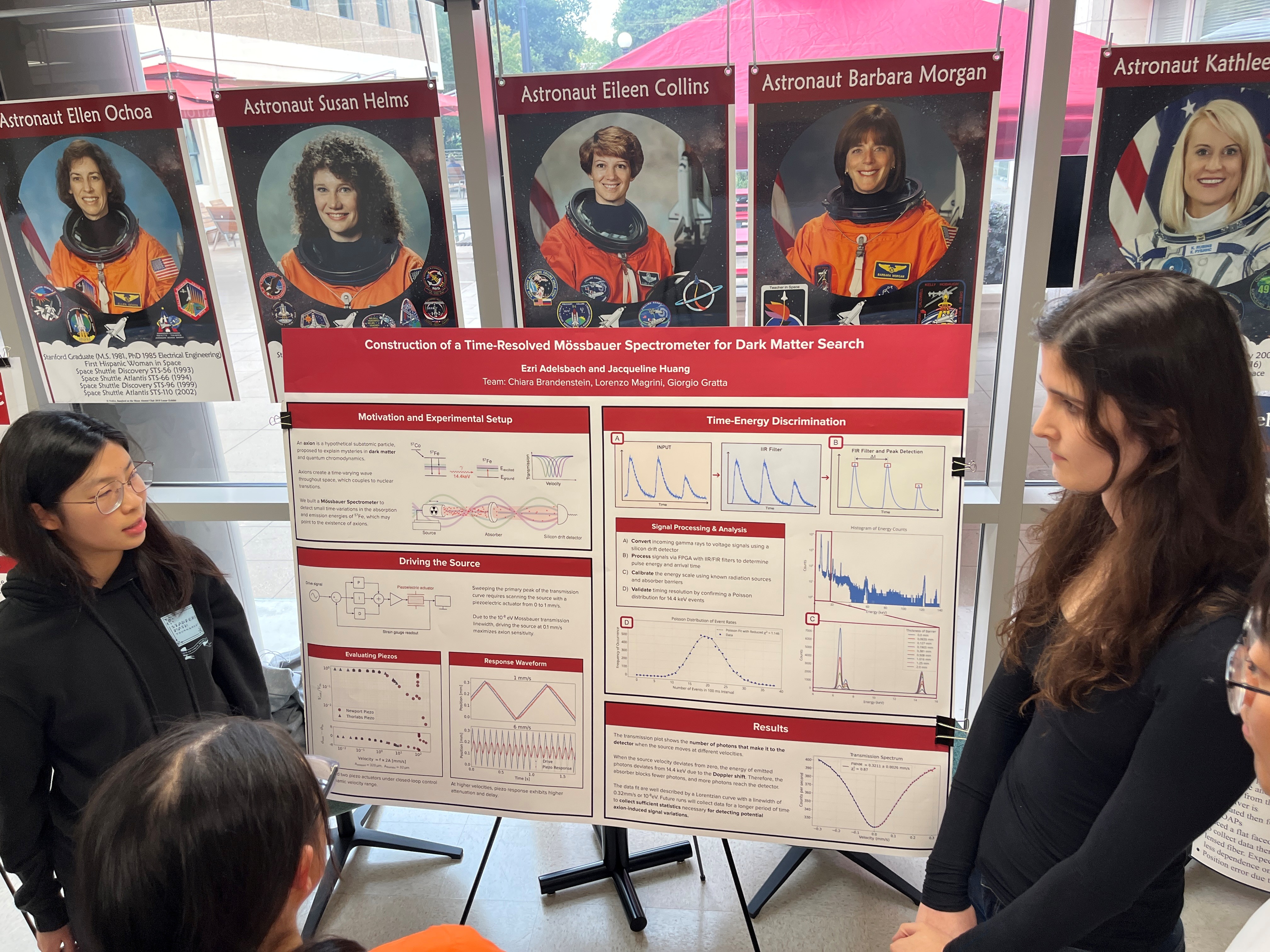
The most recent project in the group involves the use of Mossbauer spectroscopy to search for new interactions at sub-micron scale, where electromagnetic effects on atomic matter produce overwhelming backgrounds. The idea is that nuclear matter is substantially less sensitive to these effects and Mossbauer spectroscopy uses photons produced and absorbed by nuclear transitions. In this new area, we are building a first experiment using a “classical” iron-57 source, but we are also developing new techniques, whereby the pumping of the interesting states is produced with synchrotron light photons.
We also have a program to develop novel radiation detectors for application to science, homeland security and medical physics.
Joint us in this exciting ride! We have openings for new graduate students in (almost) all of the projects above.
Design: Giulio Gratta
Report Website Problems/Mistakes: Natalie Pogue