Gratta Group History
Our group is generally interested in exploring the fundamental building blocks and elementary forces of Nature. The approach is broad, whereby we do not hesitate to develop new techniques to reach the physics goal. We also like to develop experiments from scratch, often starting new directions, build detectors and analyze data. Students and postdocs in the group gain an unusually broad perspective of experimental physics.
In 1995-2000, in collaboration with a small team from Caltech, the University of Alabama and Arizona State University, we built and operated a neutrino oscillation experiment at the Palo Verde Nuclear Generating station near Phoenix, AZ. These where the pioneering days before neutrino oscillations were firmly established and oscillation experiments using reactors were assumed by most to be unreliable. The Palo Verde experiment did not see neutrino oscillations but set Phys. Rev. D 64, 112001 (2001) what remained for 13 years the second best limit on the neutrino mixing angle θ13. Only a dozen years later did new experiments at reactors and accelerators improve our measurements. In fact, as it later turned out, the experiment’s sensitivity was just a bit too low to detect oscillations!
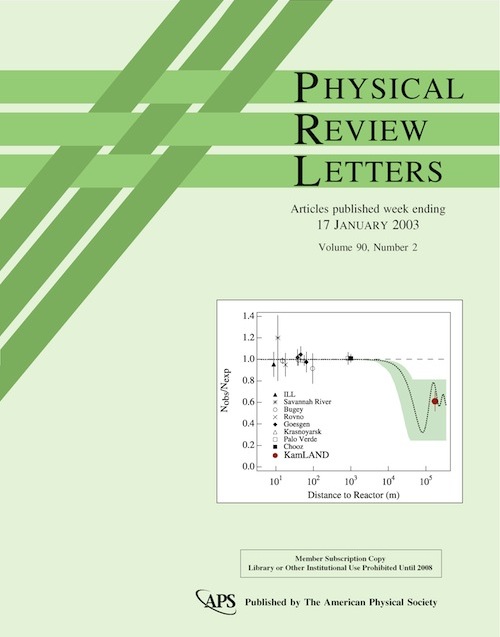
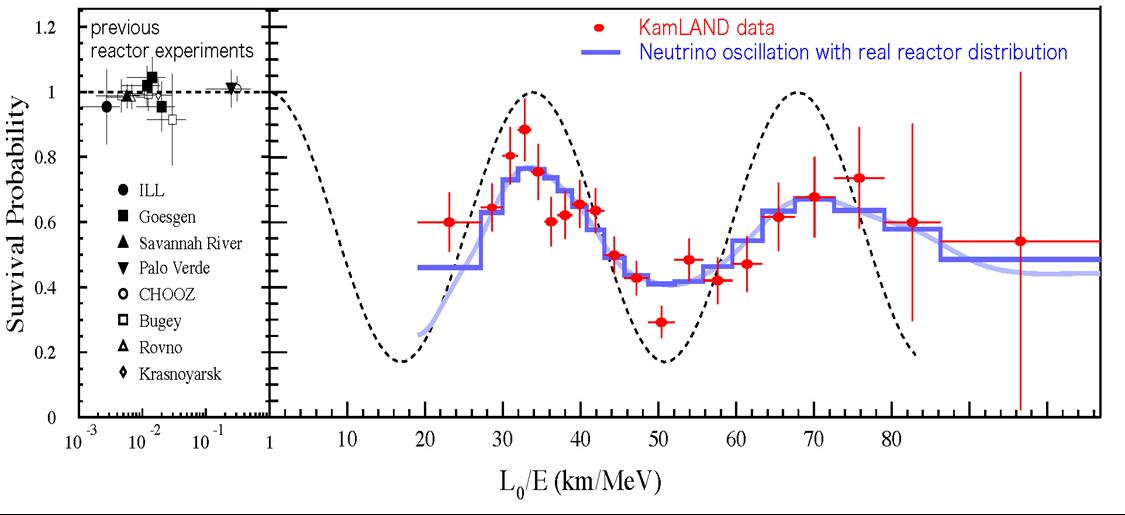
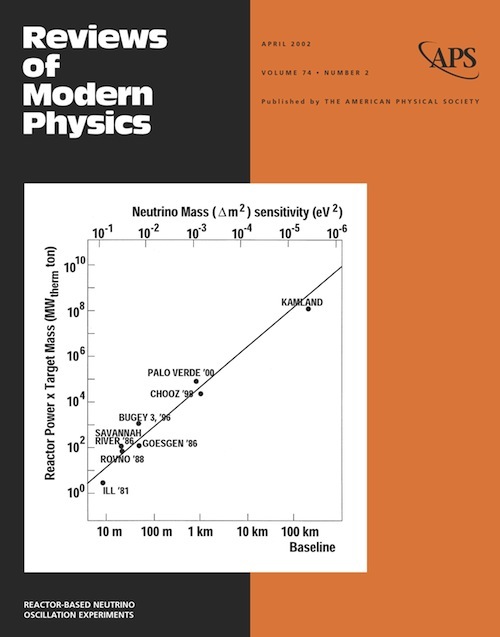
In 1998 we contributed to the design of the KamLAND detector in Japan and initiated the US component of the KamLAND collaboration. These were the days when Japan was producing much of its electricity with nuclear reactors (btw, keeping their carbon footprint down!) and, since cooling considerations require the reactors to be near the coastlines, an experiment under a mountain in the Japanese alps is roughly surrounded by a corral of reactors. The KamLAND detector started taking data in 2002 and made the first observation of anti-neutrino oscillations with a terrestrial source, providing the best measurement of the 1-2 mass splitting. The first data on this subject made the cover of Phys Rev Lett and vindicated the use of reactors for this science, something many colleagues, apparently, still have not understood 20 years later!Eventually KamLAND reported data where more than one full cycle of oscillation is clearly visible. The progression of oscillation experiment using reactors was highlighted in Reviews of Modern Physics and later extended by several other experiments (not involving our group).
With larger statistics KamLAND also made the first observation of antineutrinos from the Earth's interior. This is the first case of "applied neutrino physics" and was the subject of the PhD thesis of one of our students, winning the APS nuclear physics dissertation prize. Many more measurements of “Geo Neutrinos” have been performed since by KamLAND and Borexino in Italy.
At the opposite extreme in energy, between 2002 and 2010 our group developed a new technique for detecting ultra-high energy cosmic-ray neutrinos from the acoustic pulse they produce when showering in water. Initially unbeknownst to us, the basics of this were set by G. Askaryan many years prior, but we were able, for the first time, to actually make measurements in a large body of water, borrowing a US Navy hydrophone array. The final paper describing our results, Phys. Rev. D 82, 073006 (2010), still represents the best limit on the ultra-high energy cosmic-ray neutrino flux obtained with the acoustic technique.
Since 2000 the group has been working on progressively larger double-beta decay experiments using 136Xe as a source and detection medium. The discovery of neutrino-less double beta decay would establish the existence of elementary Majorana fermions, the violation of lepton number conservation and provide insights about neutrino masses, that, being so much smaller than the masses of charged fermions, are generally believed not to arise from the Higgs mechanism Physics World 23 (2010) 27 .
Our early R&D on liquid xenon detectors discovered that the energy resolution can be substantially improved by using at the same time ionization signals and scintillation Phys. Rev. B 68 054201 (2003). This technique was incorporated in the design of our EXO-200 detector and adopted by several other groups using liquid Xe for Dark Matter searches. The EXO-200 detector was a 200kg enriched Xe double beta detector that started taking data on June 1, 2011. At the time of turn on EXO-200 was the largest double-beta decay detector in the world, and it immediately discovered the href="figure 4.png" 2-neutrino double-beta decay in 136Xe . With more data and a better analysis EXO-200 has measured the half life of the two neutrino decay with the smallest uncertainty among all two neutrino decays. At 2.165x10²¹ years this is the slowest process ever directly measured in our universe ( Phys Rev C 89, 015502 (2014)). In the end, EXO-200 did not detect the much more important neutrino-less double beta decay, but it performed one of the most sensitive searches to date ( Phys Rev Lett 123 161802 (2019)), achieving a sensitivity of 5x1025 years; this is over 1015 times the age of the Universe!
While EXO-200 analysis in some exotic channels is still ongoing, our attention in the area of double-beta decay has shifted to the nEXO detector, a 5-tonne enriched Xenon detector that we are designing together with a substantial group of over 150 colleagues from around the world. nEXO will have a sensitivity to the neutrino-less decay beyond 1028 years and will likely operate deep underground at SNOLAB in Ontario, Canada. R&D on many aspects is in full swing in out group which currently operates the largest liquid Xenon test detectors in the collaboration.
Over the years, we have also worked on the development of new radiation detectors, not necessarily connected to specific experiments. Most recently, this has taken the form of developing an innovative type of optics that allows for imagine in liquid scintillation detectors ( Phys. Rev. D 97 052006 (2018)), and the re-examination of room temperature, organic liquid Time Projection Chambers ( JINST 16 P07053 (2021).
In 2012 the group started a new program to investigate gravity at micron scale using levitated microspheres. Many theoretical ideas predict that new, long rage forces may be present at micron or submicron scale (empirically, this is equivalent to deviations from the inverse square law of gravity). Traditionally, this area has been investigated using torsion balances or micro-cantilevers and our new technique was the first not to use mechanical springs to measure forces. While the first search for new forces was recently published ( Phys Rev D 104 (2021) L061101 ), along the way we have discovered many other applications of levitated microspheres, both in fundamental physics (e.g. the search for very small fractional charges or, equivalently, for minute differences between the charges of protons and electrons) as well as in technology (e.g. using spinning microspheres to make local measurements of pressure or gas species).
In order to extend the sensitivity to new forces to the sub-micron scale, where electromagnetic background become prohibitive, we have just started a new program whereby nuclei, instead of atoms, are the probes for the new interactions. This program makes use of Mössbauer spectroscopy, with enticing connections with synchrotron light sources ( Phys Rev D 102 (2020) 115031).