| |
007. |
|
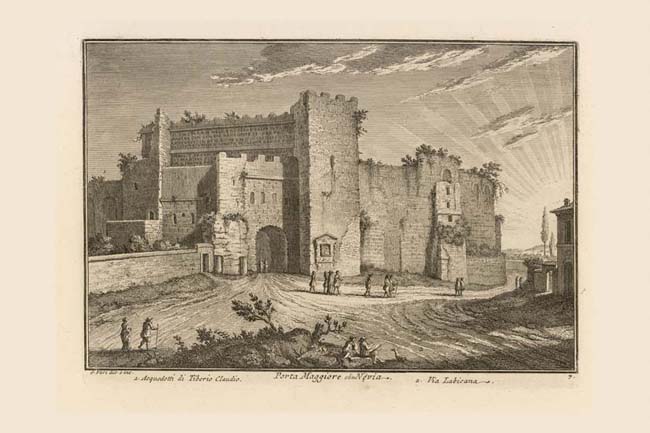
Porta Maggiore olim Nevia |
|
 |
|
 |
|
 |
|
| |
|
Porta Maggiore olim Nevia |
| |
1. |
Acquedotto di Tiberio Claudio |
| |
2. |
Via Labicana |
| |
-. |
Tomb of Eurisace |
A dramatic rising sun reveals Rome's largest city gate: the monumental Porta Maggiore. Since the gate looks very different today with its two open arches, the best way to understand this Vasi view is to compare it to the Nolli plan of the site. The emperor Aurelian (270-75 AD) used a section of the Claudian aqueduct (1) (visible as the taller element in this print) for this part of his city walls, filling in all its arches except for the two spanning Via Labicana (2) and Via Prenestina, two ancient roads which converged just beyond this point. These arches became a double gate in the walls. Honorius (395-423 AD) reduced this to a single gate by blocking the southern arch with a wall anchored on the tomb of Eurisace and building a new arch spanning from the tomb to the aqueduct). The tomb is identifiable on the print as the masonry mass with two short columns at its corners. Pope Gregory XVI (1831-46) had the Honorian accretions removed during his restoration of Porta Maggiore. Near the corner of the wall on the right and meeting it perpendicularly, we see the stacked aqueduct Marcia-Tepula-Julia in cross-section. The lower opening is the rectangular duct of the Acqua Marcia, built in 144 BC. Above it is the Acqua Tepula (125 BC) and the Acqua Julia (33 BC) started by Julius Caesar. To the right of the aqueduct is a sign reading DRITTO A S. LORENZO (straight to St. Lawrence) which seems to refer to the road curving away to the right, leading to Porta S. Lorenzo, Plate 6. Just to right of center at the bottom of the print Vasi appears to be sketching this view while drawing the attention of a curious bystander and an inquisitive canine.
|
