| |
011. |
|
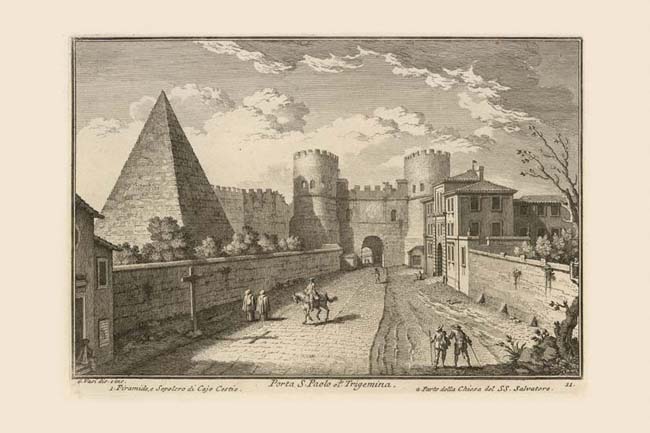
Porta S. Paolo ol. Trigemina |
|
 |
|
 |
|
 |
|
| |
|
Porta S. Paolo |
| |
1. |
Piramide, e Sepolcro di Cajo Cestio |
| |
2. |
Chiesa di SS. Salvatore |
Vasi refers to this gate as the ancient porta Trigemina, which was actually the name of a gate in the Republican rather than the Imperial walls. Vasi depicts the gate which was referred to in antiquity as Porta Ostiensis, named after the road leading to the Republican port of Ostia. Its medieval name of Porta S. Paolo refers to the Patriarchal Basilica of S. Paolo fuori le Mura (St. Paul's outside the walls) which is located a mile further out on the Via Ostiense and was a goal of pilgrims visiting the Sette Chiese (seven churches). Both the church of S. Salvatore (2) at the far left and the buildings of Vigna Lazzarini at the right are shown on Nolli, but no longer exist. The pyramid (1) is the late 1st century B.C. tomb of Caius Cestius, former governor of the Roman province of Egypt. It was used as an anchor point in the building of the Imperial city walls by the emperor Aurelian following 270 A.D. Like the Via Appia (see Plate 10) where they still exist, Via Ostiense was once lined by property-boundary walls.
|
