| |
053. |
|
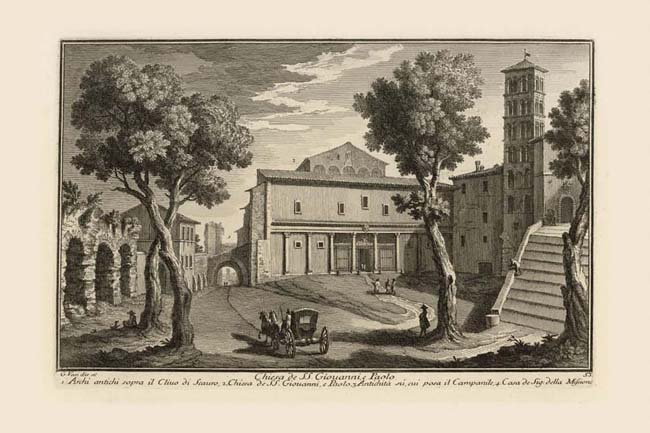
Chiesa de SS. Giovanni, e Paolo |
|
 |
|
 |
|
 |
|
| |
1. |
Archi antichi spora il Clivo di Scauro |
| |
2. |
Chiesa de SS Giovanni, e Paolo |
| |
3. |
Antichita su cui posa il Campanile |
| |
4. |
Casa de Sig della Missione |
Starting out as a titulus, or center of Christian worship in an earlier, non-religious structure, the church of SS. Giovanni e Paolo (2) underwent a long series of transformations and reconstructions in the medieval period, culminating in the largely 12th century structure we see today. The six arches spanning the ancient Clivo di Scauro (1) (clivo = sloping street) are medieval buttresses bracing the southern flank of the church, which was heavily damaged in the sack of the city of 1080. To the right of the church is its monastery (4), dedicated at the time to the training of missionaries. Its entrance is approached by a wide cordonata (stepped ramp) visible at the right edge of the print. Both the monastery and the tall campanile (3) are built directly on the Claudium, the ancient temple dedicated to the emperor Claudius (41-54 AD). Some of the ancient stone blocks of the latter are visible at the foot of the tower. Opening onto this piazza is a secondary entrance to Villa Mattei (see Plates 52, 196).
|
