| |
055. |
|
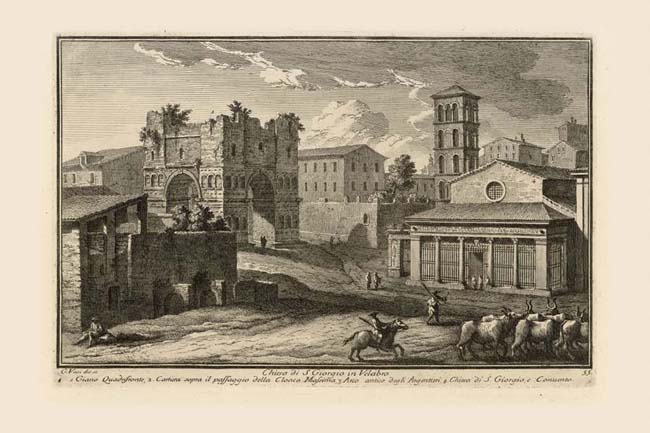
Chiesa di S. Giorgio in Velabro |
|
 |
|
 |
|
 |
|
| |
1. |
Giano Quadrifronte |
| |
2. |
Cartiera sopra il passaggio della Cloaca Massima |
| |
3. |
Arco antico degli Argentieri |
| |
4. |
Chiesa di S Giorgio in Velabro |
Velabro was the name of the low lying swampy area near the Tiber. In order to include the Cartiera (2) (paper factory) on the left, Vasi has moved the arch of Janus (1) back and away from its actual position closer to the church of S. Giorgio (4). While the Cartiera has been replaced by a later building, the two arches next to it survive, marking the course of the ancient Cloaca Maxima, or great storm sewer which drained the area of the Roman Forum into the river. The arch of Janus, which dates from the time of the emperor Constantine (306-337), presents an urban problem because this kind of four-way arch usually spanned two streets intersecting at right angles. However while the trace of an ancient east-west street passing through the arch has been identified, remains of a perpendicular one have not been found. Vasi shows a brick superstructure on top of the arch which was removed in 1827 under the mistaken impression that it was a medieval addition, while actually most of it was ancient. Though impossible to see from this angle, Vasi includes the early 3rd century Arco degli Argentari (3) spanning an ancient street which defines the west flank of the 7th century S. Giorgio in Velabro. This church was restored in the 9th century at which time the porch was added. The tall bell tower is a 12th century addition. The lantern of the church dome immediately to the left of this tower probably belongs to the demolished church of S. Galla, Plate 177; NN 1040) on the Strada delle Carrozze (NN 1044) which was absorbed into the present Via del Teatro di Marcello in the 1930s.
|
