| |
054. |
|
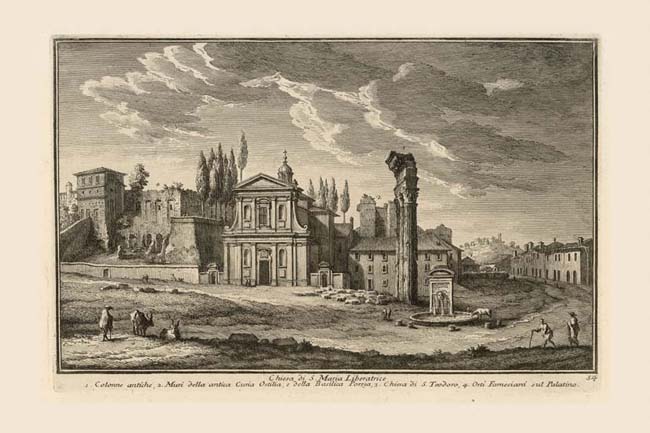
Chiesa di S. Maria Liberatrice |
|
 |
|
 |
|
 |
|
| |
|
Chiesa di S. Maria Liberatrice |
| |
1. |
Colonne antiche |
| |
2. |
Muri della antica Curia Ostilia |
| |
3. |
Chiesa di S Teodoro |
| |
4. |
Orti Farnesiani sul Palatino |
| |
-. |
Piaz. di Campo Vaccino con. font.a |
The print which features the church S. Maria Liberatrice, is the third of three prints that Vasi dedicates to the Roman Forum (see Plates 31, 32). We are looking south with the Palatine hill on the left and the Aventine hill visible in the far distance at the end of the Via di S. Teodoro on the right. That street takes its name from the circular church S. Teodoro (3) silhouetted against the Aventine, and sunk in a court well below the ground level. In the foreground, the only evidence of the ancient Forum are the three half-buried columns of the Temple of Castor and Pollux (1), which Vasi shows from a different angle in Plate 32. The same print shows the cattle trough which here we see frontally with three jets of water pouring into the circular basin (NN 927). Like so many others in the city, this fountain was designed by Giacomo della Porta, and bore an inscription with the date of 1593. The circular basin was moved to Piazza del Quirinale in 1818, to become the fountain in front of the grouping of statues and obelisk at the center of that piazza (see Plate 61). Most of the buildings visible in the left two thirds of this print were demolished in the late19th century to make way for the Forum excavations. These demolitions included the early Baroque church of S. Maria Liberatrice in 1900 (NN 929), built by Onorio Longhi in 1617 over the early Christian church of S. Maria Antiqua. To the left of the church we see the substructures of the imperial palace extending out from the Palatine hill (4) topped by the Orti Farnesiani (4), the gardens planned for the Farnese family by Vignola (1565-73). Vasi's identification of the tall ancient structure to the left of the columns of Castor and Pollux as the Curia Ostilia (2) is erroneous. This ruin, which still survives, seems to have been part of a transitional building connecting the Forum to the Palatine residence of the emperors.
|
