| |
080. |
|
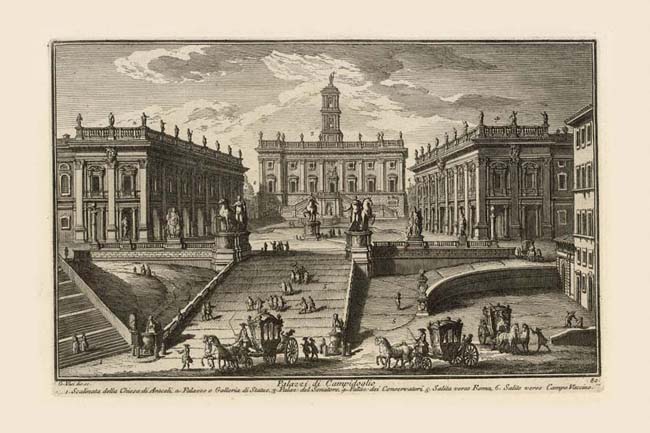
Palazzi di Campidoglio |
|
 |
|
 |
|
 |
|
| |
|
Campidoglio |
| |
1. |
Scalinata della Chiesa di Araceli |
| |
2. |
Palazzo e Galleria di Statue |
| |
3. |
Palazzo del Senatore |
| |
4. |
Palazzo dei Conservatori |
| |
5. |
Salita verso Roma |
| |
6. |
Salita verso Campo Vaccino
|
| |
|
Marcus Aurelius statue |
Vasi's representation of Michelangelo's mid-16th century masterpiece of urban planning brings to mind the 1569 perspective view of the same site by Duperac. But while both are taken from an elevated point, Vasi's view is lower than Duperac's, thereby showing less of the piazza surface. It is also avoids the axial symmetry of the earlier view, which allows Vasi to give a clear view of the central element of the double stair in front of the Palazzo Senatorio (3). Both artists show the short facades of the Palazzo Nuovo (2) and the Palazzo dei Conservatori (4) in full frontal view, which amounts to a considerable distortion because in fact they do not lie on the same plane. Neither artist is able to suggest the trapezoidal plan of the space between these two non-parallel buildings, a near impossibility in perspective representation. Perhaps more successful is Vasi's rendering of the trapezoidal cordonata (5) (stair-ramp) leading up to the piazza. The elaborate geometric pattern in the Duperac view was not executed until 1940, so Vasi shows the radial pattern which existed in his day though he barely suggests this. Through the left angle of the piazza, above the series of descending roofs which suggest the cordonata sloping down to the Roman Forum (6), we see the dome of SS. Martina e Luca, Plate 42. The scalinata (1) (large stair) in the left foreground climbs up to the church of S. Maria in Ara Coeli, Plate 130A. During the 1930's many of the buildings and features along the edge of the Capitoline Hill were demolished including the building on the right (NN 983) and the curved cordonata passing behind it which was replaced by a switchback street.
|
