| |
117. |
|
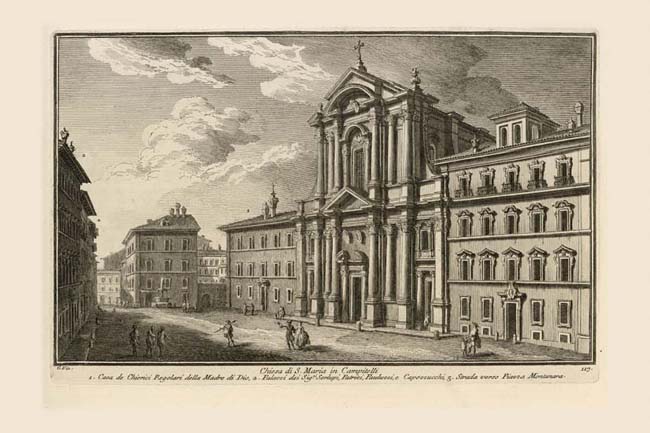
Chiesa di S. Maria in Campitelli |
|
 |
|
 |
|
 |
|
| |
1. |
Chiesa de Chierici Regolari della Madre di Dio |
| |
2. |
Palazzi dei Sig.ri Serlupi, Patriai, Pauluzzi e Capozzucchi |
| |
3. |
Strada verso Piazza Montanara |
Unlike many other prints in this volume where the emphasis is not on the church named in the title, S. Maria in Campitelli completely dominates this image. Campitelli, like Campidoglio, is derived from Capitolium, the Capitoline hill. It was the medieval name for the Tenth Region (rione) of the city's original fourteen. In Vasi's day the Rione Campitelli contained a broad sweep of varied topography. It not only included the Capitoline, Palatine and Coelian hills, but also the Forum, and Colosseum. In the 1920s the Colosseum and Coelian were split off from Campitelli and were given the name Rione Celio and numbered nineteen. The Rione Campitelli also included (and still does) the area next to the Theater of Marcellus and the Ghetto (both in Rione S. Angelo). It is here that we find the parallel-sided piazza with Carlo Rainaldi's masterpiece, S. Maria in Campitelli, begun in 1662 under Alexander VII Chigi (1655-1667). The richly endowed church, which contains a particularly sacred image of the Virgin, was served by the monastery (1) next to it. The 1551 Bufalini map shows the original church labeled as S. Maria in Campidellis and located in the next block to the west. This was demolished and rebuilt on the present site in the early 17th century only to be demolished once more and rebuilt in the present location by Rainaldi. Visible at the end of the piazza is a fountain by Della Porta dating from the 1580s beyond which the street (3) continues toward the nearby Piazza Monatanara, Plate 30. The Nolli map should be consulted for the names and locations of the palazzi adjoining the piazza as Vasi incorrectly lists the palazzi on the left as "Serlupi, Patrizi, Pauluzzi, e Capozzucchi." Actually Palazzo Serlupi (NN 1019; now named Lovatelli) stands on the opposite side of the piazza on the right side of the church and Palazzo Patrizi (NN 1002) occupies a site on an entirely different block.
|
