| |
121. |
|
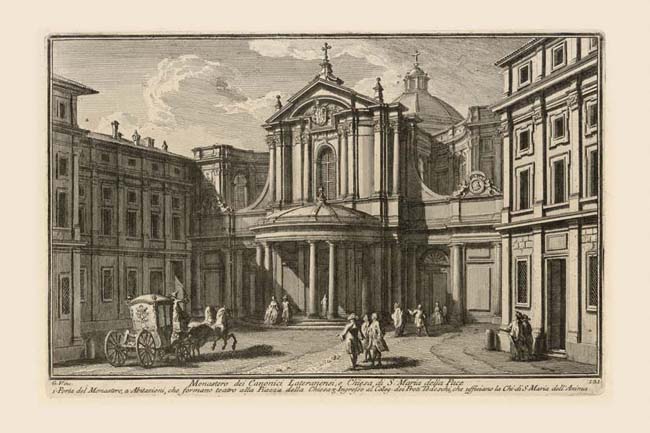
Monastero dei Canonici Lateranensi, e Chiesa di S. Maria della Pace |
|
 |
|
 |
|
 |
|
| |
|
Monastero dei Canonici Lateranensi, e Chiesa di S. Maria della Pace |
| |
1. |
Porta del Monastero |
| |
2. |
Abitazioni che formano teatro della Piazza della Chiesa |
| |
3. |
Ingresso al Colleg. dei Preti Tedeschi, che uffiziano la Chi di S Maria dell' Anima |
In his print of the church of S. Maria della Pace, Vasi is well aware of Pietro da Cortona's masterpiece of urban planning, because he refers to the buildings to right and left as "houses which create a theater for the Piazza of the church" (2) Abitazioni, che formano teatro alla Piazza della Chiesa. Before Cortona reshaped this space in the 1650s (see also Plate 110), it was a tight Y-intersection or trivium framing a late 15th century church built under Sixtus IV Della Rovere (1471-1484). By demolishing large portions of the Palazzo Gambirasi (NN 598) on the left, and of the parish house of S. Maria dell'Anima (NN 600) on the right, the architect created a pentagonal piazza symmetrical with the axis of the church. Jutting into this space Cortona built a semi-oval porch against a new facade whose convexity echoes that of the porch. Convexity is countered with concavity in the two added wings, which look like part of the church, but in reality serve only to mask the flanking buildings, while the gate (1) piercing the left wing leads to the monastery attached to the church. The round-headed window in the right wing belongs to the apse of the nearby church of S. Maria dell'Anima (3). The two streets which form the branches of the former Y-intersection pass through what look like doorways in the continuous facades around the piazza.
|
